
by Eric Schenck
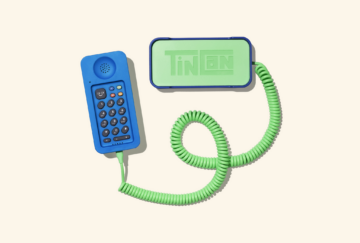
I was just visiting my family for Halloween. One night, I lay in my sister’s living room with my parents sitting next to me, and heard the phone ring. But this wasn’t a normal phone. It’s called a Tin Can, and it’s made especially for kids. The premise is simple: parents buy their children a corded (already charming) telephone, and load it with a few numbers. These are the only phone numbers that a Tin Can is able to call.
My niece Charlotte was calling my mother with an interesting request for an 8-year-old: she wanted to know about my mother’s family.
Charlotte had developed an interest in where she came from, and the first step? Finding out the stories of my parent’s past.
Charlotte is an intense child, and I could hear her questions through the phone. My mom was glad to provide the answers.
The conversation went something like this:
- Charlotte: And you had parents?
- Mom: Yes, of course. I had a mom and a dad.
- Charlotte: And…they aren’t living anymore?
- Mom: No. They both died a long time ago. Before you were born.
- Charlotte: And are you sad?
- Mom: Well, sometimes. But it’s just part of life I think.
- Charlotte: Were you close with your mom?
- Mom: Yes.
- Charlotte: And what did she like to do?
- Mom: Well, she liked art. And she loved to run.
- Charlotte: And how many brothers and sisters do you have?
And then, just like that… It was on to the next person. The conversation was surreal. Listening to my mom tell my niece about her own mother was beautiful. And, technically, it was all correct. But there was a problem with this: while it may have been correct, it was in no way sufficient.
People are so much more than a couple of lines spoken into a phone. They are so much bigger. Who they really were? All of their quirks and dreams and inside jokes and things they did better than anybody you’ve ever known? A few words about a person you loved so deeply doesn’t come close. Because yes, my granny liked art. And yes, she loved to run. These are things Charlotte would understand. But Charlotte will also never know what it was like to hug granny. Or how her eyes crinkled up when she smiled. Or what her voice sounded like. Or all the things that made Doris…
Doris.
It’s true that you need to make choices when describing other people. Simplification is how humans make sense of the world. But with those choices come a sad kind of editing. And with that editing comes a question you have to reckon with:
How can you possibly fit the universe that was your mother into a few lines that an 8-year-old can understand?
…
I’ve been thinking about that conversation this last week.
Is it mostly a sad thing that we eventually get lost to time? That everything we were, all the complexity of being a human, somehow gets smoothed out into a few adjectives and “things we liked to do?”
Or is it mostly a happy thing that we aren’t lost? At least not completely? That some eight-year-old my grandmother never had the pleasure of meeting somehow takes an interest in her life 40 years later?
I guess I’ll never know. As my mom hung up the phone that night, I didn’t spend too long thinking about. All I knew at that moment is that I had my own mother in front of me, and we were both alive at the same time and sitting in the same room.
And that was enough.
Enjoying the content on 3QD? Help keep us going by donating now.