
by John Ambrosio
 What goes around comes around. In 1963 during a speech at the Manhattan Center in New York, Malcolm X, the Black Muslim leader, described the assassination of President John F. Kennedy as “the chickens coming home to roost,” meaning that you reap what you sow, that it was the inevitable result of a violent and oppressive American culture and foreign policy.
In other words, the assassination was a kind of reckoning, blowback from a society that has willfully ignored and disremembered its history, a people who refused to see what’s in front of them, a country that failed to come to terms with its dark side. That is, with the genocidal violence perpetrated against Native Americans, the atrocity of chattel slavery and racial apartheid, and an uninterrupted history of military interventions and imperial wars.
Today, America has reached a historical moment when national amnesia is no longer an option, when a neofascist authoritarian movement intent on preventing a reckoning is seeking to rewrite U.S. history to conform with an invented and sanitized past, with a vision of American society purged of undesirable ideas, inconvenient facts, and non-conforming identities. Trump and MAGA Republicans are manufacturing a fictionalized past to justify an authoritarian future, to create a racially and ideologically purified society cleansed of opposing realities, values, and beliefs.
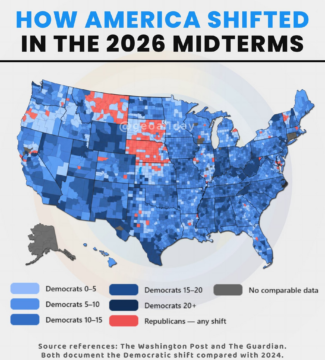
The resounding defeat of Republicans in the midterm election is a stunning rebuke of Trump and a prostrate Republican-led Congress. The sheer scope, scale, and margin of the Democratic victory was simply too big to steal. As it turned out, the 2024 Republican coalition was built on electoral sand, the blue wave was actually a tsunami, political gravity is still in effect, and a tidal wave of Republican dark money was unable to prevail over the discontent and anger of voters. American voters across the political spectrum and in every major demographic group imposed a titanic reckoning on Trump and MAGA Republicans, a political earthquake (especially in Texas) that took the form of a Democratic blowout that reached into deep red districts and states, to punish Republicans for their cruelty, incompetence, corruption, and callous indifference.
Despite this historic outcome, it remains to be seen if America will have the fortitude to look in the mirror and grapple with an honest and historically accurate representation of itself. Does America, like South Africa, need a truth and reconciliation commission to come to terms with its violent and oppressive history? Is America capable of reinventing itself, of experiencing “a new birth of freedom,” as Abraham Lincoln envisioned at Gettysburg, without acknowledging its hidden history? Is a reckoning even possible in a nation as deeply divided as the U.S.?
Let’s begin with some basic facts. America is not a country; it is a global empire built on a historical foundation of violence, repression, military interventions and coups, some of which overturned democratically elected governments, as in Guatemala and Iran, that had the temerity to demand the right to national sovereignty and self-determination, to choose their own form of government and control their natural resources. The U.S. has more than 700 military bases abroad so it can project overwhelming military force anywhere in the world. It has engaged in gunboat diplomacy, settler colonialism, and neocolonialism to steal land, extract raw materials, open markets, and exploit cheap labor in less developed countries. American wealth and prosperity stems, in large part, from its economic and military power, from its ability to bully, coerce, threaten, and attack other countries, although the costs of U.S. imperialism, in blood and treasure, have always exceeded the benefits for ordinary Americans.
Rewriting the past is a standard feature of authoritarian and totalitarian societies. M. Gessen wrote that “a saying among the intelligentsia in the former Soviet Union was we live in a country with an unpredictable past.” That is, with a past that is subject to continuous revision, to erasure, in order to align with the shifting demands of state propaganda. “Now Americans, too,” they argue, “live in a country with an unpredictable past.” As Gessen points out, Trump’s efforts to rewrite U.S. history began almost immediately in his second term and took a variety of forms.
Two months into his second term, President Trump issued an executive order titled Restoring Truth and Sanity to American History, in which he directed officials to “remove improper ideology” from the Smithsonian and its museums, to cut funding to “programs that degrade shared American values” and to reinstate some monuments removed after the 2020 Black Lives Matter protests. A very incomplete list of things that have happened since that order was issued: The National Park Service has been removing signs about slavery; the statue of a Confederate general has been reinstalled in Washington; a scathing report by the White House Domestic Policy Council accused the Smithsonian of using history “as a political instrument to divide, dispirit and discourage our citizens”; and on July 24, Trump issued a new executive order mandating that signs be installed outside the Smithsonian “warning visitors about the ideological capture at the National Museum of American History.”
In rewriting U.S. history, Trump is not only seeking to misrepresent and erase the lived experience and stories of oppressed social groups, but to restore historical myths that were used to justify and glorify what the defeated Confederacy, in a prior effort to rewrite history, termed the “lost cause,” the civil war it began to perpetuate and extend slavery. It is no coincidence that some insurrectionists who attacked the Capitol on January 6th carried Confederate flags or that Trump renamed a number of military bases after service members who shared the same last name as the Confederate generals the bases had originally been named after.
In his effort to obliterate unwanted history, Trump singled out a few people in particular, including Lonnie Bunch, the former director of the Smithsonian Institution’s National African American Museum, the late Howard Zinn and his best-selling book, A People’s History of the United States, which presents U.S. history from the perspective of ordinary people, and Nikole Hannah-Jones, who led The 1619 Project, a collection of essays that “reframe the country’s history by placing the consequences of slavery and the contributions of black Americans at the very center of our national narrative.” Trump was so obsessed with critical race theory and the 1619 Project’s reframing of U.S. history that he established the 1776 Commission to promote “patriotic education.”
Many individuals and organizations in the U.S. are pushing back against deliberate and willful national forgetting, which began long before Trump entered the White House. One of the most prominent Americans working to promote historical truth, to presenting an accurate account and telling an inclusive and complete national story, is Bryan Stevenson, a lawyer, civil rights leader, and founder and executive director of the Equal Justice Initiative. In Montgomery, Alabama, in the heart of the old Confederacy, Stevenson created legacy sites that include museums and monuments that “chronicle the legacy of slavery, lynching, and racial segregation, and the connection to mass incarceration and contemporary issues of racial bias.” These sites aim to incite a kind of reckoning with the atrocities of white supremacy and to showcase the contributions and remarkable strength and resilience of Black Americans.
These and other efforts to facilitate historical truth telling are an important source of counter-narratives opposing the manufactured history propagated by the far-right. For Trump and MAGA Republicans, society must be purified of anything that is inconsistent or conflicts with their grand narrative of national glory, greatness, and strength, that questions the assumptions and beliefs that undergird their invented history. Without an accurate and full accounting of the national story that includes inconvenient facts, ugly truths, and the stories of oppressed people, the nation will remain willfully ignorant of itself, blind to its motivations, and oblivious of its mistakes, making it more likely that they will be repeated. It will also undermine the possibility of the nation moving toward becoming a more perfect, inclusive, and just union.
An American reckoning can happen in one of two ways: it will be voluntary or imposed. That is, it can take the form of a deliberate and willful coming to terms with the past or as blowback that forces people and nations to face the consequences of their actions, in which the past catches up with them.
Whether or not Americans ever come to terms with their dark history, they are already experiencing a kind of reckoning in the disastrous re-election of Trump and his MAGA allies, who have dismantled and demolished large parts of the federal government, including the national structure of scientific research, leaving the country more vulnerable to future pandemics, climate breakdown, nuclear war, and unregulated A.I. They also gutted agencies, and rules and regulations, that protect Americans from polluted air and water, contaminated food, and financial fraud. Trump has weakened the institutions of liberal democracy, withdrawn from international agreements, and unraveled the post-war international order, which will result in a less stable and more dangerous world. As usual, the price will be paid by those who can least afford to insulate themselves from the consequences of Trump’s reckless indifference. While some of this damage is potentially reversable, much of it is not.
Both political parties are in crisis. One could reasonably argue that the Republican Party no longer exists, that it no longer functions as an independent political entity, but is a kind of cult completely beholden to Trump, and that the increasingly bitter factional struggle over the future of the Democratic Party has undermined its ability to function effectively. The spectacle of Haley Stevens endorsing the Republican candidate for the U.S. Senate over Abdul El-Sayed, who defeated her in the Democratic primary, is one indication of how far some so-called moderate Democrats will go to prevent progressives from gaining power.
What can we learn from the recent election in Hungary that ousted Orban and his Fidesz party after 16 years in power? Was it a rupture with illiberalism or a tactical retreat? The vote against Orban was so overwhelming that he was unable to steal the election without the use of extreme state violence, despite using every means at his disposal to do so. By conceding electoral defeat and agreeing to a democratic transfer of power, which for many Hungarians was unexpected, he may want to preserve the possibility of a comeback when political conditions are more favorable. After all, the far-right in Hungary did not just disappear after the election, but remains a powerful force in electoral politics despite its devastating loss.
Unlike Hungary, the US does not have an independent third party movement that is able to pose a significant challenge to Trump and MAGA Republicans. What lessons did American post-liberals like JD Vance learn from Orban’s defeat? Was it that liberal democracy will always pose a threat to the far-right’s political project and its ability to remain in power? Magyar and his Tisza party may have produced a rupture with illiberalism, but its policies on many core issues were similar to those of Orban. While Orban’s authoritarian model failed, he succeeded in moving the population further to the right on many important issues.
The political reality is that “less than 40 percent of Americans over the age of 25 have a four-year college degree.” Although it may be true of many college-educated voters as well, they tend to be low-information voters who have little interest in the intricacies of passing legislation and governing. What they want to know is whether promises made have been kept. If Democrats make promises they cannot keep because they have no possibility of overcoming Republican filibusters in the Senate, or presidential vetoes that require a two-thirds vote in both chambers to override, they may be setting themselves up for failure in 2028.
While putting down legislative markers for 2028 and conducting investigations and oversight is important, Democrats must also take concrete steps that show a commitment to playing political hardball. In the House this means reasserting their constitutional authority to end Trump’s tariff policy and war against Iran, and their influence over the appropriations and budget process. In the Senate, it means blocking Trump’s judicial nominations and executive branch appointments so he will be unable to fill judicial vacancies and cabinet positions (on a permanent basis) with his cronies and loyalists. Democrats must clearly and consistently show a willingness to do whatever is necessary to push back against Trump’s authoritarianism. This is clearly what the vast majority of Democratic voters want and expect.
Democratic leaders in the House recently announced plans to engage in a “shock and awe legislative sprint” after the election to restore Trump’s savage cuts to Medicaid, Affordable Care Act subsidies, and SNAP benefits, and to expand tax credits for low income people. They also made clear their intention to conduct investigations into the administration’s unprecedented corruption and self-dealing and to restore congressional oversight of its cruel and destructive policies. While this is essential, Democrats must also reclaim and reassert their constitutional authority as a co-equal branch of government and use every lever of power at their disposal to obstruct and unwind Trump’s authoritarianism.
Of course, Trump and Russell Vought, his Budget Director, will almost certainly seek to illegally impound or redirect congressional funding, as they have done in the past. Democrats must resist the temptation to capitulate to the willingness of Republicans to pursue the nuclear option, to create a crisis by threatening to shut down the government or by refusing to raise the national debt ceiling, to prevent Democrats from achieving their political goals. Democrats must be willing to stand up to these threats and face down Republicans to advance their political priorities, even if they are unsuccessful.
Since Trump will veto any legislation passed by Democrats to advance their political priorities, they should put them on the floor of both chambers for a continuous series of votes to force Republicans to take a public stand and to preview their legislative agenda for 2028, if they can keep Congress and win the White House. Republicans must pay a political price for Trump’s willingness to veto popular legislation. While a lame duck Trump will likely not care about the political consequences of his actions, some members of the soon-to-be post-Trump Republican Party may have a different view as they move toward the 2028 election.
Some analysts have argued that the political pendulum has swung back to Democrats, but it more accurately swung against Republicans. Democrats should not make the mistake of reading the election results as an ideological shift or a realignment of the electorate, but as a national mandate to address the issues voters deemed most important. They could just as easily unleash their ire on Democrats in the next election cycle, or sit out the election, if Democrats break their promises. In a stunning reversal, every major demographic group that swung to the Republicans in 2024, including Hispanics, voters under 30 (especially men), non-college whites, Blacks, and older voters, swung back to the Democrats in 2026. It remains to be seen how durable this demographic shift will be, and if the anger of former Trump voters who turned against Republicans will recede after Trump leaves office.
America stepped back from the edge of a precipice. While it’s important to celebrate this stunning victory, Democrats must now prepare to respond to how a mentally unstable and increasingly delusional Trump will react to this devastating defeat. Trump will likely lash out with rage and fury and want to punish Americans who voted against Republicans, especially once Democrats launch investigations into his unprecedented corruption. Still, he has nothing left to lose, electorally speaking, so there is no telling what an increasing deranged and uninhibited Trump will do to remain relevant and the center of attention.
Since Democrats of all political stripes won House and Senate seats across the country, different factions within the party cannot credibly claim to have the one best strategy. Perhaps Democrats can settle on an all of the above electoral strategy tailored to the specific electoral conditions of the places where they are running, since this is clearly a winning approach. A significant influx of newly-elected centrists is about to enter the Democratic caucus and may want to privilege issues of affordability over investigations and accountability, and may make the terrible mistake of trying to cut deals with Trump, who does not abide by them. While Democrats can walk and chew gum at the same time, the challenge will be to navigate these differences in ways that do not seriously undermine Democratic unity going forward.
How will Democrats respond when Trump stonewalls their investigations and ignores their subpoenas, when things really get ugly? Trump will likely try to run out the clock in the courts by continually appealing adverse decisions, as he did the last time Democrats tried to investigate his administration. The question is how will the Blue Dog Coalition and other emboldened moderates in the New Democrats and Problem Solvers groups deal with Trump’s intransigence. Will they seek compromise and bipartisanship? Will they concede to Trump’s demands to avoid a confrontation, to getting into a bare knuckles brawl with Republicans? Will this create a giant fissure in the Democratic party caucus?
Senator John Thune, the likely Senate minority leader, already announced that Republicans intend to “thwart Democrats at every turn.” It also appears that Trump is doubling down on his authoritarian agenda by appointing the neofascist ideologue Stephen Miller, an uncompromising and implacable advocate of invoking the Insurrection Act, blowing up small boats in the Caribbean and eastern Pacific, separating migrant families at the border, and other extreme policies, as his new chief of staff.
Democrats will have to sort out what the party stands for and how it will position itself in the 2028 election. But a major dilemma they face is how to lower prices in the short two year window they have to address the affordability crisis. Democrats can provide some immediate economic relief by eliminating Trump’s tariffs, ending his war in Iran, and restoring heath care spending and subsidies. But lowering the base price of goods and services for things like housing, healthcare, childcare, and education, that have risen sharply and been compounded over many years, requires the ability to pass major legislation and make structural changes in the economy, neither of which is likely to happen in the short-term.
While the U.S. remains a deeply polarized nation, except perhaps when it comes to A.I. data centers and corruption, something fundamental shifted in American politics on November 3rd. This was not an ordinary wave election, but a populist revolt, a national upheaval against a corrupt status quo, a rigged and unfair economic system controlled by Silicon Valley billionaires and the oligarch class. It was an anti-establishment category-five hurricane of voter discontent and anger that crossed party lines, demographic categories, and geographic boundaries.
The Democratic Party has a historic, perhaps a once in a generation opportunity, to change the political map. The stars lined up for them in this election cycle, in which a number of politically charged and salient issues came together and propelled voters to the polls. This historical confluence of issues and constituencies, supercharged by Trump’s unhinged policies and unforced political errors, is not likely to happen again anytime soon. But Hakeem Jeffries and Chuck Schumer, the soon-to-be new speaker of the House and Senate majority leader, and other Democrats must put up a fierce and sustained fight to roll back Trump’s authoritarian project. That is, they must do everything in their power, including impeaching cabinet secretaries like Pete Hegseth and eliminating or carving out exceptions to the filibuster, to deliver on their campaign promises to combat corruption, oppose data centers, stop ICE and CBP lawlessness, end the Iran war, and lower prices, or something worse than Trump will likely follow his departure from the White House in January 2029.
Unless this happens, the Democratic Party could have a reckoning of its own.
Enjoying the content on 3QD? Help keep us going by donating now.