
by Martin Butler
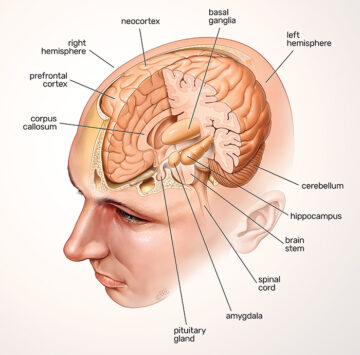
Light is reflected from a rose in my garden. Focused by the lens in my eye, this forms an image on the retina, which in turn sets off a neural impulse along my optic nerve. This in turn travels to the visual cortex at the back of my brain, where a mental image is formed. I then see the rose. Activity arises in my pre-frontal cortex. Motor neurons in my spinal cord and arms activate the muscles needed to point the hose I am holding in the direction of the pot in which the rose is planted. The movements necessary to water the rose are coordinated by activity in the cerebellum which sits at the back of my skull just behind my brain stem. A swarm of bees approaches me. After my visual cortex registers this fact, the limbic system deep inside my brain activates the sympathetic branch of my autonomic nervous system, producing the ‘fight or flight’ response. My heart rate increases, I feel fear, drop the hose and run away.
Everything we do, experience, feel or think seems to either come from the brain or end up in the brain. Unsurprisingly, there is a strong temptation to claim that for all intents and purposes we are our brains, and this seems true to such an extent that philosophers have envisaged the possibility that for all I know I might be no more than ‘a brain in a vat’. They mean by this that a brain immersed in suitable nutrient fluid and connected up to a super computer feeding it appropriate neural stimulation could create all the ordinary experiences of everyday life: a world created within a brain. The story told above about the rose and the bees suggests that, provided I have the right inputs and they are coordinated with the outputs produced by the decision-making in my pre-frontal cortex, I could never know I was not simply a brain in a vat. (This of course is the basis for the film The Matrix)
Putting the brain in a vat hypothesis aside, it’s worth noting that neuroscientists and cognitive psychologists are quite happy to talk as if the brain produces ‘representations’ or ‘models’ of reality, suggesting that we come to know the world secondhand in the brain rather than in the world itself. To go back to the rose example, the account I gave indicates that I see the rose in my brain rather than in my garden, or at least that the only experience I can have of the rose is the representation produced in my visual cortex.
Something has gone seriously wrong here but it’s not immediately obvious exactly what it is. Two errors initially stand out. The first is the mistake of thinking that neural activity in the brain somehow is conscious experience; in my example, the conscious experience of an image of a rose. However, although the brain is extraordinarily complex, it does not contain images. The brain is, after all, just a very complex biological entity composed of billions of cells. In what sense then could it contain an image? Certainly there is an image on the retina of the eye when I look at the rose – just as there are images on a camera sensor or, in the old days, on light sensitive film. But we kid ourselves if we think this somehow gets translated into a mental image, which although unobservable in the brain, exists there. It might be argued here that advanced scanners can show the activity in the visual cortex, and that this is the brain ‘seeing’ an image, and we might want to regard this as a kind of metaphorical ‘seeing’, but there is no image involved, mental or otherwise. Our eyes do the actual seeing and the objects seen are out there in the world around us. A fully operational visual cortex is absolutely necessary for us to see anything at all, but that is by no means the same as saying that the seeing goes on inside this part of the brain.
The second related error is to believe that our knowledge of the world around us can be reduced to sensory experiences. Once we accept this it’s an easy step to locate these experiences ‘inside’ our brains. The starting point for any understanding of the human condition has to be that we, along with others who are similarly self-aware, are self-aware human beings inhabiting a world of objects. Our relation to the world around us and to others is a crucial part of who we are. This cannot be reduced to brain biology.
Any attempt to regard this starting point as a shaky hypothesis, deducible only on the basis of sensory experience, ends up going round in circles. Remember that the brain itself is merely another object in the world. To talk about it at all is to have already accepted a level of objective existence which cannot be reduced to sensory experience. We should also recall that the ‘brain in a vat’ hypothesis mentioned early only makes sense if we already accept a world where vats and super-computers exist as objects in the world. Here’s a thought experiment: imagine seeing the neural activity in your own brain which corresponds to the image of this act of seeing. (This might occur while having brain surgery.) The seeing ‘would have to be both the experience and the experience of seeing itself from the outside: it would have to be at once subjective experience and an objective experience of the basis of the subjective experience’[1] This is hardly coherent to say the least!
One argument in favour of the view that perception must involve images in the brain is the fact that we can experience hallucinations. If I hallucinate a rose in my garden then I can’t be perceiving an actual rose. The rose I seem to be perceiving, it might be argued, must exist only in my brain. But hallucinations can involve subjective experiences that are indistinguishable from veridical experiences. So if we can claim the hallucinated rose is in my brain, why can’t we also claim the image of the actual rose I perceive is also in my brain? The first thing to say here is that although hallucinations might on some occasions be temporarily indistinguishable from veridical experience, they are very different in their nature and origin; the very fact that we can identify a class of experiences as ‘hallucinations’ tells us this. But in any case we don’t have to say that hallucination experiences are in our brains, other than in a metaphorical sense. Better to say that they arise from distorted perceptions or projections onto the world. And this only makes sense if we assume we are subjects existing in, and interacting with, an objective world. Brains play a crucial part in this process but they are not the whole story.
Memory is another area where we can easily be misled by a mistaken understanding of the role of the brain. Memory is a crucial part of our identity. Individuals with severe amnesia lose a sense of who they are, and so if memories are located in the brain then this seems to support the claim that we are brains. Psychologists claim that memories are ‘encoded’ in the brain. Let’s imagine I remember a rose in my garden from a couple of years ago and how it was bigger and more beautiful than the roses I presently have there. A neuroscientist might want to claim that the memory of this rose is ‘encoded’ within a series of synaptic connections in a particular part of my brain. But in what sense can a synaptic connection be of, or about, anything? Synaptic connections are simply physical structures which allow neurons to interact with each other. Unless we assign meaning to them, these structure cannot have a significance in themselves anymore than a series of marks on paper can have significance unless someone has assigned a meaning to them.
There is an even bigger problem with the idea that memories are encoded in brain structures. Let’s not forget that memories are about the past, and yet structures in the brain are simply what they are now. They do not have a tense. How can neurons or synaptic connections provide a sense of the past? One approach might be to argue that because memories, like old photographs, fade with the passage of time, so do synaptic connections weaken. This weakening, it might be argued, can provide us with a sense of the past. But of course this doesn’t work because a faded image – as with a weak synaptic connection – does not in itself signify the passage of time. The passage of time might cause the fading but that is a different matter. And of course some memories are extremely vivid, but that doesn’t mean they are not still about the past. The basic problem here is that physical structures of any sort cannot represent the passage of time without an observer. For a physical structure to have a ‘now’ or a ‘then’ or a ‘not yet’ requires a human subject. And yet encoded memories in the brain are suppose to give an account of how human subjects can grasp their ‘thens’ as opposed to their ‘nows’. So it seems that structures that are supposed to encode memories assume the very thing they are trying to explain. They assume a human subject who already has a grasp of the then/now distinction.
It might be claimed that the then/now distinction can be recorded in the brain through changes in the brain, or through a succession of brain events. Change or succession could perhaps represent the passage of time. But this doesn’t work either. Mere change or succession is not the same as grasping what has been as opposed to what exists now. William James makes a similar point about feelings when he says, ‘a succession of feelings is not a feeling of succession. And since to our succession of feelings, a feeling of their own succession is added, that must be treated as an additional fact requiring its own special elucidation’.[2] In other words, a mere succession of events (feelings or whatever) does not in itself provide a sense of the passage of those events through time.
An understanding of the human condition must include as a starting point not only self-aware subjects who inhabit an objective world with others, but also subjects who have an awareness of the passage of time. No amount of brain biology is going to somehow explain how that arises.
Of course none of this calls into question the importance of the brain. Having a brain is certainly a necessary condition for having memories, as it is for perception and the sense of self. But despite the amazing advances in neuro-science let’s not forget that there is much more to us than our brains.
[1] Tallis, R. 2011, Aping Mankind: Neuromania, Darwinitis, and the Misrepresentation of Humanity. Durham, acumen press, p97
[2] James W. 2007, The Principles of Psychology. New York, Cosimo, p628-9