
by Marianne Janack
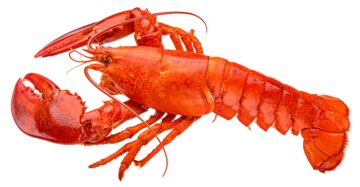
In an essay he wrote for Gourmet magazine about a lobster festival, David Foster Wallace considers the ethics of eating “flesh based viands”, and particularly the practice of boiling lobsters alive. Do they feel pain? Comparing human neuroanatomy and lobster neuroanatomy doesn’t really answer the question, he concludes—it could lead us to think that they don’t feel pain, but the same facts might mean that they suffer even more than humans do. The upshot? The answer to the question of whether lobsters feel pain can’t be answered by recourse to physical structure: the evidence is ambiguous.
I. Uncomfortable thoughts about preferences
Wallace points out that lobsters’ behavior seems to suggest that they’d prefer not to be boiled, and seeing such behavior would, in ordinary circumstances, lead us to think that the creature behaving that way is in pain. In fact, he says, anyone who has seen a tank full of live lobsters at the grocery store will see that they prefer the dark. And studies of lobsters suggest that they also prefer cooler waters. So it’s hard to come to the conclusion that lobsters don’t feel pain when they are boiled alive without doing a lot of intellectual gymnastics.
But, of course, the tradition of distinguishing animal pain from human pain is long, going back at least to Descartes. Descartes famously denied that animals could feel pain because they didn’t have minds. They were complicated mechanisms, like watches, and though they acted like they were in pain, that’s all it was: behavior unconnected to the experience of pain. Human beings, anthropomorphic to the core, project human feelings and reactions onto that behavior. Nicholas Malebranche, who was a committed Cartesian, is reported to have kicked a dog whose howls of pain were, he said, nothing more than the noises of a malfunctioning mechanism, signifying little. Animals, he claimed, did not feel pain. They merely act like they do. Humans are deceived by the behavior—it makes us uncomfortable.
More recent philosophy has distinguished between the idea of suffering and the idea of pain: while pain might be unpleasant, it isn’t the same thing as suffering, which requires the idea of time. Suffering isn’t just pain, but pain that the sufferer understands as extended in time. Humans can wonder if the pain will stop, think about its duration, and understand it as an affliction, while animals cannot. In his essay about boiling lobsters alive, Wallace canvases these claims, but still, he wonders, is this all just special pleading?
Wallace ends the essay with a series of questions about the ethics and aesthetics of eating animals that he doesn’t answer, and then raises the question of whether the readers of Gourmet think about these issues, or whether they only think about food as an aesthetic experience. And if they don’t think about the questions raised by the ethics of animal pain and eating, why don’t they think about those questions? Is it just that the questions are uncomfortable? Or are there certain questions that one ought not to raise, on pain of being impolite? Wallace concludes the essay with the thought that maybe the question about the ethics of eating is a bridge too far. “There are limits to what even interested persons can ask of each other,” he concludes.
The responses to Wallace’s essay in subsequent issues of Gourmet were mixed. Some people complained that there were no recipes included with the article; some threatened to end their Gourmet subscriptions; some complained that they didn’t subscribe to Gourmet to get an essay about philosophy and ethics; some people applauded Gourmet for publishing it. But the larger question that the essay raised—are there certain things that people should not be asked to think about—remained unanswered.
II. Making People Uncomfortable
As I was talking with some fellow faculty at my college about courses, one (whom I’ll call Dr. Thorvald) said that he didn’t think that a course about the ethics of food was itself ethical. I didn’t take Thorvald to be saying that there were some issues that people shouldn’t have to think about; rather, I took him to be objecting to the coercive nature of student life and the ethics of making them think about things over which they have no control, or that make them question what they take for granted. Students have to live in dorms and eat institutional food, Thorvald pointed out: if they don’t have a choice about what they eat, he suggested, then it didn’t seem right to make them question the ethics of the food system that led to them eating what they ate. Maybe what was lurking behind Thorvald’s concern was a concern about student mental health.
Is it wrong to make people think about things that they can’t change? That can’t be right, since the very prospect of large scale political and ethical change often depends on people acting in ways that might not bring about change in their lifetimes. Civil rights, women’s suffrage, animal cruelty, same-sex marriage—much of American history is a story of how changes in these fundamental political arrangements were thought to be impossible. The idea that non-white people in the US should have the same rights and responsibilities as white people seemed absurd to many—until it didn’t. Arguments against women’s suffrage often cited women’s presumed irrationality or their connection to husbands and fathers as reasons for denying them the vote; they were thought to lack the capacities to make decisions about politics and policy, or their judgments were thought to be represented by the men in their lives. Animal cruelty was seen as either necessary or something that wasn’t particularly bad for hundreds of years. Same sex marriage went, in my lifetime, from unthinkable to acceptable (to most Americans).
Will our ancestors look back in 100 years and wonder how we could have allowed certain practices to go on? Will they wonder how we could be so callous or ignorant? Will they explain our inaction as just to be expected of those who don’t know better? Who are just a “product of their time” held captive by a flawed picture of the world or bad morals? Will we seem to our successors like the slave holders of 19th century America now seem to us?
Maybe. Maybe not.
But, Thorvald might say, if we force people to think about things that they cannot change but then also force them to participate in something that they might come to think of as immoral, haven’t we violated some fundamental principle having to do with autonomy?
We might say that all human choice is made against a background of what Simone de Beauvoir and Jean Paul Sartre called ‘facticity’: there are some things that we cannot change. We cannot change who our parents are, or the social and historical context in which we spend our lives, or our own mortality. But we also have choices about how we understand ourselves as connected to, or rebelling against, that “facticity”. We might accept it, shrugging our shoulders about how it’s unchangeable; we might fight against it; we might resist thinking about it because we prefer comfort to knowledge.
And what makes it seem OK to not think about it? Of course, there is the old saw that “ignorance is bliss”—if you can’t change it, then better not torture yourself by thinking about it. The suffering and pain that takes place outside of your view and that you don’t know about doesn’t require anything of you: you can remain blissfully ignorant.
But if blissful ignorance is the highest calling of human life, then why exercise the ability to think of the ways things could be better or more just at all? Even if we think there’s nothing we can do to bring that about?
Part of understanding human moral choices is understanding how we live with other people, whose choices or ignorance or profit set the stage for those choices. The facticity of human life means that we are not perfectly autonomous. Blissful ignorance is, of course, easier and more comfortable—but not, I think, better.
Enjoying the content on 3QD? Help keep us going by donating now.