
by Dilip D’Souza
 It didn’t really surprise me that someone has worked out the mathematical laws I have been reading about of late. It did surprise me that it’s taken me till the ripe old age I’m at now, when the laws have been known for over a century, to find out about them.
I refer to Lanchester’s Laws of combat. These are, of all things, mathematical equations that describe war. That most chaotic and unpredictable of human endeavours, and mathematicians have tried to model it. These laws were worked out during World War I, independently by Frederick Lanchester and Mikhail Osipov. (After learning about them, I find that a mathematician I am proud to call a friend, John Allen Paulos, wrote about the Laws here on 3QD a few years ago.)
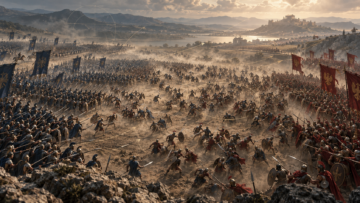
I won’t get into the actual (differential) equations here. Think for now of two armies that confront each other and begin fighting. Let’s assume the soldiers of each army are about equally competent (or otherwise) fighters, meaning all of them can kill opponents at about the same rate. Their opponents’ competence, of course, may differ – and that difference will obviously have some bearing on how the battle proceeds. Also remember that the size of the two armies steadily decreases, because soldiers are dying as the battle progresses.
Started with this rate of mortality in each army, Lanchester sought to describe how they would fare in battle. After all, how quickly an army loses soldiers is determined by the number of opponent fighters, and by their competence in battle.
In wars in ancient times, soldiers confronted each other one-on-one, and the war as a whole was made up of all these individual fights. How quickly an army loses soldiers is then described by the numerical strength of the enemy multiplied by their competence – which is, in fact, the enemy’s overall fighting power. That is, one army’s fighting power describes its opponents’ rate of mortality. You might also think of it this way: the death rate per capita in one army is the ratio of enemy numbers to friendlies, multiplied by the competence of the enemy soldiers. This is Lanchester’s Linear Law of combat.
But as weapons became ever more powerful, war itself evolved away from those frantic one-on-one battles. Armies began engaging from a distance; soldiers can fire their weapons at multiple enemy soldiers or units at the same time. Lanchester used calculus (thus “differential equations”) to show that the battle competence of armies fighting this way – certainly all modern armies – is related to the square of the number of soldiers it has, but directly (not squared) to their individual competences. If that’s a little opaque, think of it this way: as a commander going to war today, you’re better off recruiting a large army than recruiting skilled fighters. Lanchester’s Square Law tells us that if you want to defeat an army that’s twice the size of yours, you need soldiers who are four times as good at battle than the enemy soldiers – and good luck with that. That’s the dilemma the constantly evolving firepower of weapons has wrought. So the easier path is to put together bigger armies.
Hold on, if you can, to just the flavour of these laws.
A paper I read not long ago – entirely by chance, it’s by someone I know slightly, Renee Borges – has these intriguing lines:
“Since competition and therefore some form of combat, is part of the fabric of life, it would be interesting to examine how other species organize their battles. For example, do warring ants follow Lanchester’s Laws?”
Ants! By my reckoning, there are no more beguiling creatures on this planet. And yes, they go to war. A paper by Jackson Champer and Debra Schlenoff that I also read not long ago, titled simply “Battles between ants: a review”, answers Borges’ question above: “Ant fighting [is] amenable to mathematical analysis, particularly in the context of Lanchester’s Laws that consider how total numbers influence the outcome of a confrontation.”
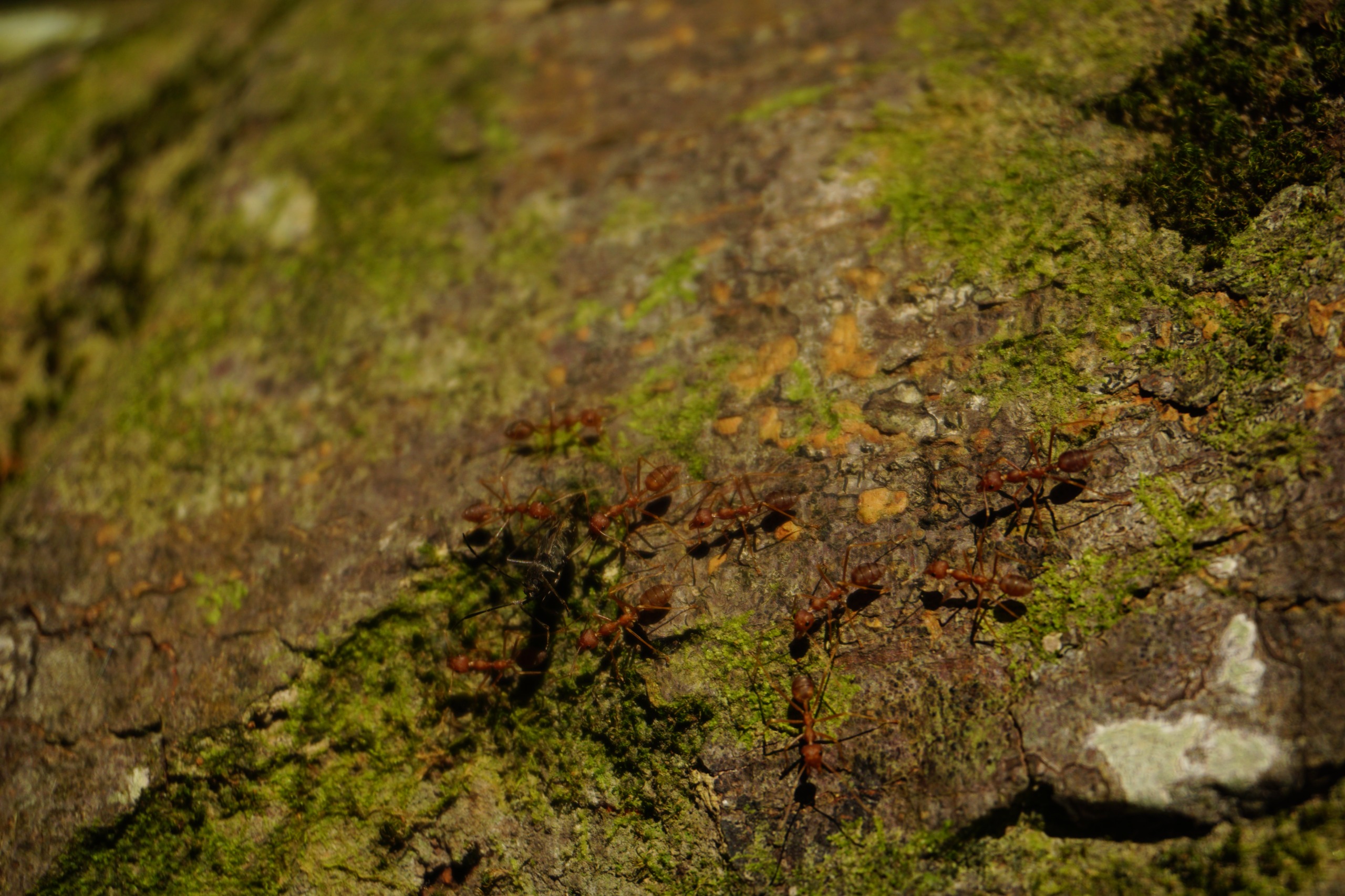
Though first, why do ants go to war? For much the same elemental reason humans often go to war: “ants must compete with other ants for resources.” And when that competition gets intense, ants can be every bit as brutal and violent as us humans.
Borges tells us that one species of ant, Eciton burchelli, can send up to 200,000 ants into battle against other species. The species is made up of four different “castes”. The frontline is dominated numerically by the two smallest of these. Similarly, the species Atta laevigata, despite having a “soldier” caste, actually throws many smaller ants of the species into battle. The point in both cases seems to be to build a larger force than the enemy, but to use effectively expendable individuals to do so.
This strategy, if that’s what we can call it, actually fits Lanchester’s Square Law well. Use large numbers, and treat these smaller ants as expendable weapons rather than individual soldiers. After all, how good the small creatures are at fighting individually is not particularly important. Instead, compare them as they swarm into battle to a hailstorm of bullets human soldiers might fire at an enemy from a distance. Sheer numbers are what these species count on, to win their wars.
And there are ant species whose wars more closely resemble ancient human warfare too. Formica pergandei, for example, seeks to force its enemies into individual encounters. This is a species that raids other colonies to collect “slaves”. But the ants in those colonies are often more numerous than the raiding party. The raiders seek a way to negate that advantage. They have learned to spread specific chemicals that “cause alarm among the defending workers”. These substances are even known by that properly scientific term, “propaganda”. What the raiders manage to do with their propaganda is dismantle any coordination among the defenders. Now they are forced to fight the invaders one-on-one, and so Lanchester’s Linear Law applies. In these individual bouts, F. pergandei can rely on its “powerful mandibles and stings” – it is the better fighter – to overpower the opponent.
Champer and Schlenoff remark that “a notable difference between human and ant warfare is that there is no leader or central decision maker for ants; collective strategy arises out of individual behaviors and the interactions between individuals.” I thought about that while reading, of all things, Madeline Miller’s novel Circe. When Circe meets Odysseus, he tells her about the Trojan War, and has this to say about his soldiers: “though they are weak and unsteady, when they are harnessed together they will carry you to victory.” Among humans going to war, then, you can’t assume that a “collective strategy arises.” They need a “leader or central decision maker” – in this case, Odysseus.
The examples above only hint at how wide the study of ant combat really is. And this is not to suggest that if we find ants fighting, we’ll recognize Lanchester’s Laws in the brutality. The Laws are really just broad descriptors; the nitty-gritty of the creatures’ actual warfare may stray far indeed from there. But me, I’ve always felt I can never learn enough about war, mathematics and ants. So to find ways in which all three weave together is simply fascinating.
Throw in a slice of Greek mythology? The cherry on top.