
by Philip Graham
While Mary Cappello’s Frost Will Come may seem, at first glance, to be about the stages of death (specifically, the death of her mother Rosemary Cappello, whose “soul was gloriously Rubenesque”), it is also a book that is vibrantly about life; about caring and obligation; about love’s varied and complicated revelations; and about what has been given to a daughter who, now grown, honors those gifts with fierce commitment and compassion.
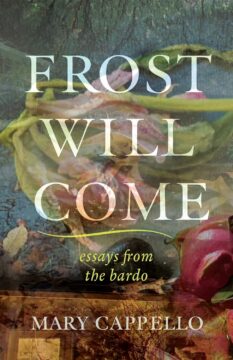 Rosemary Cappello was by all accounts an extraordinary person, someone who found a way, throughout the challenges of her long life, to both “mother and make art,” and she combined in daily life her interests in nature and culture, solitude and sociality, and film, music, and literature. Rosemary played classical music on the piano, she painted, she wrote and published poetry (I am an admirer of her poetry collection Wonderful Disaster), and she was a central figure of a literary community in Philadelphia.
But the initial portrait of Rosemary Cappello that is most striking in Frost Will Come is that of an almost confoundingly heroic woman, clinging through sheer will to her love of life through every remaining moment.
(Note: Captions for images will appear at the end of this conversation.)
PHILIP GRAHAM: Frost Will Come is a book of such richness that I’ve hesitated how to pick a beginning for our discussion. But here goes!
On the surface, your book’s primary locus might seem to be the bardo of your mother Rosemary’s transition from life to death. But it seems to me that you also recount another bardo, one that unfolds in a different direction: from death to life. As you grapple with your mother’s passing—its own kind of odyssey— you address her still powerful presence: “I have to write this, Mom, because I can’t remember who I was before this happened or imagine who I might continue to become.”
So, a book simultaneously and almost dizzyingly alert to the intricate links between life and death.
MARY CAPPELLO: What an incredibly beautiful précis of the directions in which my book moves, Philip! Thank you for that marvelous insight.
One of the early centers of Frost Will Come focuses on re-finding myself in my mother’s library when my partner Jean and I were camped out in her one-bedroom apartment in the last months of my mom’s life and rediscovering those books that had shaped me, too, but suddenly being made privy to her marginalia.
PG: Ah marginalia! Not just her comments in the margin, but the nature of her handwriting offered you unsuspected paths to your mother.
MC: Being with the books in my mother’s library settled me during the unsettled time of her caretaking, and her marginalia kept me company in a different way than the books themselves, even as it put me face-to-face with the undeniable fact of her one day no longer being present or only being present in those traces. There’s a relentless push-pull in the way of emotionally charged magnetic forces in that in-between space—the bardo of “anticipatory grief”—that is difficult to put into words.
While reading her copy of Henry James’ The Golden Bowl, I found her in a favorite Italian phrase, “dolce far niente!”/ “the sweetness of doing nothing,” which she penned next to James’ coy sentence: “She looked as if her most active effort might be to take up, as she lay back, her mandolin, or to share a sugared fruit with a pet gazelle.” The sentence is humorous and her marginal note, penned with a flourish. I had started to read the book after having misplaced my knapsack on our way to her, making me realize that her own library always met me at my most bereft.
My mom’s library is the place where I begin and end, and my relationship to those books and that space had a different valence before, during and after. So, there was a kind of new knowledge that I felt suffused with in the months that we helped to care for my mom, and then there was a whole new surfeit of knowledge that met me when I had the sad job of dismantling the library after her death. So maybe that’s a sort of metaphor for what you are observing.
I am perpetually fascinated by the question of what conditions need to be in place for something, anything, to come into being, whether that coming into is a coaxing or a sudden, gasp-making revelation.
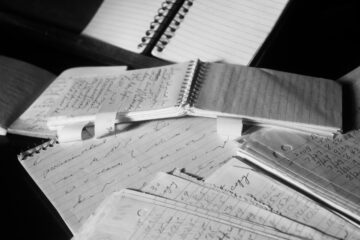 In that segment of the book in which I revisit books in my mother’s library, I find myself returning to the meaning of “cocoons” and a stirring essay that Sam Anderson wrote during the pandemic on how the decomposition of one body lays the groundwork for the emergence of another one. My mother was, herself, big into ideas of renewal, transformation and rebirth. She remade herself at least a half a dozen times during her life; her favorite earrings were a pair of phoenixes. Just yesterday while reading copies of a big sheaf of letters she wrote in the mid-1970s, I found this humorous quip, “I am discovering that one of the problems of being reborn is facing many of the same disappointments one had in the first life.”
PG: Her multiplicity posed a dilemma for you, right from “the larval stages of my mourning,” as you so poignantly describe it. You ask: “Which mother do I grieve? How can I possibly grieve all of them or hold them all in consciousness?” These questions, I think, point out one of the great narrative tensions of Frost Will Come.
MC: It’s been two years since I finished composing Frost Will Come but the revelations keep coming. I recently happened upon drafts of a poem that my mother wrote about the day her father died and one on the untimely passing of one of her sisters who died a truly terrible death of undiscovered causes. Reading those poems after having witnessed my own mother’s course through death had an entirely different effect: I know her losses more truly having now experienced my own.
In one of these poems she writes, “Death is like giving birth/There is a labor involved in dying.” The lines stopped me in my tracks because I hadn’t remembered her having written that, but I present it like my own discovery in Frost Will Come: “My mother’s dying confirmed my suspicion that death was a labor like birth, all out of proportion with any depiction of it, however philosophical or full of grace.”
Had I heard her say it and I forgot? I thought I had arrived at this discovery on my own. But, no, it was an insight she had already voiced but that I failed to hear or perhaps wasn’t able to hear or to understand until I experienced it.
PG: Moments of discovery such as this—and there are many in Frost Will Come—helped you to begin replacing your “sadness with astonishment.” Yet another gift you mother has given you.
MC: Writing of course is life-giving, to quote another of my mother’s poems, maybe a “thumb nose at death.” Can we, through writing, simultaneously face death and bring forth life? One needn’t deny death to bring forth life. A copy editor who was a stranger to me said that reading Frost Will Come made her feel alive; a fellow writer whom I’d shared it with in draft form, said it made her own mother present to her again. These are the greatest compliments.
PG: Yes, I can imagine most readers having a similar reaction to your book: that the loss of a loved one, if properly tended, can reveal unexpected complexities. Somehow, the dead wait for us to breathe a form of life back into them through memory.
MC: I think it’s really interesting that the object of the verb “tend” in what you’ve said is “loss”: we tend the dying in our caretaking and our witnessing—we attend; we tend the dead by remembering them, but I think tending the loss itself could risk fetishizing it. Maybe being open to it and letting it act on and through us? I’m not sure. I don’t think the dead wait for us—I think they are pretty much done with us and it’s impossible for us to catch up with them though we might spend the rest of our lives trying.
It’s that inimitable break, the cut, that seems unbearable, the lifelessness of a once vibrant human, beyond our comprehension.
PG: This trying to understand is what makes Frost Will Come so powerful, I think. The dead may be done with us, as you say, but we aren’t done with them. My parents died over thirty years ago, and yet I still reevaluate them in my mind as I age, finding hidden shades of nuance. And through that, I find I begin to understand myself more, become better able to offer my parents a long-delayed forgiveness. Recently, your book has been a helpful guide on this path to greater empathy.
MC: I’m glad my book has provided you company in that process, Philip!
Of course, my mother will continue to teach me for the rest of my days: the relationship is both over and infinite.
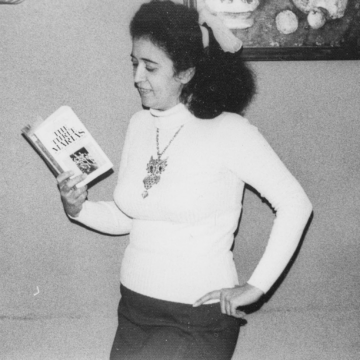 Unexpected cultural excavating unfolds in Frost Will Come as my mother continues to introduce me to figures such as Sara Teasdale and Amy Lowell; the African-American jazz great, Hazel Scott; the singular dance moves of Eleanor Powell; and the Portuguese writers, the 1970s radical feminists whom I’d never learned about across my own career who called themselves The Three Marias.
So, too, I have wondered if death allows us maybe to begin to see our parents as fellow humans apart from their care of us. At what point in our lives do we grant them the integrity of separate selves? With their own lives and desires quite apart from ours? It might be a sad fact of the matter that such understanding doesn’t fully emerge until a parent has died.
PG: Throughout your book, while we encounter Rosemary in her last and physically difficult days you always mange to slip into the narrative glimpses of her earlier, vibrant life—or should I say lives?—and art. And the portrait of her that you build makes it quietly clear how you and your wife Jean Walton could so selflessly dedicate yourselves to her needs in those final months.
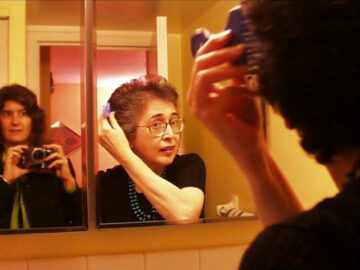 MC: I’m so grateful for the multiplicity you keep returning to, Philip: the numerous different mothers that I grieve; her being a person who lived many lives; the triple portrait the book traces of ourselves, intertwined and individuated—the two of us together, and each of us alone—as well as the portrait I try to create of Jean who cared for my mother as fully as I did but whose relationship with her was complexly her own.
I think you tap these multiplicities in your own work, most recently in your novel where you imagine after-lives, the ghosts of the departed intertwined with one another but also with those still living, an endlessly generative metamorphosis.
You mention my mother’s “earlier, vibrant life,” but she also remained robust amid her suffering. Even at her most ill, she often seemed like someone in the flush of youth (!), and it was this contradiction—to be dying yet overbrimming with life—that was difficult to bear witness to. It confounded some of the hospice workers who were helping us to take care of her. They would remark on how they didn’t know what was keeping her alive. One attributed her defiance of death to her piano playing; one, who had never set pen to paper in her life, started to write poetry inspired by her example; a counselor who was a member of the hospice team said she had nothing to offer her—which wasn’t true because my mother really appreciated her—but that my mother was serving as her spiritual guide. I remember on one visit, in what turned out to be the last two weeks of my mother’s life, she said to me on leaving, “I’m really going to miss your mother.” I must have looked puzzled when she said it because I remember thinking, “You mean she’s going to die?” Everyone dies, but do you know what I mean if I say that some people aren’t supposed to die?
PG: Yes, Rosemary’s vibrancy certainly does come out. Sometimes, in her apartment, she’d somehow manage to drag herself—attached to various essential tubes—from the bedroom to the living room and settle down at her beloved piano to play Beethoven’s Fur Elise, or a sonata by Clementi. Unfortunately, you and Jean were sleeping on a cot next to that piano, each of you exhausted from a day of caregiving. Yet playing the piano sustained your mother, gave her joy and strength, and you and Jean never interrupted her. And then there’s Rosemary’s endearing relationship with a Teddy Bear that your brother Anthony purchased in the hospital gift shop. She immediately embraced this bear as a companion, laughing and goofing around with it, her antics “in quotation marks . . . as if delighted by her own regression.”
MC: Yes, regarding her vibrancy, no matter how ill she felt, she always got dressed, often also putting on her makeup and her jewelry. When an upper GI bleed required that she be admitted to in-patient hospice where she spent the last two weeks of her life, the at-home hospice nurse told me that my mother recited Shakespeare and discussed poetry with the ambulance team on the way to the hospital. When I arrived at her apartment that day, I found bloodied pajamas and traces of black bile in the sink.
She was, in a word, undaunted, and I think this can be said of how my mother lived her life as well as how she approached her death.
Oh, but the bear! None of us knows what we’ll gravitate toward in our final days. The bear was a source of laughter and weirdness and, well, here we go again, astonishment!
I devote a stand-alone essay to the bear where I speculate that it served as a kind of body double to my mother when she felt the need to get out of her skin. It helped us all to cope with what I call “bardo boredom” (a state that Sigrid Nunez also invokes in one of her books). I came to think of the bear as a “repository of [my mother’s] esprit: if she were fading, it sprung to life; if the space next to her in bed were empty, it filled it; if death asked her to embrace the emptiness, it forbade such darkness to enter consciousness, displacing it with delight and, for lack of a better word—just see that face!— ‘confidence.’”
Moments when my mother pantomimed the bear walking a tight rope were, as you can imagine, kind of raucously poignant. It may seem like I’m over-signifying it, but the meaning that we lend to objects and the purposes that they serve in our lives as well as our after-lives, is an unselfconscious through-line in the book.
A friend who is teaching the book this Fall asked if there were sections to do with objects that she can draw her students’ attention to since her course is focused on memoir-writing and the life of objects. Seeking out passages that focus on objects as containers of loss and desire, as markers of meaningfulness and meaninglessness, of relationships and of history, of bridges between the animate and inanimate, made me realize that objects abound in the book, from start to finish.
PG: They especially abound in the closing pages of the narrative when, in the wake of your mother’s passing, you undertake another role, moving from caregiver to that of archivist, arbiter of what to keep and what to release of Rosemary’s personal and artistic legacy. An emotionally complex task, since, as you write, “If you’re put in charge of the great dismantling, there’s no way not to strip the deceased’s things of their histories inside a vast web of relationships, to unseat them from their place inside an intricate puzzle of desire.”
MC: I learned early in life about the importance of tending to the archive when I watched my mother rescue her father’s writing from the dust heap to which other of her family members might quite possibly have consigned it. Her father was a shoemaker, musician, and a closeted writer who not only wrote fiction (more than one novel) in between repairing shoes but also and maybe more importantly, aphoristic notes and meditations that he sometimes literally inscribed onto the materials of his trade. My first book, Night Bloom, treats this.
Decades ago, a well-known historian who also was the director of an immigrant history archive at the University of Minnesota got wind of my grandfather’s and mother’s work and asked her if she might donate both of their papers to that collection. All that exists of this legacy in that archive if you go looking for it is a slender folder with my mother’s name on it. That’s because she was not able to part with her father’s papers; so, the forty boxes that they might have received if my mother had been able to let go of them—including the archives of the poetry annual that she founded and edited, Philadelphia Poets—are now in my basement where, four years since her death, I’ve not yet had the wherewithal to catalog or collate them. For three years, I stowed them in a storage locker outside of Philadelphia; I only recently brought them to my home in Providence with the help of a friend—the task required two cars. I hope that time will allow me this important task, not least for what I consider to be a significant archive-within-the archive of the letters and cassette tapes that passed between my mom and two California-based poets, Ann Menebroker and Joan Smith. My mother only met Annie and Joanie in person once or twice in her lifetime, but they maintained a life-long correspondence that documents the ways they each forged literary lives amid the onus of conventional expectations for women of their time.
PG: There turned out to be so much for you to remember and to discover. Even when your tending of your mother’s belongings was essentially completed, you worried about “the possibility that there’s something I have missed, that there might be some reminder of my mother I’ve yet to find, some fragment sunk into a crevice or buried in a hidden fold.” Yet it seems to me that Frost Will Come is that essential last piece: your focusing sensibility giving shape to your mother’s diverse facets.
MC: Certainly, in Frost Will Come, I’m keen to introduce readers who might not already know about it to my mother’s unique sensibility, literary voice, and poetics: in addition to the poems of hers that appear in the book there is her letter-essay in answer to the question, “What Is Poetry?” that I placed at the very end as an appendix. My two fantasies for that piece were either for it to appear as a book inside the book (like a play within a play?) discoverable in an envelope at the back, or, for its pages to be dropped out of an airplane where they might land gently on a populace in search of the solace of art in a dark Age.
Some people are left with very little in the aftermath; others with too much to assimilate, especially, if like my mother, the deceased hadn’t ever been introduced to The Gentle Art of Swedish Death-Cleaning!
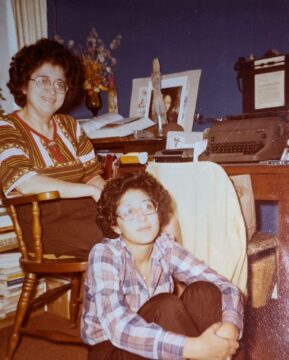 On a more micro-level, in a section of the book called “Her Father’s Apron and Her Mother’s Gloves,” I ask questions that I think each of us might ask if we’re charged with “the great dismantling”: “These things mattered to her, but do they matter to me? Must they matter to me because they mattered to her?”
Everything, to my mind, comes down to “meaning”—meanings that inhere or meanings that our imaginations lend to things.
Most people, I’d venture to guess, like to think that some discoveries entailed by “the great dismantling” are meant for them and them alone—I mean, we are sometimes hopeful for “messages,” whether we believe in an afterlife or not. We want the communication between ourselves and our dead to continue and one of the most palpable ways that can happen is through objects, maybe most especially through what I all “accidental finds.”
PG: Speaking of an afterlife, I think you have effectively and lovingly managed, in Frost Will Come, to offer a kind of resurrection of Rosemary Cappello’s artistic world. Her essay “What Is Poetry,” which you’ve mentioned; examples of her vibrant paintings; and especially—in the “Notes” section—nearly two dozen of her poems. We’ve seen her bravely face death with seemingly unlimited pluck, and now in the final pages she comes vibrantly alive in poems that range from the celebratory to the meditative, from wry to devastating. In that sense, she is not lost but found.
MC: Thanks, Philip. I was listening to my mother reading some of her poems on a cassette tape she made in the ‘70s the other day as I prepare for some upcoming events around the book. Sometimes I like to present what I call “multimodal” readings that have audio and visual components intertwined, and I’ve been thinking how my mother’s actual voice might figure in such a performance.
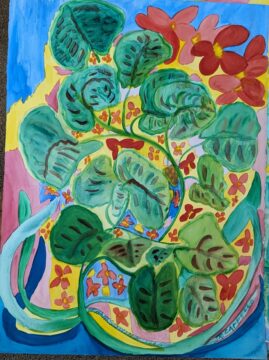 As I was listening, I was reminded again of how my mom was entirely without pretense as a person, and how this extended to her poetry, which, has, for lack of a better word, a kind of purity about it. Of all my books, I have come to feel that in Frost Will Come I was able to access a purity of voice, and I credit that to its being in conversation with the voice of my mother’s poetry. When it comes down to it, I like to think of Frost Will Come as a book that puts us in touch with care in a period in world history where harm more often seems the order of the day.
As you’ve touched on throughout our conversation, what do we tend, attend, how do we care and what do we care about?
Here’s a poem in which my mom meditates on her care of her plants. An appropriate note to end on!
Thank you for the generosity of your questions, Philip, and this encounter. Thank you for your care! It’s always a pleasure.
MY GREEN THUMB
by Rosemary Cappello
People say I have a green thumb and I say
how can this be, when I don’t even have a garden,
until they point out the thirteen plants
thriving on my windowsills.
We’ve been living together for many years,
these plants and I, and before they came here,
one was my mother’s, another was my father’s,
and yet others were my sister Jo’s. My most recent
addition is my begonia, a true treasure.
Recently my daughter
joined the chorus and told me I have a green thumb, and I said, why
do you say that, and she replied because you don’t feed your plants, and
look at them! But I water them, I remarked. And I also care for them very deeply.
I think that’s what a green thumb is—a love of nature so strong that one actually
starts to turn green, as green as a leaf in summer, as green as a desert cactus, as
my shiny begonia, so green, so beautiful, it begs to be painted in all its green glory.
***
Image captions:
Cover of Frost Will Come (University of Wisconsin Press, 2026).
Rosemary Cappello’s notebooks (photo credit: Karen Carr).
Rosemary Cappello reading The Three Marias, and author photo for Rosemary’s co-authored bookwith Joan Jobe Smith and Ann Menebroker, The Habit of Wishing (photo credit: Rosemary’s sister, Francis Brown, Darby, PA circa 1975).
Photo Jean Walton took of Rosemary and her in the mirror, Philadelphia 1997 (photo credit: Jean Walton).
Mary Cappello and her mother seated in Rosemary’s writing nook (Darby, PA circa 1997).
Rosemary Cappello, “Thanksgiving, 1990” (watercolor, 27 x 36 inches).
***
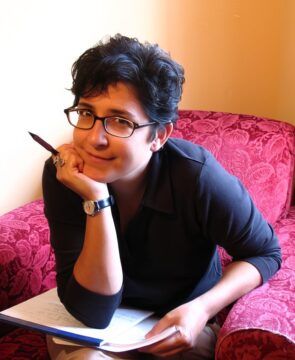 Mary Cappello works in the vanguard of the essay, literary nonfiction, memoir, and experimental prose, on the page and in performance. Her eight books include a memoir based on a twinned legacy of violence and creativity in her Italian American family; a breast cancer anti-chronicle; a Los Angeles Times bestselling detour on awkwardness; a lyric biography of a medical pioneer and his cabinet of aspirated and swallowed things (set in Philadelphia’s Mütter Museum); the mood fantasia, Life Breaks In; and a speculative manifesto on the lost arts of the lecture, the notebook, and the nap. A Guggenheim and Berlin Prize Fellow, as well as a former Fulbright Lecturer at the Gorky Literary Institute (Moscow), she is Professor Emerita of English and Creative Writing at the University of Rhode Island. Frost Will Come/essays from the bardo appears this October from the University of Wisconsin Press. Find her at www.marycappello.com.