
by Eric Feigenbaum
“You might have Dengue,” the nice Thai doctor who spoke excellent English with a twang from his days at University of Tennessee told me, “Or you might have Weil’s Disease. We’ll need to take you for bloodwork to know which it is.”
“What will the difference be if I have Dengue versus Weil’s Disease?” my clammy, sweaty self asked.
“Well, none really. They have the same symptoms, and we treat it the same way – you go home, take Paracetamol (Tylenol in Asia), drink lots of fluids and wait it out. We just need to know for public health records and follow-up.”
In Bangkok – and across Thailand – Dengue wasn’t and isn’t uncommon. Only, unlike Leptospirosis – the mild form of communicable, bacteria-caused Weil’s Disease I had – addressing the mosquito population can control its spread. Of course, in Thailand, this is more theory than reality as anyone can tell you – mosquitoes and their bites are just a part of life.
Not so in Singapore.
I began visiting Singapore for business two years after leaving Thailand and residing there for a two-year stint about nine months after that. There was so much about Singapore that struck me in those early days starting with the obvious things like the culture, technology, development, cleanliness, order…. However, we don’t always register the absence of problems or annoyances, especially when they’re small – like mosquitoes.
I never got mosquito bites in Singapore. Ever. Frequently I was in shorts and t-shirts with lots of skin exposure – including at dusk and no bites. In Singapore’s extremely clean urban environment, it was easy to think it was normal – as it would be at home in Los Angeles. Only Singapore is a degree north of the equator and there isn’t a city, or a country in its region in which one wouldn’t get bitten. However, at that time, it just didn’t register for me.
It wasn’t until one day, sitting in the living room in my fourth-floor rented condo an American friend asked me – a little jittery – about the giant white plume of smoke outside the window. I didn’t know, but a mixture of caution and curiosity led us out of the building to take a look.
It was fumigation. A man was walking through the complex sprayed immense amounts of toxic fog around the perimeter of each building, forming clouds that engulfed walls, balconies and awnings all the way to the top.
Once I noticed, I couldn’t stop noticing – the fumigation was everywhere – office buildings, residences, parks, malls. It just blended into the background in the same way as my unbitten, itch-free skin.
Sure, I had read Singapore eliminated malaria in 1982 and had taken mitigation measures since the British established their colony in the early 1800’s – but so have lots of countries that still get mosquito bites.
I hadn’t considered Singapore’s incredibly low rate of Dengue nor how that was achieved. From the early 1990’s onward, fewer than one percent of households have been found to have breeding mosquitoes – the primary measure used by public health officials targeting Dengue. That number was reduced from 48 percent upon the country’s independence in 1965, having already dropped to five percent within a decade.
While Singapore does get an occasional spike of Dengue, Singapore hits back hard. Only its techniques have changed since my time there in the early 2000’s.
The thing about poison fog is it’s not selective. It kills every kind of bug in its path including butterflies, beetles, spiders and dragonflies. A mosquito-less world is also a butterfly-less one. Which I began to notice as well.
One irony of fogging mosquitoes is it also kills off their natural predators – which was leaving Singapore ever-more dependent on fogging. It also impacted an entire chain of animals who feed on bugs such as oriental magpie-robins, flycatchers, sunbirds, tailorbirds, bats and geckos to more omnivorous creatures who found the occasional toxic dead bug threated them too – such as wild jungle roosters in Singapore’s limited wildlands to songbirds in arboretums and gardens. Fish – both freshwater and oceanic – experienced illness and death from toxic runoff.
Singapore was in an addict’s bind. It needed the pesticides to maintain, but it was clear there were multiple serious, problematic costs.
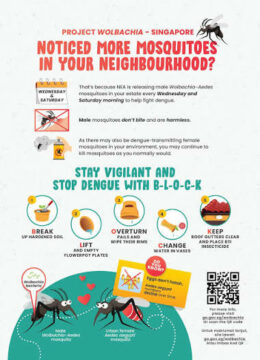
In 2016, Singapore turned to a new kind of science. Wolbachia bacteria kill mosquitoes. Project Wolbachia is a government initiative that infects male mosquitoes with Wolbachia in labs (while sterilizing the females among them) then releases them into the community. Because only female mosquitoes bite, the bacteria are not transmitted to any other animal. Male mosquitoes find and mate with females, infecting them and they all die together.
Over the past decade, the mosquito population has dropped 80 to 90 percent and the risk of Dengue has declined roughly 88 percent.
Singapore’s government has ended fogging as a standard part of pest mitigation, using it only if there is concern for a dengue outbreak – which doesn’t happen much anymore. Private establishments such as commercial properties and non-governmentally-owned condos – like the one I lived in – still have the right to fumigation. So, it still exists. But the Singaporean government highly discourages it and educates property owners on the incredible results of Project Wolbachia. In 2025, Dengue reached a historic low with 3,990 among a population of 6.1 million.
There are many lessons to be drawn from Singapore’s approach to pests and mosquito-borne illness. For one, Singapore aimed high in not only reducing diseases its neighbors struggle with, but even the phenomenon of mosquito bites in an extremely tropical, densely populated setting.
Its incredible drive for results also took a hammer to its ecology – leaving Singapore with a shrinking population of pollinators, threatening one of the accomplishments of which its founding Prime Minister, Lee Kuan Yew was exceptionally proud: the greening of Singapore. The incredible tropical city-state ran the danger of becoming urban jungle instead of the well-manicured garden-city it’s known to be. Plus, what can one say about leaving your children to grow-up without butterflies?
At the same time, it may have also ensured a lot of children had the chance to grow up. Malaria and Dengue are serious diseases that kill. Moreover, it’s very hard to develop an economy in environments plagued by illness. Foreign direct investment propelled Singapore’s economy and increased the standard of living at a speed and level few countries have achieved in two generations. It’s easy to criticize spraying pesticides when looking at the issue in isolation, but for every butterfly lost, there were children who grew up with financial and educational stability – and the kind of futures generations before them didn’t have.
Then there’s the lesson of continual improvement. Frequently, Singaporeans decide the job is never done. They innovated themselves out of disease and into an ecological hole, and then out of that into what appears to be a self-sustaining, much safer way to control disease and target a select group of problematic pests. Many countries and cultures would have lived with the negative externalities of the pesticide approach. Singapore persisted.
Is this the end of the line? Probably not. Dengue isn’t fully eradicated. And who knows what targeting mosquitoes does in the long run. Sure, few people like them – but they are pollinators and clean wetlands. It’s always possible new, unimagined challenges will emerge. It’s also possible Dengue will be in check and Singaporean scientists can turn their attention to Leptospirosis – which I can say from personal experience, many people will be fortunate to avoid.
Enjoying the content on 3QD? Help keep us going by donating now.