
by Ken MacVey
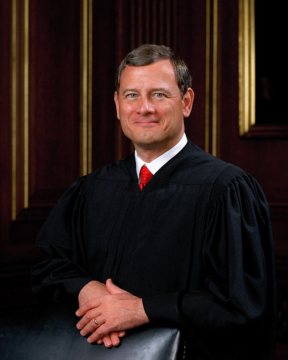 Chief Justice Roberts in his 2005 confirmation hearing famously testified that as a Supreme Court justice his job was not to “pitch or bat” but to be an “umpire” calling “balls and strikes.” History since suggests otherwise. In collaboration with his conservative colleagues on the court, Roberts has been more like an agenda-driven baseball commissioner calling the shots by re- defining the rules of the game. He has led the court to grant Trump and other presidents virtual immunity from criminal prosecution and to seal the deal for the idea of a unitary presidency which subordinates independent regulatory agencies, inspector generals, and the Department of Justice to a single president’s will even if Congress has legislated otherwise.
With the upcoming November midterm elections Roberts may face his first constitutional crisis. Trump has made the midterm elections personal. He has pronounced he should be considered the de facto candidate on all the midterm ballots and declared that the midterm elections are all about and only about whether you are for him or against him. He has “humorously” made his MAGA devotees in a Republican convention in Dallas swear they will vote “for him” this November whether or not they are registered to vote. This “joke” is no joke. Trump is prepared to break legal rules to prevent Democrats from gaining control of the House or the Senate.
Trump in fact broke the rules when he issued an executive order that would have filtered mail-in ballots in the midterm elections. Although the Trump administration denied it, according to expert election lawyers, the executive order was crafted to put the US Post Office in the gatekeeper role of reviewing and preventing Democratic votes in the Congressional elections from being counted.
Trump’s Nightmare: The Midterm Elections
In a way, Trump’s rule- breaking is understandable. Trump faces for what must be for him the terrifying prospect of the midterm elections. Trump won his second presidential term on the theme he would not get the US entrenched in pointless wars and that he would whip inflation. But when Trump once said “I alone can fix it” he apparently picked the wrong “f” word.
Trump’s tariffs war on the rest of the globe has fueled inflation and world contempt. His war on Iran—which less than two weeks after its initiation he announced had been won—lingers on seven months later with no resolution in sight and with Iran defiant and surprisingly well leveraged. In the meantime oil shipments through the Strait of Hormuz are at a trickle and gas pump prices have gone up almost 50%. The polls show Trump’s approval rating at an all-time low, according to some as low as 32%, with disapproval rates in the 60’s. Trump has proved stunningly tone deaf to outcries about affordability, an issue which Trump dismisses as a “hoax.” Trump is now even being more “bidenized” than Biden was—with reports on his frequently falling asleep in public or on his AI generated images he posted of himself walking with George Washington or piloting a plane dropping excrement on people or on his 2:30 in the morning posting of 160 posts on Truth Social. As Americans worry about holding on to their jobs and paying for their groceries, it is not lost on them that Trump in his second term has monetized the White House and garnered billions for himself with friends and family helping themselves too. Political pundits have projected that Republicans could lose the House and maybe even the Senate. And if one or both happens, Democrats will have Congressional subpoena power that almost certainly will uncover shocking facts, be it about Epstein, Hegseth, Patel, Blanche, and Trump himself.
So no wonder Trump is terrified. Which takes us back to Chief Justice Roberts, the Supreme Court, and the midterms. Chief Justice Roberts and the Supreme Court faced its first critical midterms elections test when Trump’s executive order on mail-in ballots came up in two head spinning Supreme Court rulings on August 24 and September 14.
The Supreme Court’s Frenzied Handling of the Trump Mail-In Ballot Rule: A Possible Preview of Things to Come
The following chronology of these rulings is fast and furious. Don’t worry if you find it dizzying, the fact there was such a frenzy should itself be noted because a similar history could repeat itself.
The two rulings center on a March 2026 Trump executive order that required the US Postal Service to issue a rule setting specific standards and requirements for mail delivery of ballots. This included having formatting and scanning codes specifications for ballot envelopes and a mechanism to confirm citizenship by checking with a Trump administration portal of listed voters for each state.
Article I Section 4 of the Constitution provides that the states have the authority to set the time, place and manner of House and Senate elections subject to further regulation by Congress. Several states and groups brought lawsuits challenging the executive order on several grounds, including that the Constitution gives no authority to a president over elections. They also argued that the executive order would give the president the power to disenfranchise millions and rig election results.
Federal courts issued injunctions against implementation of the executive order. One case made its way to the Supreme Court’s emergency docket and on August 24 the court overturned the injunction because it said the Postal Service rule implementing the executive order was not final. (Justices Sotomayer, Kagan, Brown dissented.) But the Postal Service rule was actually finalized and published on August 21 and a federal court in Massachusetts on September 5 released its opinion issuing a new injunction against implementation of the rule. The Trump Administration petitioned the First Circuit Court of Appeals to stop this new injunction. Then on September 8, with its petition with the First Circuit still pending, the Trump Administration also petitioned the Supreme Court to lift the Massachusetts court’s new injunction. In the meantime, on September 10 the First Circuit Court of Appeals issued its decision, which rejected the Trump administration’s petition to suspend the new injunction. The appellate court in its opinion noted that the president and the USPS have no authority over elections and that the rule would disrupt voting already in process and threatened to disenfranchise millions of voters.
On September 14, the Supreme Court issued a ruling that could on the surface appear to be an about face on its August 24 ruling. In a one paragraph unsigned opinion, the court denied the Trump administration’s application to overturn the injunction against the Postal Service. The opinion succinctly stated the administration’s position was unlikely to succeed on the legal merits and the balance of equities was against the administration. Justice Kavanaugh concurred in the judgment but suggested the Postal Service rule had a fair chance of surviving on the merits but to apply the rule to the 2026 elections would be arbitrary and capricious and extremely disruptive. Justices Alioto and Thomas dissented. They still would have had the mail-in ballot rule apply to Congressional elections less than two months away when voting by mail-in ballot was already underway in a number of states.
The ultimate outcome of this series of races to the courthouse is that the Trump Postal Service rule is legally dead at least for the 2026 midterms. The national chaos and crisis that would have inexorably followed if Justices Alioto and Thomas’ positions had prevailed was avoided. This is, of course, a good result.
“Paul Revere” Constitutional Originalists Sound Their Warnings
But that doesn’t mean we are out of the woods. Trump is not necessarily done. Two “Paul Reveres” who are warning more could come also happen to be prominent conservative constitutional originalists.
One such Paul Revere is Judge Luttig. Retired Judge Michael J. Luttig once again is speaking out about what he calls the unprecedented dangers that Trump poses to American democracy. Luttig is often called (accurately) a conservative icon and a constitutional originalist. Although a long-term Republican, he has been an unhesitant critic of Republicans who have supplicated themselves to Trump. His conservative pedigree is unquestionable—as a federal appellate judge he was a guiding light in conservative circles. But that didn’t stop him from joining forces with those who might be considered having opposing orientations, such asc onstitutional law expert Laurence Tribe, who is considered liberal. Both of them, for example, jointly condemned the Supreme Court decision that held Trump could not be disqualified from the presidential ballot in 2024 under the insurrection clause of the 14th Amendment. They forcefully argued that Trump’s January 6 attempt to subvert by mob violence the electoral college vote certification of Joe Biden’s election was an insurrection for 14th Amendment purposes. The Supreme Court went the other way in overturning a Colorado decision that Trump as an insurrectionist could not be on the state’s ballot. The court did so by creating the rule that Congress had to act first, which it hadn’t. Luttig and Tribe jointly called the decision “a stunning disfigurement of the Fourteenth Amendment.” Both also condemned the Supreme Court’s decision in United States v. Trump, which gave Trump and future presidents sweeping immunity from criminal prosecution.
Judge Luttig Warns That Next January 3 Could Be Our Next January 6
Judge Luttig is speaking out again. In a September article in the New Republic called “The Final Battle for America’s Democracy,” Luttig warns that “Donald Trump and his Republican and congressional allies are even more determined to prosecute the president’s war against American democracy to its catastrophic end than they were on January 6, 2021.” But the date he is focusing on is not November 3rd when the midterm elections are set, but January 3rd when the House member- elects are supposed to be sworn into office. Luttig notes that November 3rd has been targeted: “Trump has exploited every conceivable unlawful means possible to rig the midterm elections in favor of the Republicans, and the federal courts have struck down as unconstitutional every one of these unlawful attempts.” But he warns the federal courts could prove “to be institutionally incapable of checking his final unlawful rampage.” He also notes there was a time not too long ago when it could be expected virtually every member of Congress would commit to the peaceful transfer of power in advance of an election. Bluntly he finds “those times came to an abrupt end upon Donald Trump’s arrival in January 2017. . . . it would be hard to find even one congressional Republican with the integrity, sense of duty to country, honor, and courage to put America above the Republican Party, let alone above Donald Trump.”
What Luttig envisions could happen on January 3rd is that when the House member-elects are supposed to be sworn in Republican Speaker of the House Mike Johnson could refuse to seat Democratic member-elects on spurious grounds of fraudulent voting. To get there, Johnson would have to relieve the current clerk of the House, who according to Luttig, is well respected and has integrity. Johnson then would appoint a temporary clerk of the House who would go along with the scheme to refuse to put various Democratic member-elects on the clerk’s roll for being sworn in. If Democrats brought a lawsuit in court challenging this action, the House Republicans could argue that under Article I Section 5 of the Constitution the House has exclusive jurisdiction to “be the judge of the elections, returns, and qualifications of its own members . . .” (Quoting Article I Section 5.) Thus, courts, according to this argument, have no jurisdiction to act and would have to defer to the House’s decisions. Luttig does not believe this position is legally sustainable. He believes the clerk of the House would have a non-discretionary legal duty to put member-elects on the clerk’s roll for seating purposes, and a court could so order.
Luttig says he does not intend to be “overly sanguine” about the Supreme Court yet he adds:
“But surely by now this court must understand what it has wrought for the U.S. and the Constitution, and is aghast as we all are, even if it is not penitent. Surely, surely, it will understand the signal moment in American constitutional history that would be presented, and this time understand its supreme obligation to the nation.”
Perhaps so. Perhaps not, and almost certainly not if Justices Thomas and Alioto were to have their way. But Judge Luttig’s article was not meant just for the liberal readers of the New Republic. It is a memo addressed to each member of the Supreme Court, to each judge sitting on a federal appellate circuit, and to each federal district court judge in the nation. But most particularly it is addressed to Chief Justice Roberts. It is improbable Roberts has not read it—Luttig and Roberts are, or at least were, close friends.
Another Constitutional Originalist Sends Chief Justice Roberts a Heavily Footnoted Memo
Another conservative originalist Paul Revere is Caleb Nelson. He is a professor of law at University of Virginia law school and is widely respected as one of the most authoritative constitutional originalist theorists. Several of his academic writings on constitutional law have been cited by the courts, including the Supreme Court. In September, an 80-page academic piece by Nelson was made available on the internet for review and downloading. It’s titled “AGAINST THE DICTATORIAL PRESIDENCY.” It is also expressly noted on each page it is a “Work in Progress (Last Revised 8 Sept 2026).” As such it is subject to revisions and it is unclear where it may be published. In any case it is thoroughly researched and footnoted (it has 548 footnotes). Nelson systematically, historically, and legally, point by point, explains how the Supreme Court and others in the name of originalism have aggressively expanded the scope of the executive power of the president in a way that cannot survive an originalist interpretation. And by so doing the Supreme Court has endangered the constitutional republic itself. It is worth quoting Nelson’s summary of his article, keeping in mind it is part of a work in progress:
“Article II of the Constitution says the ‘[t]he executive Power shall be vested in a President of the of the United States of America.’ Ever since the 1980s, it has been an article of faith in Republican legal circles that this spare sentence answers an enormous number of questions about personnel practices and decision-making structures for everything the federal government does outside of Congress and the . . . courts. Among other things, it is said that the Constitution requires the President to be able to control every individual exercise of authority by all nonlegislative and nonjudicial officers in the federal government . . .
The current Supreme Court has enthusiastically embraced these aggressively pro-President readings of the Constitution. But the text of the Constitution is at best ambiguous about the issues that the Court takes it to resolve. . . . [ I]n any event, the Court is wrong about both its historical evidence and . . . theory …
The stakes are high. Even as the Court is moving swiftly to expand presidential power, daily events illustrate the dangers of its preferred course.”
Thereupon Nelson in excruciating detail documents his take down. Toward the end of his study he reviews how the aggressive unitary theory of executive power endorsed by the Supreme Court in the name of originalism has been abused by the Trump administration. He cites the example of Trump strong arming law firms and using criminal prosecution to go after political opponents. He goes into detail how the Trump administration has “aggressively inserted itself into matters of election administration—demanding access to voting machines, seeking voter-registration lists from states, threatening state and local election officials with criminal prosecution . . .”
After detailing these and other abuses of presidential power by the Trump administration facilitated by the Supreme Court’s embrace of an all-encompassing unitary executive branch–the only branch of government that is infused into a single individual– Nelson at the conclusion of his article takes on Chief Justice Roberts by name. He thoroughly dismantles Roberts’ various positions and rationales that help promote a “dictatorial presidency.”
Judge Luttig didn’t simply write an article–he sent Chief Justice Roberts an advisory memo. In turn, Nelson is sending to Roberts a thorough legal memorandum that obliterates Roberts’ rationalizations of unbridled presidential power. He shows that this unprecedented expansion of presidential power alarmingly coincides with a president with the appetite to use this power free of constitutional or other constraints.
Both Luttig and Nelson could not be clearer in their message to the Chief Justice and the Supreme Court: Thou shalt not destroy the Constitution and the liberties it protects and the republic it founded in the name of the Constitution’s supposed original meaning.
New Development
Just as this column was being completed, the Supreme Court in an emergency shadow docket decision (Justices Brown, Sotomayer, Kagan dissenting) restored the Trump administration’s voter verification system. This decision allows states to access this system to purge voters. The system uses confidentail Social Security data and reportedly– according to internal Trump administration review–can have an error rate as high as 81% in some localities.
Maybe Chief Justice Roberts and the court majority didn’t get the memo.