
Ivan Kenneally at The Hedgehog Review:
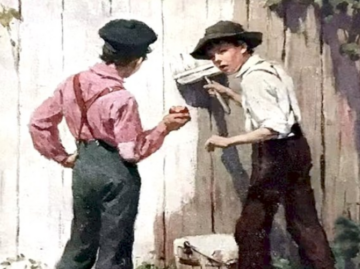 Mark Twain unreservedly disdained celebrations of the Fourth of July, those perfervid cataclysms of self-aggrandizement whose blasts of fireworks stand in for “bombs bursting in air.” As he saw it in “The War Prayer” (1905), they stoke the always hot embers of the “holy fire of patriotism” and encourage the unbinding of a rabid nationalism. He joked that thousands die every year in these orgies of jingoism—he lost two uncles himself.
Twain’s principal grouse was that patriotism lobotomizes its practitioners, subduing reason with heedless exuberance. Most patriotism is “majority patriotism,” he averred in “As Regards Patriotism” (1901): a herd-like solidarity sophistically fashioned by politicians and newspapers. This unthinking nationalism is just rote convention mixed with gunpowder, sparked by a tinderbox of passion and dim-wittedness. By contrast, Twain defined a healthy patriotism as one “manufactured on a man’s own premises…reasoned out in the man’s own head, and fire-assayed and tested and proved in his own conscience.”
However, this seems a tall order for what he called, in Life on the Mississippi, a “nation of moral cowards” whose citizens exhibit an “exquisite sensitiveness” to criticism and a terror of defying consensus sentiment, with every small step outside the cozy circumference of public consensus pronounced an apostasy.
All of this raises, and was intended to raise, the question of what constitutes a befitting patriotism, a truly rational love of one’s country.
More here.
Enjoying the content on 3QD? Help keep us going by donating now.