
by Jochen Szangolies
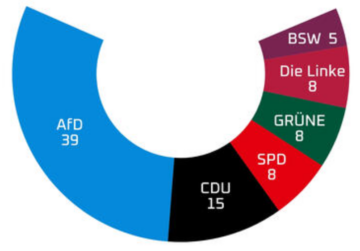
Last Sunday, on the sixth of September, for the first time in more than 80 years, a far-right extremist party won the majority of votes in a German state election, and has a realistic chance at leading the state government of Saxony-Anhalt. (They had previously won the majority in the 2024 Thuringian state election, but had no chance of forming a government because none of the other parties would join them in a coalition.) While narrowly missing the absolute majority, at 43.8% they very nearly equaled the combined result of the CDU, SPD, Grüne, and Linke (of 44% according to the preliminary count). In particular, the conservative CDU, party of Chancellor Friedrich Merz, has lost more than half their share of the vote compared to the last election. These losses are attributed by many to vastly unpopular reform plans and a general perception of failing to meaningfully engage with the needs and concerns of the majority of the electorate (mostly those having to work for money, instead of having money work for them). Merz holds the historically lowest approval rating for any German Chancellor: around 80% of Germans are dissatisfied with his performance.
There are, as always in such a situation, conciliatory voices: perhaps the work of government might demystify (‘entzaubern’) and expose a party that has little to offer except inflammatory rhetoric and beer hall populism. Perhaps the promises made on the campaign trail will evaporate in the harsh light of political reality. Perhaps disillusioned voters will turn away again from a party that fails to deliver. Perhaps, that is, no Bad Thing will happen. I deeply hope this optimism will prove true. But I do believe it is misguided: in Germany, a democracy explicitly engineered to prevent a repeat of fascist terror, a ‘confirmed right-wing extremist’ (‘gesichert rechtsextrem’) party will most likely lead a state government. That is the Bad Thing, happened.
Germany, here, is not an isolated case. Democracy has been on retreat in large parts of the world. Autocrats, and particularly right-wing populist movements in Europe and beyond, are on the rise. After the fall of the Soviet Union in the 1990s, narratives of ‘the end of history’ and the victory of liberal democracy seemed to herald an era of global democratization. But history seems to stubbornly continue. So how did we get here from there?
Erik Hoel, neuroscientist and occasional cultural commentator at his substack The Intrinsic Perspective, pinpoints the year 2012 as the turning point for many long-running trends, especially in regard to a shocking decline of mental health, particularly pronounced among teenagers and young adults.
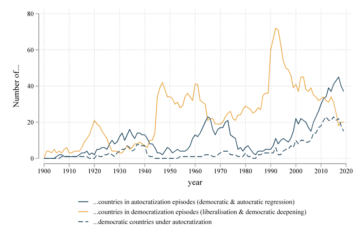
And indeed, looking at long-running trends of autocratization vs. democratization, we again find the approximate turning point in the year 2012. Is this an accident, or is there something more behind it? I think that the possibility of a link here is at least worth investigating.
Now, if there is a correlation between A and B, and you suspect this to be more than chance, you can either look at possible ways that one causes the other, or you can look for a common cause of both. While it is not completely implausible that democratic backsliding has effects on mental health (mine certainly took a hit last Sunday), nor that a widespread mental health crisis fuels at least some form of dissatisfaction with the status quo, the causal story seems weak in either case. Autocratization may lead to mental health decline, but what explains the rising autocratization? Declining mental health might make one vote against the current order, but why is mental health declining in the first place?
Hoel points to 2012 as the year that (in the US, at least) more than 50% of people owned a smartphone for the first time. But he (perhaps more wisely than I) largely neglects to provide a causal narrative, although he does single out the rise of online debate around ‘woke’ topics and the resulting backlash. Nevertheless, it is not immediately clear why widespread smartphone ownership should have such psychologically devastating consequences, nor foster antidemocratic sentiment. Smartphones provide many blessings: the near-instantaneous access to essentially all the world’s knowledge would have been beyond the wildest dreams of any scholar of the past. Yet, the correlation is hard to ignore.
So, is our current malaise the little screen we all carry around in our pockets? I don’t think this gets it quite right. The smartphone is the vector, but not the infection itself. Rather, I think it is a loss in the means of identity-formation due to social-media driven fractionalization of society that is at least a contributing cause in both trends. Let me explain.
Antisocial Media
Social media sells itself on the promise of connecting everyone to everybody else. In theory, we carry all of our connections with us, all the time. Nobody is ever more than a few clicks away. Yet while in 1990, 33% of Americans reported having 10 or more close friends, in 2021, that number had sunk to nearly a third. Conversely, the share of people having no close friends at all quadrupled, from 3% to 12%. Evidently, social media isn’t increasing social relationships.

Everybody knows the scene: couples or families, maybe at lunch, ostensibly together, yet all lost in their own screens. Everybody’s probably been part of such a scene. I certainly won’t throw the first stone. But that just speaks to a change in social relationships, not necessarily a decline—true, every change seems corrosive from within the axioms of the old order, but nothing new would be born without it.
Yet even on social media, we’re engaging less with one another. In fact, less than half of users report connecting with close friends online regularly. Looking at my own timeline on facebook (yes, I’m old now), most posts aren’t from my own friends, nor from groups or people I follow, but whatever The Algorithm judges to be relevant to my interests. Authority over who I connect with, what is presented to me, has largely been ceded to an impersonal force, rather than being the result of my own choices and relationships.
Indeed, once one starts looking for it, many aspects of online media seem almost deliberately designed to isolate, rather than connect. (I’m not pretending that this is a shockingly original insight, but it is necessary to provide some ground work here.) Echo chambers lock us into spirals of self-amplifying opinions, with people of different views often effectively experiencing a different world online. Online shopping removes the need to go out and interact with another person to cover your daily needs (and wants). Online dating makes romance a matter of matching profiles rather than the gradual budding of connection through shared experiences. (Tinder, incidentally, was released in 2012.) Relationship rates are declining, particularly among young adults. Most related discourse online seems centered on ‘red flags’ to avoid, outsourcing real engagement to shallow metrics and ‘no-gos’.
This isn’t (just) middle-aged griping about the decline of proper cultural values. My contention is that this increasing isolation robs us of one of our central means of fostering a sense of individual identity, and thus, makes us vulnerable to the shallow identity constructs—race, nation, sex, and other surface-feature based groupings—peddled by the right, while leaving us starved for self-recognition and meaning.
Identity Groups
I have previously remarked on how identity formation is a problem that has come much more to the foreground in modern times. Identity used to be largely a solved problem—although very badly so. Essentially, you were defined by the circumstances of your birth, and were unlikely to ever veer far beyond them. The son of a lord would be a lord himself, the daughter of the cobbler married early and tasked with tending to home and children. This was, let me emphasize once again, a terribly unjust way of structuring society, and responsible for many of the greatest moral tragedies in human history, from exploitative colonialism to the systematic marginalization and mistreatment of women.
Modernity has started to make some inroads on the injustices fostered by this system. While we are obviously very far away from a truly ‘equal and fair’ society, there is greater social mobility—although here, too, trends have stalled or reversed in more recent times. But this essential progress also opens up the question of identity anew: what used to be given from birth, now has to be found or created. Again, that’s a good thing on the whole. But the problem is that the fractionalization of society due to online media is depriving us of our best tools to make our own identities.
On the most elementary level, identity is a means of comparison: I’m like that, but not like this. Thus, the groups we associate with—and those we distance ourselves from—play a large role in who we consider ourselves to be. I’m a nerd; I’m not a football fan. But if social media disrupts the complex web of interactions that helps us situate ourselves in the world, and replaces it with shallow, impersonal echo chambers where the only thing we ever really see is our own warped reflection, what else could be the outcome other than that we turn to the most shallow means of identification—skin color, sex, nationality, creed?
The right has an easy narrative about who you are: you’re one of us if you tick the right boxes. Those that don’t look like you are the others. You’re not like them; in fact, they’re a threat to who you are. Over and done with. In comparison, the left has a much harder task: drawing circles around identities that exclude others won’t do, if we intend to foster an inclusive, equal and tolerant society. A lot of this has to do with the negative goals of many left-wing movements—negative in the sense that if a certain goal is reached, the underlying unifying force dissipates. Hence, a left with any hope of stemming the tide of increasing autocratization will have to find—or rekindle—a new, positive means of identity formation against the isolating influence of online interaction.
Of Wolf And Sheep
It’s a rule of thumb of mine that if I judge the merits of an organization, group or movement, I look at what their ‘success condition’ means for their own continuation. In general, if achieving its goals means that a movement disbands, there’s a good chance that they’re at least coming from good intentions. (Of course, many bad deeds are done with the best of intentions.) A movement of that kind can’t be self-serving, since the ‘self’ they embody is what ceases to exist once they achieve what they set out to. So, for instance, a society for saving some endangered species simply becomes superfluous once that species is actually saved.
On the contrary, a movement that seeks to install a particular type of people into a superior position—say, blond and blue-eyed—is inherently self-serving: they want to rule, and that’s what defines them. If they succeed, they persist as the ruling class. Their ends lie within, not beyond them. That also means that belonging to this group, you’re not in danger of facing your identity collapsing once their aim is achieved. Thus, such a group confers a strong sense of identity, which is attractive in a time where identity-formation is difficult. There’s a ready-made, off-the-shelf answer to the otherwise difficult question of who you are and what your place in the world is.
This is, I think, a key difference between left- and right-leaning movements. It’s in the end why the ends of the horseshoe don’t meet: while both left- and right-wing discourse can be discriminating, right-wing movements discriminate based on intrinsic characteristics, while left-wing movements discriminate on the basis of discrimination. One often hears cries of hypocrisy when left-leaning persons or organizations resort to exclusionary language or tactics (‘don’t talk to Nazis’, etc.), but the difference is in the origins of this exclusion—while you can’t change the way you were born, your gender, sex, orientation, or skin color, nobody needs to be a fascist. The intolerance of the left is generally intolerance of intolerance. Unfortunately, that is also why many left-leaning movements fail to foster a strong and lasting sense of identity: there is no Antifa if there’s no fa, for instance. Whereas if the fascists win, they’ll continue to be fascists.

I have heard this cast illuminatingly like this: if you’re equally open to wolf and sheep, that is, to the predator and the prey, you won’t end up with a nicely equal society of wolves mixed with sheep; you’ll end up with fat, happy wolves. Neutrality isn’t neutral in a situation slanted in one party’s favor. It’s a question of power differentials: discrimination, or exclusion, becomes oppression once it operates along a power gradient. It is not oppressive to, say, tax the rich, even though it is certainly discriminatory. You should absolutely side with the sheep over the wolves, even if you want a society for both. Accusations of ‘reverse racism’ or ‘reverse sexism’ and the like are just the same false equivalence. The horseshoe theory is horseshit. (Of course, this doesn’t mean that one can’t condemn acts of left-wing terrorism, or that there can’t be oppressive left-wing governments. As already noted, good intentions don’t necessarily make for good deeds, and strains of the authoritarian left question the certainly simplistic narrative set out above. Nothing’s ever easy.)
Thus, the factors that make the left (by and large) what it is are those that disadvantage it in our social media-isolated society. It isn’t so much the content or the messages that we receive via the screens perpetually in our pockets, it’s the style of connection that they foster that contributes to the rise of simplistic identitarian narratives. And those are the domain of the right. What does this mean for those of us who would prefer an egalitarian, tolerant society?
Another way to find likely causes of an event is to look to those who stand to benefit: they have, at the very least, a vested interest in making it happen. That doesn’t entail conspiracy: as the great George Carlin once observed, you don’t need a formal conspiracy when interests converge. And it should come as no great shock when it is pointed out that those who have benefited the most in the past decade are the rich and ultra-rich. The ultra-rich, of course, are also the ones that both run the infrastructure of online life, and increasingly the driving force behind the political shift to the right.
Does that mean that I think social media was engineered in order to drive a wedge between interpersonal relationships? No: such developments are almost always evolutionary rather than deliberate. Power first and foremost wants more power, and nothing but opportunistic embrace of developing trends is needed as explanation. But this gives us the direction in which the finger of blame should actually point: not left, not right, but up. Society is not a line spanning from left to right extremes, it’s a pyramid, and while the squabbles between all those of us at the bottom see us increasingly isolated, those same squabbles line the pockets of those in the thin top wedge.
It’s sometimes said that the greatest trick the devil ever pulled is to convince us he doesn’t exist. But the greatest trick of the rich and powerful is to convince one corner of the pyramid that it’s the other corner that’s responsible for all their woes, and not the exploitation of those who work to create value by those who extract it. But there’s a way to resist both the rise of a right driven by fractured identity-narratives and find a positive, identity-forming narrative for the left: a return to the notion of class as a valid identity. Rather than infighting at the bottom, a united working class can resist the direction in which power is actually exerted—from the top. The notion of class cuts across the divisions in society on which right-wing narratives find purchase, and unites those on the receiving end of the steepest power gradient in society. And even if the ultimate end may again be the dissolution of class in a class-less society, it is so only by pushing the boundary outwards until there is nothing left on the other side—until the line between the ‘haves’ and ‘have-nots’ vanishes by everybody becoming ‘have-enoughs’.
That may, of course, be an idealized hope for the foreseeable, or indeed any future, but still, there is a twin chance for the left here: find a new identity-narrative in the reinvigoration of class, and resist the ongoing digital fractionalization of society. We need to seize the means of identity production.
Enjoying the content on 3QD? Help keep us going by donating now.