
by Ken MacVey
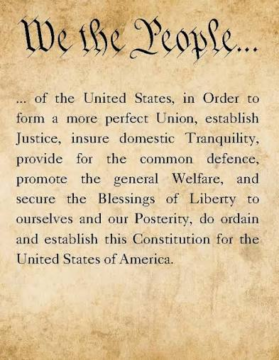 The preamble of the US Constitution famously begins with the phrase “We the People”. Who, and how many, constituted this self-identified group? How well founded was this invocation of “We the People”?
Let’s start by looking at the US population as a whole when the Constitution took effect in 1789. The Constitution itself has provided a mechanism to aid in this assessment. The Constitution required that a census of the United States population be taken every ten years. The first census was in 1790. According to this census as reported in the National Archives, the US population in 1790 was 3,929,214, which should also approximate the size of the population in 1789. How does this number break down?
How Many Voted to Ratify the Constitution?
The 1790 census broke down its count by categories of “free white males,” “free white females,” “other free,” and “slaves.” ( Non-taxpaying indigenous American Indians were excluded from census consideration.) Slaves were counted at 694,000 (rounded) –which would be almost 18% of the US population. Free white females were counted to be 1,541,000 which would be about 39% of the total population. When the Constitution was ratified slaves and women were not eligible to vote in any of the 13 states. That means about 57% of the counted population was automatically excluded from voting in the 13 states when the Constitution was ratified. If free white males of the age 16 and under are further deducted, then the percentage excluded rises to 77%.
But most of the remaining adult white males and “other free” were not eligible to vote either. The 13 states had additional restrictions that varied state by state—such as requiring ownership of property, being of a certain Christian denomination, being a taxpayer, or being white. The “other free” identified in the 1790 census consisted of 59,000 and presumably included free Blacks. Five states at the time of ratification allowed free Blacks to vote but they still might not have satisfied other requirements, such as being property owners. It is not known precisely how many in the United States were eligible to vote in 1788-90, but some estimate only 6% of the total of the 13 states’ populace was eligible.
As a Demographic Matter in 1789 “We the People” Excluded Almost the Entire US Population
How many actually voted to approve or ratify the Constitution? The Constitutional convention was convened in Philadelphia in 1787 by 55 unelected delegates from 12 of the 13 states (Rhode Island declined to participate). The purpose of the convention was to address the widely criticized political dysfunctionality stemming from the then existent Articles of Confederation. The convention was presided over by George Washington. The proceedings were secret and after four months of internal debate a draft of the Constitution was completed in late 1787. The phrase “We the People” in earlier drafts referred to “We the People” of each of the 13 states, identifying each state by name. The final phrasing became “We the People of the United States” with no naming of specific states. At the time this phrase was finalized there had been no vote by anyone other than delegates at the convention.
Of the 55 delegates at the constitutional convention, 39 signed off on the proposed Constitution to be submitted to the 13 states for ratification. The delegates unanimously directed that ratifications could not be by the state legislatures but only by separate conventions in each state. These conventions were to be attended by delegates elected by eligible voters. Because underlying records no longer exist, the total number of those in the 13 states who voted in the election of state convention delegates is unknown. After reviewing still existing documents, however, historian Charles Beard in 1913 estimated that the total vote was 160,000. He further estimated that no more than 100,000 voted for delegates supporting ratification. This last number of 100,000 would represent about 2.5% of the total US population counted in the 1790 census. In any case, no direct popular vote on ratification ever occurred. The only vote was by convention delegates.
The proposed Constitution required ratification by a minimum of nine states and was ratified in June 1788 when nine states voted by conventions to ratify. Ultimately all 13 states through their conventions voted to ratify the Constitution. The total delegate vote for all 13 states was 1071 for ratification, 577 against, or a total of 1648 voting one way or the other on ratification. Thus, the total of actual direct votes for ratification of the Constitution was only 1071.
Undoubtedly, the historical accuracy of some of these numbers could be challenged but probably not the factual conclusion that follows from them. The bottom line is those who actually got to vote directly or indirectly to approve the Constitution represented a minuscule percentage of the total population of the 13 states. The phrase “We the People” as a demographic reference point in1789 excluded almost the entire US populace.
As we will see, after a rocky start, the scope of what is meant by “the People or the United States” in the Constitution expanded exponentially in the two centuries following the Constitution’s ratification.
The Supreme Court’s Disastrous Pre-Civil War Take on the Constitutional Meaning of “We the People”
In the early years following ratification, the Constitution’s preamble itself received little attention in the courts. In 1820 the Supreme Court relied on it without directly quoting it in McCullough v. Maryland when it upheld the constitutionality of Congress’ establishment of the Bank of the United States. Chief Justice Marshall noted that the Constitution was ratified by “the people” — not state governments — in rejecting the claim state sovereignty trumped the federal government.
The Supreme Court did not address who was covered by the expression “We the People” until Dred Scott v. Sanford in 1857. In that decision Chief Justice Taney, based on what he claimed was the understanding at the time of the Constitution’s ratification, concluded Black people, whether enslaved or freed, were excluded from what he called the “people of the United States.” In other words, some people were not to be considered people for constitutional purposes.
Frederick Douglas in a speech before an anti-slavery group responded to the decision by quoting the Constitution’s preamble:
“‘We, the people’—not we, the white people—not we the citizens, not we the privileged class, not we the high, not we the low, not we of English extraction, not we of French or Scotch extraction, but “we the people;” not we, the horses, sheep and swine, and wheelbarrows, but we the human inhabitants . . .”
Douglas shifted the focus away from the historical origin of the phrase “We the People” to the actual text of the preamble and the ideal it portrayed—that government was to serve, not to be served, and that its authority came from those governed. Douglas’ version and vision ultimately were advanced by constitutional amendment.
A Century of Constitutional Amendments Expands the Circle of Inclusion and Gives New Meaning to “We the People”
Controversy over the Dred Scott decision helped trigger the Civil War. As the war closed, the 13th Amendment was adopted in 1865 and abolished slavery. Afterwards, the 14th and 15th Amendments were adopted. The 14th Amendment was ratified in 1868. It repudiated the Dred Scott decision by declaring: “All persons born or naturalized in the United States, and subject to the jurisdiction thereof, are citizens of the United States and of the State wherein they reside.”
In 1870, the 15th Amendment was ratified, which stated the “right of citizens of the United States to vote shall not be denied or abridged by the United States or any State on account of race, color, or previous condition of servitude.”
In United States v. Wong Kim Ark in 1898, the Supreme Court ruled that a child born in California and of Chinese immigrants was under the 14th Amendment a citizen of the United States. This represented an affirmation of the then existing common law principle that soil, not blood, determined citizenship. This has been called birthright citizenship.
Through the 13th, 14th, and 15th Amendments the circle of inclusion for citizenship and voting purposes expanded to include former slaves and their descendants, people of color, and children of immigrants. “We the People” took on a new, expanded meaning that rejected the bigoted and narrow exclusivity of the Dred Scott decision’s interpretation of what was meant by “people.” Historians have labeled this round of change resulting from the 13th, 14th, and 15th Amendments the Second Revolution.
On the other hand, the Supreme Court in 1895 took a turn in a different direction. In the late nineteenth century the major source of federal government revenues was tariffs. Congress found this primary source financially constraining for the federal government and inequitable in raising the price of goods consumed by most Americans. Congress responded by enacting a 2% tax on income over $4000, an income level then considered to be wealthy. The Supreme Court in Pollock v. Farmers Loan and Trust Co. ruled in a 5 to 4 decision that the tax on income was unconstitutional. In a dissent that echoes themes of today’s times, Justice Henry Billings Brown wrote:
“The decision involves nothing less than a surrender of the taxing power to the moneyed class. . . .Even the specter of socialism is conjured up to frighten Congress from laying taxes upon the people in proportion to their ability to pay. . . . I hope it may not prove the first step toward the submergence of the liberties of the people in a sordid despotism of wealth.”
This decision was overturned by the 16th Amendment adopted in 1913, which holds “Congress shall have power to lay and collect taxes on incomes . . .” Again the circle was expanded—this time to include consideration of the economic interests of the people as a whole.
The circle was further expanded through ratification of another constitutional amendment in 1913, the 17th Amendment. Previously US senators were chosen by state legislatures. The 17th Amendment states: “The Senate of the United States shall be composed of two Senators from each State, elected by the people thereof . . .”
The circle then expanded dramatically with the Nineteenth Amendment’s ratification in 1920. It declares: “The right of citizens of the United States to vote shall not be denied or abridged by the United States or by any State on account of sex.” Women at last secured the right to vote.
The circle expanded again with the ratification of the 24th Amendment in 1964, which banned taxes on the right to vote (“poll taxes”).
The last expansion by constitutional amendment occurred in 1971 with ratification of the 26th Amendment, which declared: “The right of citizens of the United States, who are eighteen years of age or older, to vote shall not be denied or abridged by the United States or any State on account of age.” This amendment addressed the incongruity posed by the Vietnam War that young Americans in the US were old enough to be drafted to fight and die in war, but not old enough to vote. This has been seen as an acknowledgment of generational equity. Rarely discussed, the amendment not only lowered the age limit for voting, it also prohibits a maximum age limit. At the same time, it does not prohibit lowering the age limit.
In other words, for a period of over one hundred years, from the 1860s to the 1970s, there was a relentless expansion on what it means to be a citizen, voter or person in the US and consequently on what the phrase “We the People” means to most people today.
The Circle’s Expanse is Challenged—The Supreme Court and Others Take on Voting Rights and Birthright Citizenship
This expansion is now being challenged in the courts.
For example, the Supreme Court in recent decisions has constrained the scope of the Voting Rights Act of 1965. This act was designed to enforce the 15th Amendment. Congress found that a century after the 15th Amendment was ratified, registration rates for Black voters in several Southern states remained a fraction of the registration rates for white voters. For instance, the voter registration rate in 1964/65 for those eligible to vote in Mississippi was 6.7% for Black state citizens and 69.9% for white. The disparity was attributed to the targeted use of literacy tests, poll taxes, and physical intimidation. The Voting Rights Act provided that states with a record of voter racial minority discrimination could be required by Congress to first obtain US Attorney General clearance before changing voting qualifications or setting up vetting procedures for prospective voters. By subsequent overwhelming bipartisan vote in the House of Representatives and the Senate, Congress determined certain Southern states should remain subject to this preclearance requirement based on their record of discrimination.
In 2013 in a 5 to 4 decision, the Supreme Court ruled in Shelby v. Holder that this preclearance requirement was unconstitutional because, according to the court, the data in support of the preclearance process was dated and violated “equal state sovereignty.” Many were shocked by this decision given that Section 2 of the 15th Amendment states “Congress shall have the power to enforce the amendment by appropriate legislation.” Worse, the majority opinion by Chief Justice Roberts failed to cite any specific constitutional provision that was supposedly violated. According to constitutional law scholar Erwin Chermerinsky, the claimed principle of “equal state sovereignty” cannot be found in the text of the Constitution or reconciled with the 15th Amendment.
In 2026, the Supreme Court took the Voting Rights Act up again in Louisiana v. Callais, when it addressed Section 2 of the act, which has been used to bar Congressional redistricting that dilutes the voting power of racial minority groups. In a 6 to 3 decision the court ruled that Congressional redistricting in Louisiana must meet the decision’s new higher standard of proving discrimination based on race and not party. As Justice Kagan pointed out in her dissent, joined by Justices Sotomayer and Brown, the court in an earlier case held that gerrymandering for partisan political advantage is constitutionally permissible. When the Callais decision is combined with this prior holding, according to the dissenters, impunity to a Section 2 violation would be virtually assured even if there is undeniable minority voting dilution. The dissent declared the Callais decision finally completed the conservative majority’s “demolition job” on the Voting Rights Act. Some commentators fear the Callais decision could upend minority representation in one third of Congressional districts.
One particularly blatant effort to shrink the scope of what is meant by “We the People” was a Trump administration executive order that challenged birthright citizenship for children born in the United States of parents who were unlawfully or temporarily present in the country. In Trump v. Barbara this last July, the Supreme Court rejected the administration’s effort to overturn the court’s 1898 decision upholding birthright citizenship. The court found Trump’s executive order violated the 14th Amendment’s provision which declared those born in the US are US citizens. A contrary ruling could have opened the door to potentially jeopardizing the citizenship of millions. The decision was a 6 to 3 decision with Justices Barrett, Sotomayer, Kagan, and Brown joining Chief Justice Roberts’ court opinion. The decision, however, was closer than it looks. Justice Kavanaugh concurred only in the judgment and in a separate opinion argued that Congress still has the power to revoke or modify birthright citizenship. Dissenters Thomas, Alioto, and Gorsuch would have upheld the constitutionality and legality of Trump’s executive order altogether. Trump in response to the decision suggested he might seek from Congress legislation on birthright citizenship. He also signed new executive orders that attempt to limit birthright citizenship.
Despite a century of constitutional amendments expanding what “We the People” means, the ghost of the Dred Scott decision has not been fully exorcised and can still haunt. The fight for inclusion goes on.