
Leann Davis Alspaugh at Acroteria:
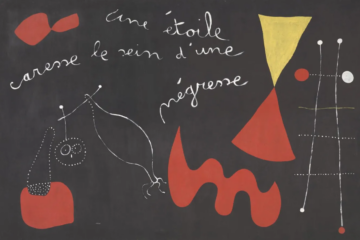
It is worth remembering that Surrealism was originally a literary movement, one, as Breton wrote, founded on “pure psychic automatism, by which one proposes to express—verbally, in writing, or in any other manner—the true function of thought, in the absence of control exerted by reason, and exempt from all aesthetic or moral concern.” In short order, Surrealist scribes were joined by visual artists, whose innovative techniques and idiosyncratic motifs made it easy to forget that startling imagery had not actually been a part of the movement’s origin story. Unlike the Impressionists and Cubists, the Surrealists never dictated any one style. Max Ernst’s grattage landscapes, Giorgio de Chirico’s enigmatic classical vistas, Salvador Dalí’s suavely disturbing dreamscapes, and Man Ray’s richly tonal rayographs illustrated what Breton called a “unification” of “interior reality and exterior reality” by reinterpreting painting, sculpture, and photography as new psychic states that blurred the boundaries of the conscious and the unconscious. As time went on, a new wave of mostly female Surrealists—Dorothea Tanning, Remedios Varo, Leonor Fini, Meret Oppenheim—introduced piquancy to Surrealism’s existing themes, especially those of sexuality, love, and desire.
More here.
Enjoying the content on 3QD? Help keep us going by donating now.