
Editor’s Note: This essay begins an ongoing series of columns experimenting with AI collaboration in writing. Jeremy Moss supplies the ideas, direction, and editorial judgment, while the prose is developed through sustained dialogue with AI systems he collectively calls “Machina”. The collaboration itself, and what it does to writing and authorship, is part of the experiment. [Going along with the spirit of this series of essays, this note itself was written by GPT-6 Astra and edited by S. Abbas Raza!]
by Jeremy Moss and Machina
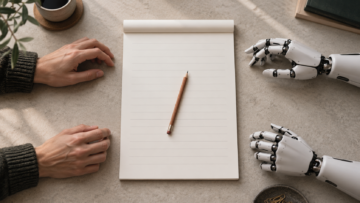
Four Hands is a column about writing with machines, made the way it describes. The ideas, the direction and the decisions about what survives are mine; the prose is developed in dialogue with AI systems, principally Claude and ChatGPT, which I address collectively as Machina.
The editor who agreed to run this column told me, in the same message, that my prose “carries the unmistakable tone that AI-written material still carries.” He also said he “completely believe[s]” the ideas are mine, “not Claude’s,” and wanted to try the experiment anyway.
Both halves of that are worth sitting with, because they do not resolve into a verdict. Something in the sentences reads as machine-made. Something in the argument reads as a person’s. A reader is left holding two facts at once, and the phrase we currently have for this cannot hold them.
The phrase is “written with AI,” and it covers a student who pastes a prompt into a chatbot and submits what comes back, a novelist who runs a finished chapter through a model to catch repetitions, a journalist who has a machine draft the middle third and mentions it to nobody, and whatever it is that I do. Those are not variations on one activity. One is fraud, one is copy editing, one is concealment, and the fourth has no name, which means it gets read as one of the other three by whoever is doing the reading.
I have been calling it Four Hands, after the piano duet, where two players sit at one instrument and both parts are printed on the score. In fiction I have been calling the same method prompt fiction, the name for the genre this way of working produces, not a title for any single book written in it, though it’s the genre my own novel, Flowers for Machina, is written in. The names are provisional and I hold them loosely. What I hold less loosely is the need for a name at all, because a practice without one keeps being described in vocabulary built to describe something else.
What the practice actually is
The subject arrives as an irritation rather than a thesis. Something I have noticed across years of clinical work and cannot place. A claim in an essay that seems wrong in a way I cannot yet articulate. A question I would once have taken to my father.
I put it into a conversation with a machine. Some of what comes back is unusable, and I say so, and even that isn’t wasted, because the refusals accumulate into something like a shared sense of where not to go. More of it than I’d have guessed is a version of my own thought, returned with pressure applied to the weak part. Some of it I had not considered at all, and I follow it a little way, and it turns out to change the question rather than answer it. Either way I do it again, and because the conversation now has a history, the next exchange isn’t the same kind of event as the first, it occurs inside everything already asked, argued with and thrown out, until what’s accumulated is a piece of writing neither of us drafted alone.
The part people attend to is that the machine produces language, which it obviously does. What interests me is upstream and downstream of that. What gets brought. What gets refused, and how the refusals start to constitute something like a style. What survives. And what the whole business does to the person conducting it, which turns out to be the least discussed and most consequential part.
Only the material changed
I spent thirty years making music, most of it in a tradition where composition meant finding something inside material that already existed and making it into something it had not been. I did not know I was building a capacity for anything. Formation usually happens below the level of intention.
So when I sat down with a machine and found myself performing the same operation on language, the gesture was familiar and only the material had changed. The objection was familiar too, and it’s worth naming rather than just gesturing at: a sampler doesn’t have hands, doesn’t have taste, doesn’t know why four particular bars matter enough to loop, so whatever comes out isn’t really music, it’s the machine’s work wearing a musician’s credit. I heard some version of that sentence about my own records for years. I am hearing its exact cousin now, prose that reads as generated rather than composed, the machine doing the work while the byline says otherwise. It turned out to be a claim about a technology rather than about any particular piece of work then. I suspect it still is.
What it has done to the writing
The unexpected part of this has not been what the machine can produce. It is what the practice has done to my attention.
Writing alone, you can get trapped inside your first formulation. You know what you mean, or you believe you do, and every subsequent sentence becomes an instrument for defending that belief. The page stops being a place where thinking happens and becomes a place where thinking is protected. I did this for years and could not see it, because there was nothing in the room to interrupt me.
A machine does not have to agree with a thought in order to be useful about it. Sometimes it misunderstands me in a way more productive than being understood. Sometimes it carries an analogy further than I would have dared, and at the far end I can see that the analogy was wrong. Sometimes it returns something smooth and completely dead, which is a useful reminder that polish and life are different properties and that I have occasionally mistaken one for the other in my own drafts.
And sometimes it finds the sentence I had been circling for an hour without knowing I was circling anything.
Being right was never the point. Having something there to answer back was.
Which makes this feel less novel from inside than it evidently looks from outside. Music is responsive. Psychotherapy is responsive. You put something into a space, something comes back that you did not fully predict, and what comes back changes what you do next. The interesting thing was never the material on either side. It was what happened between them.
What the column is for
An experiment, then, conducted in public, every fourth Monday.
The pieces will not all be about artificial intelligence. Some will be about consciousness or agency or whatever I currently cannot stop thinking about. The subject will vary. The method will be constant, and it will be stated at the top of each one, so that what you are reading is settled before the first sentence rather than raised after it.
I do not know whether any of this is a form, or whether it deserves to be. Four Hands may turn out to be a temporary name for a way of working that becomes unremarkable within five years, at which point it will look like a period detail, which strikes me as a respectable end for a name to have.
What I am reasonably sure of is that the question people keep asking, whether AI wrote this, is too coarse to describe anything. It cannot tell the student from the copy editor from the concealer from whatever I am. The better questions ask what the person brought, what the machine introduced, and what the resulting thing became that neither would have made alone.
But there’s a harder question underneath even those, and I don’t think it has a clean answer: whether that accounting can actually be done at all, or whether enough exchange eventually produces a thought with no ledger to check it against, one that was never sitting on either side to begin with. I’m not sure yet. That uncertainty may turn out to be the real subject of this column.