
by Christopher Hall
Philosophers aren’t under the same obligations as scientists; they may come to a conclusion first and then work backwards through the argument. This may be because the alternative to a given conclusion is undesirable; Derek Parfit, for example, spent his career defending moral realism because, to him, the alternative was a relativism which meant that ethics didn’t really exist at all. There is a danger, of course, in arguing for what we want to be true instead of simply letting the argument take us where it will. But if the argument is ultimately sound, who cares what impulse originated it? I’m mentioning all of this because, as a very amateur philosopher, I’d like to believe that, even if I very much want something to be true, that doesn’t mean I’m always bound to create shaky arguments for why it is true.
So, one thing I’d like to be true is that AI will never achieve anything like human consciousness. Please note that this is not the same as the claim that AI already has achieved consciousness; that’s a claim that I think is pretty readily dismissed. Even if chatbots are by now easily capable of passing the Turning test, that merely demonstrates that we have no reliable method for determining the existence of consciousness anywhere other than through words and actions, which may be well generated without any conscious thought-process behind them. And I’m actually less threatened by the world-imperilling potential of a conscious AI (the world is already plenty imperilled by more imminent dangers) than I am with aesthetic concerns. I can reject all AI writing as slop at this point purely because it’s an exercise in mindless regurgitation. An AI isn’t thinking about the color red when it writes “the red dress,” and it most certainly isn’t thinking about more complex subjective experiences like “the red dress she wore that particular day in late autumn in Toronto.” Without this interiority as a basic reference point, the writings of AI are nothing more than the noodling of a p-zombie.
This position isn’t particularly novel or innovative. The problem, of course, is with that “never” – can I say with absolutely confidence that an AI will never have the interiority – the conscious basis of experience – that it takes to write great works of literary art? It’s at this point that my belief in the inherent limitations of AI clashes with some more basic intuitions about the nature of consciousness itself.
We may take it that consciousness is dependent on a certain arrangement of matter. Humans are conscious because our brains somehow produce this consciousness, and if the brain is disrupted or destroyed, that consciousness is either altered or, presumably, disappears. Other arrangements of matter, exclusive to biological beings, also produce forms of consciousness. I’m reasonably sure that my dog has at least a kind of consciousness, as it’s at least sometimes evident that there’s a “thought process” he’s going through. (I’ll stay away from the question of where those lower forms of consciousness end; are mosquitos conscious? Even cockroaches, apparently, can have friends…) But it takes a kind of human, or even just biological, chauvinism to believe that only particular biological arrangements of matter can ever produce consciousness. Why can’t a mechanical arrangement of matter, if sufficiently complex, end up being conscious? We can’t arbitrarily set up barrier where consciousness resides exclusively behind what evolution has produced in certain biological beings.
Thomas Nagel, in Mind and Cosmos: Why the Materialist Neo-Darwinian Conception of Nature Is Almost Certainly False, argues that the irreductibility of subjective experience to mere physical explanations means that we must understand that mental stuff co-evolves with physical stuff, even if it only manifests itself in the form of conscious minds at a late stage in the process. But there’s nothing to suggest that the long march of evolution is the only route to this manifestation. Of course, the ability to reason well enough to produce something like artificial intelligence is itself ultimately a product of evolution.
Of course, the “arrangement of matter” hypothesis doesn’t need to be taken as a given. If consciousness is, as panpsychists believe, a fundamental element in the universe, at least as fundamental as matter (if not more so) that still doesn’t get us away from the problem; in fact, it makes it worse. If consciousness is just “out there” then it is even more likely, to my mind, to be found in things that aren’t human. This doesn’t entail the idea that inanimate objects are conscious – I don’t think rocks think – but it does make it at least more probable, to my mind, that new and different arrangements of matter might bring complex, human-like consciousness into being. Unless we take a position we can’t really support with evidence – that evolution alone is capable of making conscious minds – then we are stuck with the possibility of other routes. The ineffability of subjectivity, and its lack of accessibility to empirical verification, is bringing us to a point where we need to start thinking about kludges like “benefit of the doubt:” it would, of course, be an ethical obligation to treat something as conscious if we have any reasonable suspicion that it might be so.
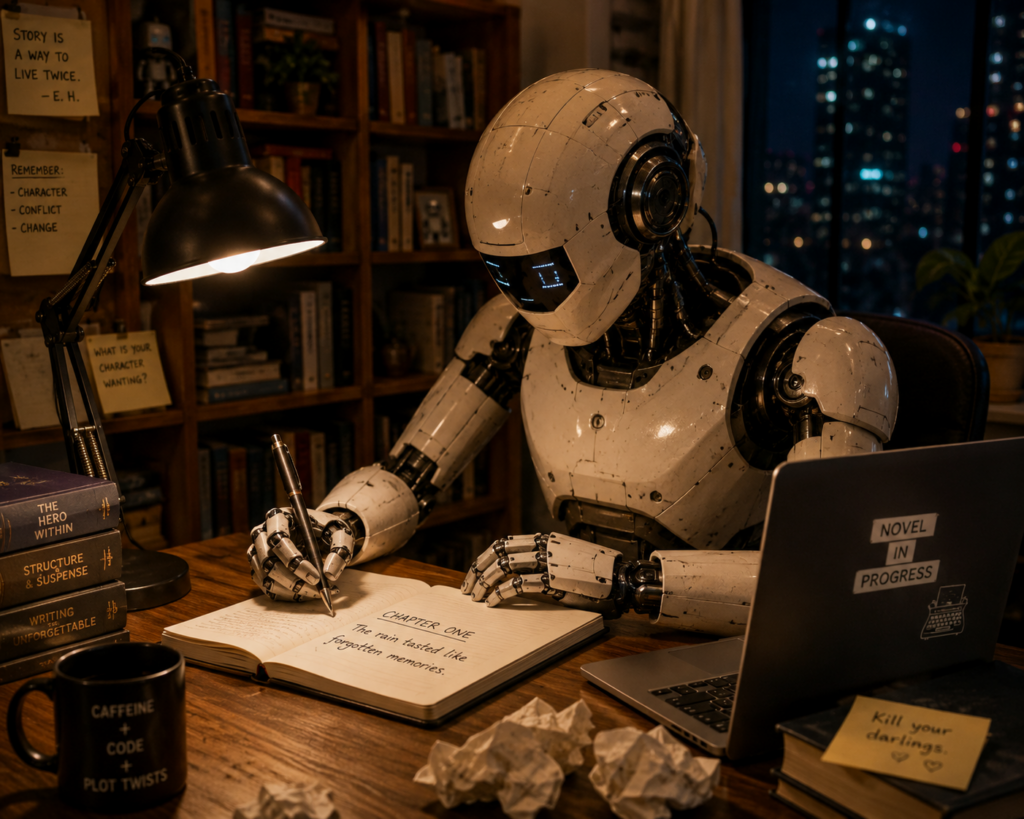
Here’s the real rub: I don’t think there’s any reason currently to take AI writing seriously. But I wonder if, within my lifetime, some robot might write a novel and whether I’ll dismiss it not because it did not emerge out of the robot’s interior, imaginative life but rather, simply, because it wasn’t written by a human. An obligation I think philosophers should labour under, even amateur ones, is to not argue oneself into atrocious positions, nor to make cruelties intellectually palatable. Will ignoring what future AIs have to say be an act of, essentially, bigotry, or merely the plausible defense of territory which is, and ought to be, the exclusive domain of human minds?
Enjoying the content on 3QD? Help keep us going by donating now.