
by Ken MacVey
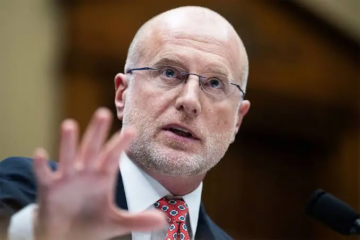
You may not have heard of Brendan Carr—he is not exactly famous but with time he is getting better known, and you are likely to hear more about him in the coming months. Officially, he is the chairman of the Federal Communications Commission, which licenses radio and television broadcast stations in the United States. Unofficially, he is becoming President Trump’s policeman on what these stations may convey and not convey about Trump and his administration.
On July 16, Trump gave his primetime speech on “election security,” which to no one’s surprise turned out to be about alleged election tampering and a push for his SAVE America Act bill to take effect before the November mid-term elections. That bill would overhaul the country’s voter registration system and restrict voting by mail. The bill is stalled in Congress. CBS carried Trump’s speech but ABC and NBC did not. The next day Trump publicly declared that ABC and NBC affiliate stations should lose their FCC broadcasting licenses because they did not broadcast his speech.
This is nothing new. Trump several times before has called out for taking away licenses of network affiliate broadcasters because he was upset with their news coverage, or more particularly, coverage of him and his administration. If any licenses are to be revoked or denied it would have to be through the FCC. By legislation the FCC has five commissioners. By statute no more than three commissioners may belong to the same political party. Currently there are three commissioners—two Republicans and one Democrat. Trump appointed Republican Carr as chairman in January 2025, who he also originally appointed to the FCC in 2017 after Carr had served as FCC general counsel.
The Communications Act of 1934–the governing statute for the FCC– provides that licensed broadcasters must serve the public interest as a condition of their license. The rationale for requiring licensing is that the radio and television broadcast spectrum must be geographically limited to a small number of broadcasters to avoid airwave interference with each other. Airwave broadcasting is a “natural oligopoly” in a way similar to how electric and other utilities are what economists and regulators call “natural monopolies.” Such monopolies, for example, are said to be necessary to prevent competing companies placing multiple parallel water pipelines or electric transmission lines in or on the same street when a single pipeline or transmission line would more efficiently serve customers. As natural monopolies, privately owned utilities must serve what is legally called “public convenience and necessity” and are accordingly regulated. Similarly, FCC broadcast licensees have a public interest requirement and are subject to FCC regulation.
In 1943 the National Broadcasting Company argued before the Supreme Court that this public interest requirement was only about technological broadcasting requirements. NBC was challenging the FCC’s consideration of antitrust factors in its license review and regulations. The Supreme Court rejected NBC’s narrow interpretation of the public interest requirement and found that antitrust concerns could be considered even though the FCC, unlike the Department of Justice or the Federal Trade Commission, did not directly enforce the antitrust laws. But the court also went out of its way to affirm that licenses could not be granted or denied based upon “political, economic, or social views.”
Section 326 of the Communications Act declares that the act should not “be understood to give the [Federal Communications] Commission the power of censorship” and the Commission shall not “interfere with the right of free speech.” The FCC’s own website currently states: “The FCC is barred by law from trying to prevent the broadcast of any point of view.”
For a while Carr as FCC commissioner gave lip service to the principle that the public interest requirement could not be used to police speech. In 2019 in a Twitter post, Carr as FCC commissioner stated in response to an op-ed by another commissioner calling for restrictions on e-cigarette advertising : “Should the government censor speech it doesn’t like? Of course not. The FCC does not have a roving mandate to police speech in the name of the ‘public interest.’”
In 2022, he posted on X (formerly known as Twitter): “Political satire is one of the oldest and most important forms of free speech. It challenges those in power while using humor to draw more people in to the discussion.”
Carr wrote the Heritage Foundation Project 2025 chapter on the FCC , which started by saying the FCC had the mission of promoting freedom of speech.
In December 2023 Carr posted on X: “Free speech is the counterweight—it is the check on government control. That is why censorship is the authoritarian’s dream.”
But circumstances changed and so did Carr. In September 2024, Trump called upon cancelling ABC affiliate licenses because of ABC’s role in moderating a presidential debate in September. In October 2024, Trump filed a lawsuit in federal court in Texas against CBS over a 60 Minutes interview with Kamala Harris when she was running against Trump. He alleged he was entitled to billions in damages under a Texas statute because CBS had edited Harris’ interview in a way that he said was misleading.
After winning the 2024 election, Trump appointed Carr chairman of the FCC and Carr assumed office as chair on January 20, 2025. Carr was busy for the rest of the month. On January 22, Carr stated in an interview that a key FCC focus would be “taking a look at media and making sure they live up to their public interest obligation.” In November 2024, the right-wing Center for American Rights filed complaints with the FCC that echoed Trump’s claims about ABC’s moderation of the presidential debate and Harris’ 60 Minutes interview. The FCC dismissed the complaints on First Amendment grounds. But in the week Carr became chair in 2025, the FCC reinstated the complaints. In that same week, in an appearance on Fox, Carr called upon CBS to release the transcript of the full Harris interview. CBS ultimately did submit the full, unedited interview transcript to the FCC, which the FCC then published on its website and thereupon placed the Center for American rights complaint against CBS on its docket for public comment on what it called a “news distortion complaint.”
On January 29, 2025, Carr sent a letter to PBS and NPR that opened by saying: “I am writing to inform you that I have asked the FCC’s Enforcement Bureau to open an investigation regarding the airing of NPR and PBS programming across your broadcast stations.” He claimed that their programming which identified major donors might violate FCC advertising rules. He added he would share his findings with Congress and volunteered he did not believe PBS and NPR should receive any federal funding.
Carr’s drumbeat carried on the rest of the year. Perhaps most famously, in September 2025 Carr took on Jimmy Kimmel for comments on his late-night show about Charlie Kirk’s alleged killer being in the right-wing camp, which had initially been reported in media. Kimmel comments triggered outrage in certain circles. Carr in a podcast interview commented: “We can do this the easy way or the hard way. These companies can find ways to change conduct and, frankly, take action on Kimmel or, you know, there’s going to be additional work for the FCC ahead.” As will be discussed, this comment was cited in a Supreme Court justice’s opinion in July.
In response to the furor, ABC suspended Kimmel. A journalist queried Carr what his reaction was. Carr responded by transmitting a GIF taken from the tv show The Office featuring two of the show’s characters wildly celebrating. Carr’s and others’reaction to Kimmel help trigger public furor about Kimmel being suspended. ABC ultimately reinstated Kimmel.
Carr’s campaign continued into 2026. After Trump launched military strikes on Iran in March 2026, Carr forwarded Trump’s post on Truth Social complaining about what Trump called “an intentionally misleading headline by the Fake News Media” regarding Iran’s counterattack on a base in Saudi Arabia. Carr posted on top of the forwarded Trump post: “Broadcasters that are running hoaxes and news distortions—also known as the fake news—have a chance now to correct course before their license renewals come up. The law is clear. Broadcasters must operate in the public interest, and they will lose their licenses if they do not.”
Even Senator Ted Cruz expressed alarm about Carr’s threat.
As FCC chair, Carr publicly raised the question whether network late night and day-time entertainment shows violate FCC equal time rules when they interview political candidates. Carr also suggested it might be worthwhile for the FCC to investigate ABC’s show, The View. In February 2026 the FCC did precisely that and initiated an investigation when the show interviewed Texan Senate candidate James Talarico. When ordered by the FCC to explain its position on whether equal time requirements applied to the show, ABC filed a response with the FCC in May to declare the show remains exempt from these requiretments. The FCC determined in 2002 that The View is a legitimate news organization and thus exempt from the equal time requirements under the Communications Act, which would otherwise require other candidates equal time when a candidate is given broadcast time. Paul Clement—a conservative and high-profile Supreme Court practitioner—is representing ABC (which is owned by Disney) and contends the FCC’s inquiry violates the First Amendment. This proceeding is still pending.
In Apri 2026, after Trump said ABC should fire Jimmy Kimmel for making a joke on his show about Trump’s wife Melania, the FCC accelerated license review of Walt Disney/ ABC’s eight affiliate broadcast stations. The review for license renewal was originally scheduled for 2028. Commentators said such accelerated review is virtually unprecedented. All filings in the licensing review proceeding are to be completed by early August. The review was supposedly originally triggered because of ABC’s diversity, equity and inclusion policies. Now there may be an additional target. Carr publicly stated that the fact ABC did not broadcast Trump’s July 16 speech on “election security” may factor in on the FCC’s licensing renewal decision.
In late July, ABC filed with the FCC a 100 page “guns blazing” brief in response to the FCC license review essentially accusing the FCC of aspiring to become America’s political censor. The brief said there have been 140,000 comments voicing opposition to FCC’s accelerated licensed review and threatened denial. ABC’s brief received media attention including coverage by the NY Times. Carr immediately afterwards did a video interview with Politco, which is posted on its website. In that interview Carr acknowledged he had previously made pro- free speech comments but said they applied to unlicensed broadcasters, such as cable, and distinguished them from broadcasters which by their licenses have public interest obligations. He acknowledged that the FCC to date has not taken any similar actions with respect to right wing broadcasters, such as affiliates of Sinclair Broadcast Group. He was also self-congratulatory about what he called the FCC’s current “libertarian style of regulation.”
The FCC is currently facing free speech challenges on other fronts. Shortly before Carr became chairman, a group of former FCC commissioners and officials (mostly Republican) filed a petition with the FCC to revoke the FCC’s “news distortion policy.” This written policy, which asserted distorted news reporting could be a basis for FCC regulatory action, dates back to 1949 but had largely been dormant. Despite the petitioners’ claims that the policy violates the First Amendment and weaponizes the FCC to silence political criticism, Carr as chair declared the FCC would not repeal the policy. In April 2026 the group filed a lawsuit in federal court to force the FCC to act on the petition, which was languishing. In June when the FCC’s response in court was due, FCC staff dismissed the petition and the FCC claimed in its court filing this dismissal made the matter moot and stripped the court of jurisdiction –a claim which the group heatedly disputes. As of this writing, the court has not issued a ruling.
Another high profile Carr initiative is a proposal to revoke FCC’s cap that prohibits a single owner from having interests in television stations that cover more than 39% of the nation’s television audience. In May FCC staff released a proposal that would revoke the cap and replace it with case-by-case basis review. The cap was imposed by Congress and critics contend any revocation would be illegal. FCC Commissioner Anna Gomez, the only Democrat among the three current commissioners, stated in a press release: “This unlawful effort to hand control of the public airwaves to billionaire buddies of this administration will destroy local newsrooms, silence community reporting, and drive-up costs for the American families who depend on local stations for news and emergency alerts.” This proposal is scheduled for a commission vote in August.
In July the Supreme Court issued its decisions on Trump’s attempted firing of a Democratic Federal Reserve Board governor and of a Democratic Federal Trade Commission commissioner. In Trump v. Slaughter the court ruled that Trump as president could not fire Federal Reserve governor Slaughter because of the unique and critical role the Federal Reserve historically has played in the American economy. But in Trump v. Cook the court upheld Trump’s firing FTC commissioner Cook. This latter decision endorsed what has been called the unitary theory of presidential and executive power and found the Congressional restrictions on the president’s ability to fire FTC commissioners violated the Constitution’s requirement of separation of powers between the legislative and executive branches. (Yes, it is a challenge to reconcile Trump v. Slaughter and Trump v. Cook with each other.)
Where does Carr now stand with this decision? Unless it is found that the FCC is somehow more akin to the Federal Reserve than the FTC, Trump probably has the power to fire any FCC commissioner at any time for any reason, including Carr. The implications of the Supreme Court’s decision allowing Trump to fire an FTC commissioner without cause is that generally independent regulatory agencies and their commissioners are now to be considered part of the executive branch and subject to the president’s command.
Justice Gorsuch in a concurring opinion in the FTC decision raised this question: “Would Congress have delegated so much power . . . to independent agencies had it known that the President would control them?” He argued that independent agencies had been wielding power “hardly with any statutory guidance”and that these agencies have not “hesitated to employ the powers Congress has given them.” Gorsuch then recited what appeared to him to be a parade of horribles involving these agencies. He concluded with this horrible: “And then there’s late night comedy. Last year, taking objection to a network host’s on-air remarks, the Chairman of the FCC suggested there would be ‘additional work . . . ahead’ for the agency if broadcasting companies did not find ways . . . to take action. . . We can do this this the easy way or the hard way.’”
As a result of the Supreme Court’s FTC decision, Carr—who already can be fairly described as a Trump “suckophant”– may even be more beholden to a president bent on going after those who dare to criticize or lampoon him. The Supreme Court has decided to dramatically expand presidential power during these most periolous times that have showcased abuse of this power. But Justice Gorsuch’s reference to Carr should also be a warning to Carr. Careening for a head on collision with the First Amendment may mean ending up being part of the legal wreckage too. Courts, in recent rulings against the FTC for violating political speech rights of nonprofit Media Matters and against the Department of Justice for subpoenaing New York Times journalists regarding their reporting, means the First Amendment–at least today—is still vibrant, still standing as a fortress of freedom. As we get closer to the November midterm elections, we will see how far Carr is willing to go in trying to run over the freedom of speech he once acclaimed and how far courts will be willing to go to stop him.