
by Carlota Figueroa
Actually, I can bet you another $5 that when you read the title of this article you thought that I was crazy and that there is no universe in which these two things can be the same. After all, you’d probably tell me that one is a stylish piece of clothing and the other is a kitchenware article that holds the magic potion to wake you up in the morning — definitely not the same thing. And you would be right. Well, partially right. But let me ask you just one thing: how do we define the word same? If we use every normal person’s definition of same as “resembling in every relevant respect,” (maybe you’re a normal person and you’d use a different definition, but this is Merriam-Webster’s so I’ll take it as a good point of reference) then yes, you win: a skirt does not resemble a coffee cup in every relevant respect. It’s not even a close call. However, if we use many mathematicians’ definition of same as “homeomorphic to one another”, then I’m sorry to tell you, but you owe me $5.
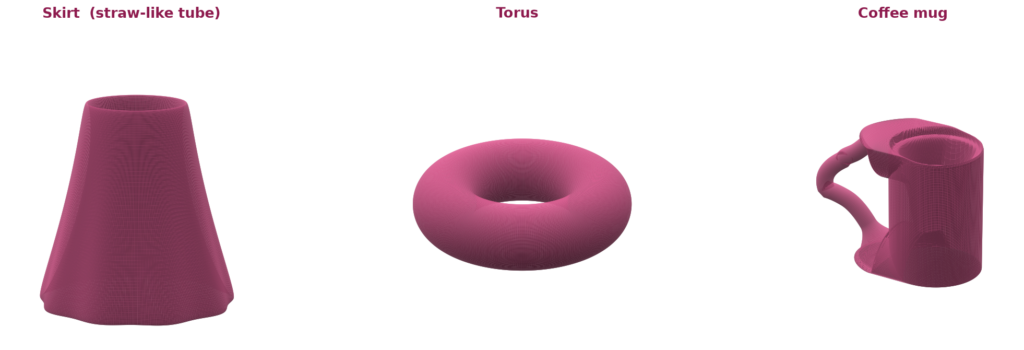
Now, unless you have some background in mathematics or physics, the adjective “homeomorphic” probably sounds rather made up. What does it mean for two spaces to be homeomorphic to one another? It means that there exists a homeomorphism between them. I know, way to go, using the word to define itself. The truth is, in mathematics, a homeomorphism is one of the most important and magical functions there is. In technical terms, a homeomorphism is a bijective and continuous function between topological spaces that has a continuous inverse function. Don’t panic, we will break down this sentence so you can get the full essence of what a homeomorphism is.
Think back to your last Calculus class — you must have heard about functions, even if you don’t remember. One of the most famous examples (and that actually comes in pretty handy for this) is our friend the quadratic function: f(x) = x^2. Before continuing, we need to talk a little bit about where our functions are defined, because this can completely change the properties that it exhibits. For now, we consider our friend f(x) to be defined as a function from ℝ —> ℝ. So, only real numbers can be used as inputs, and we can only get real numbers as outputs. We could change our domain, and open our arms to our imaginary friends and take our inputs in ℂ so we could feed our function the square root of -1 (this is i!). We could also restrict ourselves to a smaller set than ℝ: if we only considered the set of rational numbers as our domain, we would no longer be able to feed our function things such as the square root of 2. All in all, changing the domain of our function can completely change its properties, so defining it is an important first step. Now, let’s get back to our example.
For every value of x, you get a unique value of f(x), meaning that this correspondence is well-defined, and our friend f(x) is actually a function. However, it is neither injective nor surjective. For a function to be injective, there must be a one-to-one relationship between the values of x and those for f(x) meaning that if I stick different inputs into the function, it should always give me different outputs. Our quadratic is very problematic in this regard: what is 2^2? 4. What is (-2)^2? Also 4. Two different values of x give the same value of f(x) and injectivity fails. If f(x) were surjective, for every value of y in the codomain of the function (meaning, the set where the possible outputs live, so this is ℝ in our case), we should have a value of x such that f(x)=y. Now, try to think of a real number that, when squared, gives -1. In fact, try to think of any real number that when multiplied by itself, it gives a negative number. Exactly, they don’t exist. That is actually one of the defining properties of imaginary numbers: when squared, they give a negative number. So our favourite function f(x)=x^2 as we have defined it is not bijective since it isn’t injective nor surjective. I hope the concept of bijectivity is clearer now, let us move on to continuity. If you want to think about any of these concepts for a little bit longer, I have included a list at the end of this article with a series of functions and their properties so you can ponder for a bit if your heart desires.
The easiest way to define a continuous function is “you can draw it without lifting your pencil from the paper”. There are no gaps, no holes and everything is smooth. I really hope my first year Real Analysis professors aren’t reading this right now, because they would surely have a heart attack. The truth is that continuity is a very sensitive topic in mathematics and there are different definitions depending on the type of continuity you are considering: a Lipschitz function exhibits characteristics that absolutely continuous or uniformly continuous functions don’t — and yet they’re all “continuous”. Since this is a Pandora’s box I don’t want to open at the moment, we will stick to our intuitive idea. The most important thing is that a continuous function lacks discontinuities (duh), so there are no abrupt changes in value: you cannot have a function equal to 2 and then have its value shoot up to infinity at the very next point.
We are nearly done defining what a homeomorphism is. Before talking about topological spaces, I will make some comments about the concept of inverse functions. We now know that if we plug a value of x into our f(x) we get some value of y. Let us ask ourselves the opposite question: can we define a function f^(-1)(y) that maps all of our values of y to their corresponding values of x? If f(x) is bijective, this inverse function is always well-defined. On top of this, if our function is continuous and is defined on the whole real line (or an interval of it), then this inverse function is also continuous. Always. This relationship breaks down when we consider maps between different sets. For example, when we bring in the complex numbers, we no longer have a sense of order. When we consider the real numbers, we can always say whether a number is greater or smaller than another one. However, with the complex numbers, we lose this sense of order (I won’t go into more detail but the problem arises when we multiply, this great short article explains it better than I could). Don’t worry about this too much though, as I said, the important thing is that the general idea sticks with you.
Finally, topological spaces. We are nearly at the finish line. Well, or the start line, that depends on your perspective — all of this work just to define a mathematical object so that I can win $5. Maybe it wasn’t worth it, but we are too far in to give up now. A topological space is the most general standard mathematical space that you can have which allows for definitions of compactness, continuity and connectedness. They are sets, whose elements are called points, equipped with a topology which (roughly) establishes how the points spatially relate to one another. Imagine you suddenly become the undisputed leader of the entire world and are tasked with redefining countries and nationalities. You decide to build the populations of these countries based on the qualities of their inhabitants. Those with the most basic skill set go on to live in a topological space. As others specialise and develop their skills, they are granted other nationalities, and start moving up to metric spaces or normed spaces. The most intelligent and advanced humans are granted the honour of living in a Banach space. What we call these spaces isn’t particularly important, but we need to remember that people only move “up” a nationality as they develop better abilities than their previous nationality: they can always do more than the countries below them and less than the countries above them. However, you aren’t content with just making new pretty passports: you want to completely define how humans build relationships with each other. So, you add a topology. You start building neighbourhoods (fun fact: neighbourhoods are actually a huge part of how topologies are defined) and grouping people into them. By deciding whose houses are open and closed, you are defining your country’s topology. Furthermore, as you choose when people can get from one house to another, when someone’s walk might be suddenly broken up because they are about to step into a different country for which they don’t hold a visa, and which countries can be protected with a finite number of neighbourhood-watches, you are also determining the connectedness, continuity and compactness of each country. Just like that, you have reorganised the world and endowed it with a structure very similar to that of a topological space.
Okay, preliminaries are finally over, we know what it means for a function to be a homeomorphism — but what does all of this have to do with coffee mugs and skirts? Well, both my favourite skirt and your favourite coffee cup are homeomorphic to a torus (in simple English, a donut). Hence, they are homeomorphic to each other. This entails that we can define a homeomorphism that takes us from one object to the other. Picture them in your mind, you can deform the skirt into a donut by flattening it down, then turn the donut around and stretch part of it into the shape of a mug, all while obeying the definition we have just explained. The hole my legs went through is now the hole of the handle of the coffee cup. You can just as easily move back from the cup to the skirt! I have made a handy video which, hopefully, lets you visualise this better (although I must warn you, despite the best of my efforts, it isn’t very aesthetically pleasing). The most important thing is that all of these changes can be made without making any cuts, any new holes, without breaking anything and with the possibility of undoing them — that’s the true nature of a homeomorphism.
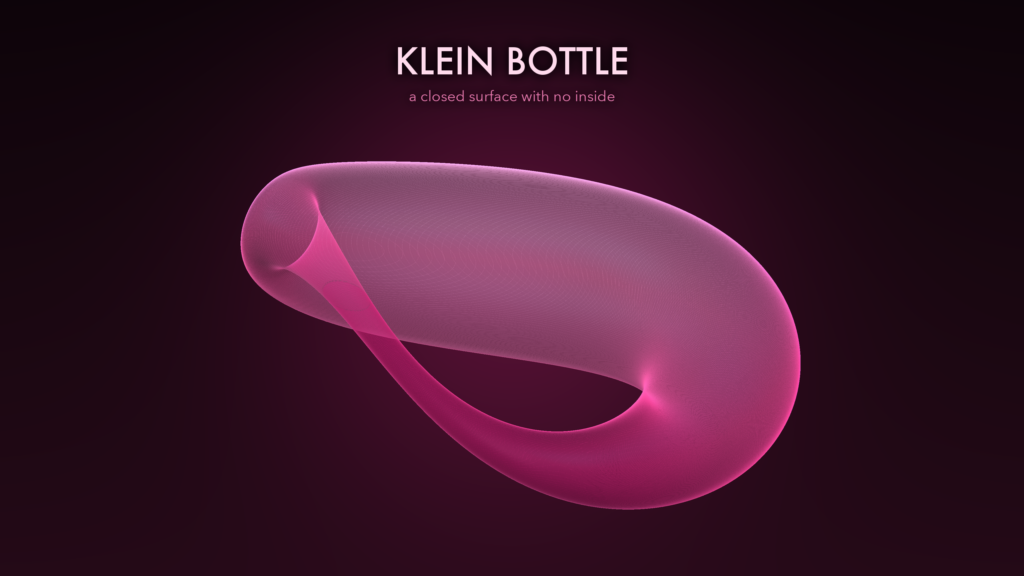
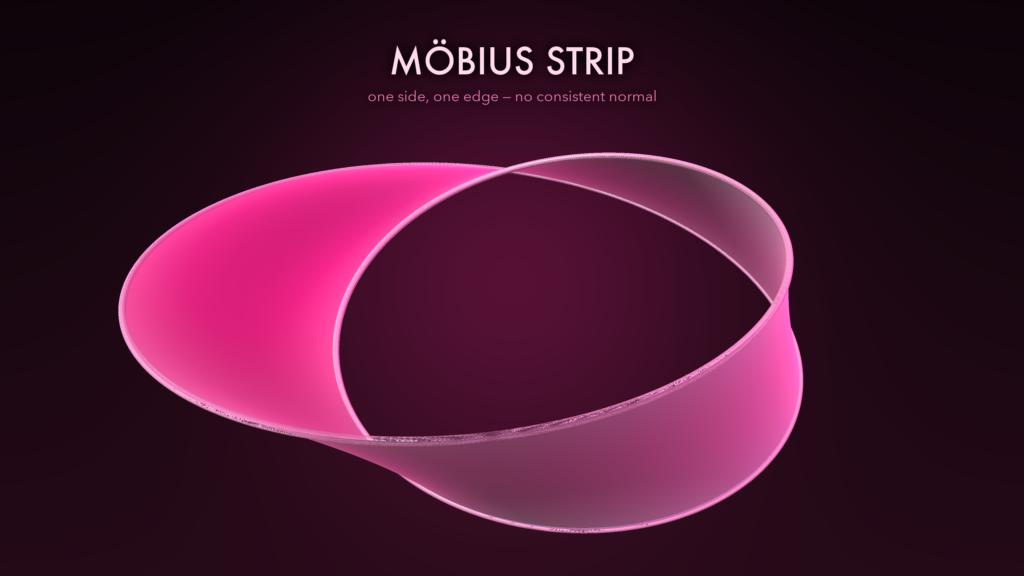
In fact, this is one of the most celebrated results of low-dimensional topology: all orientable solids of the same genus are homeomorphic to each other. Yes, more weird words, but these are easier to explain and illustrate. First of all, the word genus is just fancy for “how many holes does this solid have”. In particular, the mug, the torus and the skirt each have one hole, so they have the same genus. Next, a solid is orientable if you can define a consistent direction as “up” or “outwards” along its surface. Think of the coffee cup and place an outwards-pointing arrow along its surface. Now make it rotate around the cup. Nothing strange happens — the arrow stays pointing out and everything is fine. This is because a coffee cup is an orientable solid — as are the skirt and the torus. In fact, nearly all of the objects you can think of are orientable. This is the point where I have to admit that, as mathematicians, we tend to be a bit nitpicky and we like to come up with bogus constructions that have absolutely no use in real life but to us are beautiful because they show how you cannot take an object’s properties for granted. In the case of non-orientable surfaces, we have the Möbius strip and the Klein bottle. I have linked some nice animations to help you see why they are non-orientable. However, as far as daily life goes, pretty much every single object around you that has a non-negligible thickness is an orientable solid, so we don’t have to worry about these theoretical constructions.
To summarise, we have essentially demonstrated how any object that can be moulded with clay can be deformed, without making any breaks, into any other object with the same number of holes. You can now go out into the world and start looking for things with the same number of holes and reflecting on how you can morph them into each other. In my humble opinion, this makes for a pretty cool party trick. The truth is we started going down this rabbit hole because I didn’t want to accept the standard English-dictionary definition for “same”: linguistics plays a much bigger role in mathematics than many may imagine at first. Thanks to these subtle definitions, we can come up with incredible ways to study the world around us and concoct ways to turn a skirt into a coffee cup. So if something sticks with you from this article, let it be the fact that definitions matter and that the objects we use every day might be much more similar to one another than you might initially expect. Well, that, and the fact that you owe me $5.
FUNCTION EXAMPLE LIST
- f: ℂ—> ℂ, f(x)=x^2 is continuous and surjective, but not injective.
- f: ℕ—> ℕ, f(n)=2n is injective, but not surjective (ℕ denotes the set of natural numbers, meaning only positive integers: no negative numbers and no decimals. Easter egg if you got this far: if you’re wondering about my opinion on this long-standing debate, then no, 0 is NOT a natural number and this is a hill I will die on).
- f: ℝ —> ℝ, f(x)=x is continuous, surjective AND injective — so it is also bijective!
- f: ℝ —> ℝ, f(x)=1/x and f(0)=0 is bijective but not continuous (1/x actually shoots up to infinity as x tends to 0 from the right, so there is a big jump in the value of the function at 0 when we approach it from the left and from the right).
- f: [0,1) —> unit circle in ℂ, f(t)=e^(2𝜋it) has a perfectly well-defined inverse but this inverse is not continuous.
AI DISCLAIMER: The 3D models and videos were created using Python. Claude Opus 5 Max and Opus 4.8 Ultracode were both used to generate the code.
Enjoying the content on 3QD? Help keep us going by donating now.