
by Anton Cebalo
It goes without saying that one can talk oneself into problems. Your own stories become pathological like a slow drip eroding your senses. And you may find yourself circling a narrative so many times over that language starts to fail. What’s left then is just feeling. Exhaustion with it all gives way to resentment and anxiety as many morbid symptoms appear. This used to be called “neurosis.”
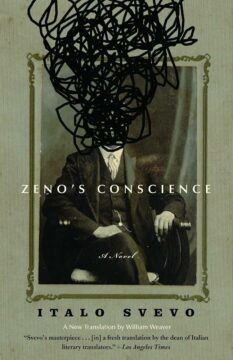 Zeno’s Conscience (1923) by Italo Svevo is the story of one such man suffering from talking too much (to himself). Zeno is a person with deep interiority, long meandering monologues, and feeling. However, despite his never-ending rhetorical skills and eccentricity—having gone through the tunnels of his mind many times over—he ironically enough lacks a conscience. He fails in health, in love, in his addictions, and in business. Rumination and ceaseless inner conversation do not produce moral clarity for Zeno. Instead, his often-comical interior life is insidious because his obsession with sentimentality and grand justifications prevents his self-actualization. And so, he lacks a real moral center. However, he does not fail to be incredibly entertaining as a personality.
World War I enters the story in the last section of the novel, largely as an afterthought and an inconvenience to his lifestyle. The whole time, the catastrophe slowly forming outside is ignored because the obsession is instead inward. The book is intended for his psychotherapist, who publishes his words to spite Zeno because he stopped meeting him. Even the supposed doctor is obsessed with petty grudges.
The novel is in conversation with the general social environment of Europe then. High-speed rotary presses and new typesetting machines made print media ultra-accessible and cheap, and for the first time there was a mass public to enjoy it. In just Germany alone, thousands of newspapers printed some 14 million copies per day by 1912. In England, The Daily Mail was the first publication to sell a million copies daily as early as 1896. And in France, daily press circulation reached around 5 million per day by 1910.
The result was a collapse of meaning, not more of it. Many felt they were trapped in their heads. In The Chandos Letter (1902), Hugo von Hofmannstahl fictionally writes of a man (Lord Chandos) describing a world where language fails him:
For me, everything disintegrated into parts, those parts again into parts; no longer would anything let itself be encompassed by one idea.
Single words floated round me; they congealed into eyes which stared at me and into which I was forced to stare back – whirlpools which gave me vertigo and, reeling incessantly, led into the void.
In the decades before World War I, Europe might as well have ‘talked itself into a catastrophe.’ As we, too, live in a time flooded by narratives and discourse, we risk finding ourselves like Zeno—exhausted by it all, receding into our inner lives, and making the world into just a passive ornament: “If only the world understood my ‘true intentions and difficulties,’ then all would be well.”