
by Philip Graham
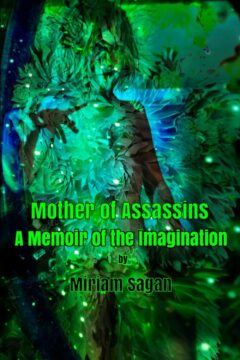 In December of 2025, Miriam Sagan published a stunning merger of memoir and fantasy fiction, Mother of Assassins: A Memoir of the Imagination. In a conversational prose that is deceptively simple, this short book weaves together what is remembered and what is imagined with such uncanny glue that at times they can’t easily be distinguished from each other. I’ve read Mother of Assassins twice now, and look forward to another return to its subtleties and pleasures.
My conversation with Miriam Sagan began with a discussion of Mother of Assassins, but soon enough we delved into some of her earlier work, and we found intriguing connections between her newest book and her extensive oeuvre of poetry, memoir, and fiction. Then we spoke of how this oeuvre has been built: over forty books created, thanks to her singular approach to a writing career. Rather than overly worrying about the world discovering her writing (thereby avoiding the often exhausting trap of self-promotion), Sagan has focused her main concern on discovering the world and herself through the simple act of writing, quietly producing a steady flow of book after book after book.
*
Philip Graham: The first chapter of Mother of Assassins begins with Layla, an old woman recounting her long life that began in the exotic Blue City. The second chapter begins with you, Miriam, declaring that you invented the Blue City when a child, though you’ve neglected it for over fifty years. In the wake of an alarming medical diagnosis, you allow yourself to return to that imagined world and discover it has continued to exist. Its characters live their lives without you. And this is where the subtitle of your book kicks in: A Memoir of the Imagination.
Miriam Sagan: We often hear writers say that their characters take on a life of their own. This can be confusing to readers and the writer too—as in “who’s in charge here?” But for me writing a book can be like living in an ongoing dream. And it isn’t a lucid dream. I don’t feel like I’m controlling the initial action at all times. How can this be? I feel like it asks an essentially unanswerable question—where does the creative impulse to make a narrative come from? I most usually find it in a half conscious state, a consciousness that lies between sleep and waking. In the past few years I tried to “work” that slippery state, or at least be aware of it. I was writing poems from a hypnagogic mind, and the Blue City seems to be there too, located on an initially private map.
PG: So it’s not surprising that Miriam (you, and the Miriam of your book), while contending with a series of disappointing medical professionals, would want to repossess some long ago and once idyllic real estate. The Blue City’s Layla, however, is having none of this:
Layla: Complain all you want like any old woman. But I do exist without you. And maybe I’ll outlive you.
Miriam: Not unless I write it down.
MS: I do wonder if other people, artists in particular, have a similar inner ongoing landscape. However, I did do some fictionalizing. The magical Blue City in the book is not identical with my childhood imaginings, which were more derivative, particularly of Tolkien and children’s authors like George McDonald and E. Nesbit. One of my early readers was disappointed to discover that I made up a lot of the Blue City while I was writing it, as opposed to remembering its earlier incarnations. But why not? It appeared in the process of writing itself, which is also a kind of waking dream. The tension and downright hostility between the character Layla, who is the primary heroine of the narrative, and the character Miriam (who is just me, the author gone third person) is my favorite thing in the book. I enjoyed writing it a lot. It breaks the illusion of fiction, which is fun as well. I’ve been accused of being bossy in real life, and I let the characters accuse me of the same thing.
PG: Well, the Blue City has changed during your long absence in ways you couldn’t have predicted when you were a child. Yet while Layla is now an old woman recounting the events of her life, you are behind her, writing these memories of the character of Layla. And she surprises you, as characters often do. Layla, for example, needs to escape from the Blue City. It appears that she has crossed the mysterious powers-that-be of the Motherhouse, the city’s school for assassins. Soon we have left your childhood imaginings far behind!
MS: I like your understanding that fictional places have a life of their own! In Mother of Assassins there is the Blue City, which includes the ominous boarding school the Motherhouse, and a kind of twin to it, the Pleasure Grounds for retired assassins. In a homage to classic Swords and Sorcery plotting, heroine Layla also takes a short sea voyage to a kind of Steampunk setting. There is a little joke with myself there. Layla has a brief love affair with the ship’s doctor. It doesn’t move the plot along and it annoys Miriam-the-author. But it’s there because it seems like in every swashbuckling tale the assassin must have an affair with the ship’s doctor (and for this of course there must be a ship!). Then the city of Saffron, which gave me a lot of trouble. In early drafts it just seemed like a low-rent version of the Blue City. However, in my “real” life I went to Las Vegas, Nevada and saw two Cirque de Soleil performances and looking up at the trapeze artists I suddenly got a better idea for Saffron, as inside a kind of magical tent.
Then Layla has to run from Saffron, and so I got to indulge one of my all time favorite tropes—woman running from scary vengeful lover. (In this case it’s her wife, who is also an assassin). I’ve often thought about how I’d disappear if I had to, and Layla is successful. The Arctic town is based on Iceland, where I’ve been twice and continue to love. Then there is the polar ice, out of my imagination but also a nod to the ending of Mary Shelley’s Frankenstein. When I say a nod, I mean not in a literary sense but more in the way that the novel totally captured me when I was young, and has never let go.
Almost all of the magic in Mother of Assassins is about place. There are no magical objects, and barely anyone with supernatural powers. No talking animals. No time travel. Just the places.
PG: I love this: that the magic is expressed through your book’s locations. They are so vividly realized. How fitting, that an earlier version of yourself found a place of her own she could imagine, and now one of its inhabitants explores the surrounding territory. Her traveling and your imagining go hand-in-hand.
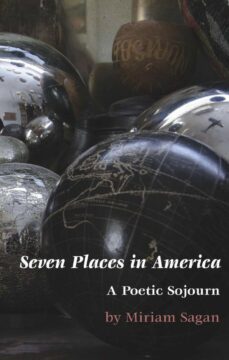 You’ve written an entire book about the magic of place: Seven Places in America: A Poetic Sojourn. It’s wonderful. You have a knack of selecting writing residencies that are parked in unusual locales: the Everglades, the Petrified Forest, and an old growth forest in the Cascades of Oregon. You don’t search out these sites so you can write with a pretty background. They are the point of the writing. Seven Places in America has a lovely structure. Each chapter begins with a brief prose section, offering a narrative of your visit, which is then followed by some of the poetry you wrote while there, the poems almost always about your surroundings. I’m wondering if your circling around a place in observation and imagination might have been influenced by your long-ago building of the Blue City when you were a child.
MS: Thanks for tying these two strands together. The sites in Seven Places in America were all about borderlines, boundaries, and what earthworks artist Robert Smithson calls the meeting of “the suburban and the wild.” This was certainly part of my childhood, and Smithson, like me, was raised in New Jersey where salt marshes and factories exist in the same place. I went on to two residencies with Center for Land Use Interpretation—living briefly in an odd trailer in Great Basin at the edge of a bombing range. This was a real confrontation with destruction, and the Blue City pulls from experiences of both beauty and disaster. All of this is an exchange with place, between words and site.
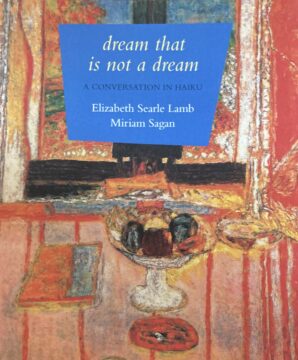 PG: An exchange between words and site! This brings me to another continuing aspect of your writing that I’ve noticed in some of your other books: a real spirit of collaboration. One of my favorites is a slim volume of poetry: dream that is not a dream: a conversation in haiku, which is an unusual conversation between you and the American haiku poet Elizabeth Searle Lamb, a friend and mentor. There’s such a moving story connected to this. When Lamb died you helped her daughter Carolyn clean out her mom’s study, and in doing so, you both discovered mostly uncollected haiku by your mentor on little hidden slips of paper—not only in the study, but eventually throughout the house. What a touching treasure hunt.
You decided to collect them, and on each page of this beautiful little book you feature one of Lamb’s haiku with one of your own, and in doing so you found a lovely way to have one last dialogue with your friend. One of my favorite pairings:
sound of rain
letting the teacup warm
my hands
ESL
tiny teapot
exact size, shape, color
of a tangerine
MS
An extended conversation across the gulf of death, a kind of sweet afterlife for a friend! I’d love to hear more about how Lamb’s poetry inspired some of your haiku responses.
MS: Several of the haiku exchanges came out of real life experiences with Elizabeth. We lived just a few miles apart, and I saw her frequently. Once I came by to pick her up for lunch and found her looking surprisingly dressed up. She was a shy person who hated making phone calls and had dressed up to talk to the bank—on the phone! Her haiku expresses this perfectly. She also always sent a thank you note after every visit—sometimes a postcard, sometimes a fancy card. Once I wrote her back with a very nice Japanese card. And then she thanked me again! The exchange could go on until we met again. So the pairing below represents these different experiences of communication. Actually they are senryu—a humorous version of haiku often with more human world emphasis.
before I make
the important phone call
fresh lipstick
ESL
a thank you note
for a thank you note—
Shinto gate postcard
MS
One evening I brought take-out over to Elizabeth’s from a deli we both liked. As we were sitting at the table a kind of shock wave ran through the house. It wasn’t a sound but a sight—a brilliant full moon rising. I tried so many times to capture it, but I couldn’t. After Elizabeth’s death I found the haiku she must have written then and there—perfect. I finally got to write my response, inspired by hers.
suddenly full moon
rising through the window
we go on eating
ESL
it startled us
an unexpected guest—
full moon
MS
Elizabeth was a fine musician. She’d stopped playing the harp by the time I knew her, but the instrument still majestically graced her living room. I believe this one was written after her husband Bruce died, an implied elegy. My response came from her funeral. A harpist friend of hers played part of the Suite from Carmen. Like Elizabeth’s presence, her funeral was lively and cheerful.
the sharp ping
of a breaking harp string
the empty room
ESL
at the funeral
the harp suddenly
plays “Carmen”
MS
Once I asked Elizabeth for her haiku writing advice, as I was about to teach a class. “I do what I like,” she said. This was an unusual response about a form full of dozens of rules. I wrote it on the board, and still follow it to this day.
PG: That motto certainly explains the wide range of genres and projects you’ve taken on in your long writing life. And now, with your latest book, you’ve woven a novel and a memoir together, to the point where you as author try to arrange a tryst between Layla and your deceased first husband, hoping to get your character pregnant. And Layla is more than willing to have “a pleasant enough encounter with a dead, and now fictitious, man.”
MS: Writing Mother of Assassins was in some way a process of disinhibition. I had a scary cancer diagnosis, putting me in touch with my mortality. Time seemed to speed up and then slow down. Formerly when writing prose I started in a narrower lane—and wanted to. If I’d had the thought “my dead husband Robert would get my character pregnant” I’d probably have disguised it. That is, created a character like him, maybe with a similar name, and let the character step into action. But during this time boundaries really blurred for me—between memoir and fiction, between the living and the dead, and between me and “my” characters. It was quite frightening, but also exhilarating. In memoir writing I’d always struggled with what was “real” and with the accuracy of my memory. Now I felt that what came to mind was simply true, whether invented or not.
PG: On the subject of that alarming diagnosis, there’s an especially poignant moment in Mother of Assassins when you address your character Layla and say
“I shouldn’t be talking about this at all to you. What is it called in theater—breaking the fourth wall? Well, the Blue City has a lot of walls. Also, how can I break a wall if I’m the one who built it? I thought I’d simply discovered it—part of the dream world that is so much bigger than the waking one. But what if I made it up? Does it die with me? Have I been keeping it going all these years without realizing it? Is it starting to die because I am? Does my most probably terminal cancer allow marauders to shoot arrows at its ramparts and lay siege to its citizens?
“But I can’t stay alive just to keep an imaginary city going. Although I am trying, sitting here drinking my morning coffee and swallowing pill after pill.”
MS: I’m often aware of how any individual person contains many worlds. And those worlds do die with us, inevitably, even simply things like how we walk down a grocery store aisle or brush our teeth, let alone our secrets, hopes, and fears. I’ve had a complicated awareness of death as I almost died of swine flu in 1976 in the Beth Israel Hospital in Boston. I was in the ICU for a month and had a classic near-death experience without having any notion of what it was. This is described more in my memoir Bluebeard’s Castle. It is also touched on in Mother of Assassins, as I burden the character Layla with a similar experience. But the experience left me with a haunting unanswerable question—staying alive for what?
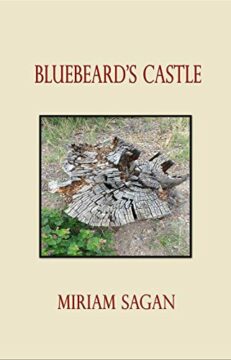 PG: I’d like to return to the subject of the entwined paths of memory and accuracy. Your memoir that serves as a portrait of your father, Bluebeard’s Castle, grapples with this unpredictable balance. What I especially admire about this book is how you strive to critically examine what you may have overemphasized in your memories of your father, and focus on other aspects of him that were there, waiting to be adequately remembered.
At one point you make a list of your dad’s, let’s say, deficits, and then you make a list of his more positive attributes, and to your surprise they are nearly equal in length. What is it that lurks in the past, positive or negative, that we cannot easily see? You seek out this often-unclaimed territory throughout Bluebeard’s Castle. I’m reminded of your lovely book of poetry about astronomy, Star Gazing, and this poem in particular:
After Image
dawn
over the great basin
turns earth colors
canyon striation: dark pink, pale red, orange
which burns to furnace
in my eye
accidental
retinal image
of explosion
floating
across eyelid
or blank page
as if I’d seen
something
I should never have
looked at directly
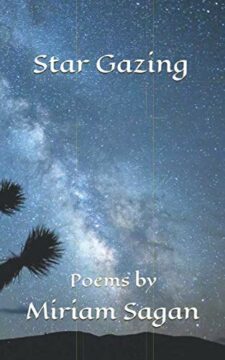
MS: I’m very touched that you understand about the relationship with my father. I was hoping to go beyond childhood idealization and adolescent/young adult negative truth-telling. The poem you note was written during the residency with Center for Land Use Interpretation. I was in Wendover, UT/Wendover NE (the main street being the border) for a week at a time, often completely alone. The only neighbors were squatters and dogs. For some reason the frightening and harsh environment led to many moments of transcendent beauty and connection. I doubt I could have stayed put if I hadn’t been writing poetry.
PG: Ah, so much traveling, and you make the most of it. I really admire how you and your husband Richard Feldman have taken extended road trips around the country seeking out sites of Outsider Art, which you’ve then posted on social media. That’s how I first came to learn of the work of the artist Mary Nohl, who over many years added a rich thicket of her art inside and outside of her home by Lake Michigan: sculptures, drawings and paintings, furnishings, wire figures and more. Now that I’ve mentioned this, I wonder if you’ve written a book about these journeys that I might have missed If you haven’t, would you consider doing so?
MS: Philip, I hadn’t considered it, so I should thank you for a great idea. But I won’t mention it to Rich, or he’ll start packing the car. Outsider Art—also called Visionary Art—is usually the work of one person, not academy trained but obsessed with something like covering every inch of a house with mosaic or creating a Garden of Eden in the garage. The Museum of International Folk Art in Santa Fe really introduced me to it, but there is amazing work everywhere in the world and it’s fascinating to see an individual’s vision intermingled with cultural ideas of beauty, religion, and home.
 PG: I’m delighted to hear that my idea might set you and Rich off on a new and quirky quest!
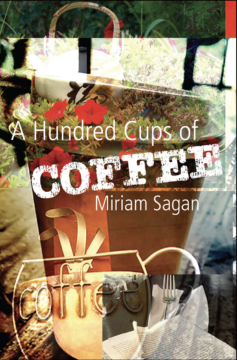
Like you and Rich, and like your character Layla in Mother of Assassins, many of your books are prone to travel. A Hundred Cups of Coffee, for example, has an intriguing conceptual framework. As you write: “Some time ago, I decided to drink a hundred cups of coffee and record them, with my thoughts and surroundings.” The project lasted nearly two years, and while many of the entries take place in various popular Santa Fe watering holes like Tune Up and Counter Culture, we also find you contemplating the world—in prose and poetry—while enjoying a cuppa in Amarillo, Texas; Charlottesville, Virginia; Hot Springs, Arkansas; Las Vegas, Nevada; Bridgeport, Nebraska; and other locales. I love Cup #86, which you drank while on a flight from Washington to Denver. Apparently so-so coffee, but it gave you the occasion for a wonderful poem:
the monk
in Saffron robe
in seat 39F
sips tea
from a paper cup
high above the clouds
he seems different
than you and me
but the years
have taught me
the checkout lady
at the grocery store
knows as much
as he does
if not more
MS: Thanks for picking this poem. I think it reflects what I’ve learned in a lifetime of seeking beauty and understanding. You don’t have to be an authority of any kind to look within and see yourself and even all of the human situation. It’s like Visionary Art in that respect. Keats said “Beauty is Truth, Truth Beauty” and you don’t need to be the greatest of Romantic poets to get a lot of good out of that understanding and experience.
PG: This conversation began with your latest book, Mother of Assassins, so let me not forget to return to what I admire so much about it, how you seamlessly combine an adventure story with the complexities of remembrance one finds in memoir, and the slippery ambiguities of authorship. At one point near the end, you-as-author say:
“I wrote down everything I thought of and some things I hadn’t. So who had thought of them, as my hand kept moving? Words leave a track of daylight. In the dream house there are rooms that haven’t been opened in years, furniture neatly wrapped in dust covers.”
And I especially admire how you’ve managed to point to the book’s possible continuation into the future for you and your main character and co-narrator, Layla. In the last pages, we learn that Layla has become a grandparent and now lives a quiet rural life. Her two granddaughters are twins who “still have a private language between them.” And the names of those two six-year-old girls, the ones who will live past their grandmother and the author of this book? Layla and Miriam.
MS: I surprised myself in writing this—didn’t plan or expect to end in this manner Yes, it is open ended and it doesn’t summarize, but rather speaks of continuing and continuity. It is an image of civilization—a grape arbor and people who greet a stranger. We’re living in tumultuous times, and I’ve felt that threat of chaos and annihilation as long as I can remember, even in childhood. I wanted the end to go beyond that fear into a kind of hope.
PG: That hope is another reason why I love your book.
As our exchange has continued I’ve found myself making connections with a number of your other books, though this barely scratches the surface of the over forty volumes you’ve written. And this in turn has reminded me of the very individual path of your journey as a writer. Everywhere else, one sees writers often circling around the whirlpool of promotion for their latest book. First, of course, there’s the enormous task of writing and completing a manuscript, followed by the task of finding a publisher, and then yet another—increasingly important—task: that sometimes long drawn-out and desperate attempt to flag the world’s attention.
You, however, seem to have chosen a different path. You write a book, then quickly find a small and independent publisher to give it a home, and meanwhile you’re deep in the immediate struggle and joy of what will become your next book. With little or no looking back, I’m guessing. The writing itself is your primary engagement, the beginning, middle and end of what has become the long haul of a literary career. All else is largely ephemera. And in so doing you’ve built an impressive body of work.
 MS: Thank you Philip! It is wonderful to hear things summed up this way. I started off in the small press community in the 1970s, back with the Boston and New York book fairs with their endlessly enticing tables spread with books and magazines. I’ve had several long-lived and very supportive relationships with editors. I often have a possible press in mind as I’m finishing up a book. I like to have projects at different stages—initiating, working hard on a manuscript, then guerrilla marketing something finished. But really I’ve been beyond fortunate in that my muse has stayed with me my entire life, starting from when I was sixteen and decided that in order to be a writer I needed to write every day and read in bulk, whatever I could get my hands on. I realized long ago that this was a relationship like any other. I’ve given my muse as much devotion and affection, time, and focus as I possibly could through all the many changes of a lifetime.
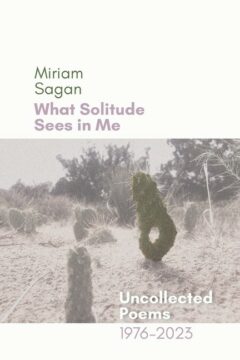
PG: It’s an enviable career, especially how you’ve managed to retain your autonomy as a writer and author. I’d like to include a coda to our conversation, the last poem in your book What Solitude Sees in Me: Uncollected Poems 1976-2023:
Just Jump
To leap from the lip of the granite quarry
is to show-off, become a corpse, touch the angel
of burning air on the way down.
Pick one.
To break the surface of the water
is to acquire a body
to brush domes and towers with bare feet
to change your name to “Return to Center.”
All of the above.
* * *
Books by Miriam Sagan discussed in this conversation:
Mother of Assassins: A Memoir of the Imagination (Alien Buddha Press), 2025)
What Solitude Sees in Me: Uncollected Poems, 1976-2023 (Casa Urraca Press), 2025)
Star Gazing: Poems of Astronomy (Cholla Needles Arts & Literary Library), 2020
Bluebeard’s Castle (Red Mountain Press), 2019
A Hundred Cups of Coffee (Tres Chicas Press), 2019
dream that is not a dream: A Conversation in Haiku, Elizabeth Searle Lamb and Miriam Sagan (Miriam’s Well), 2014
Seven Places in America: A Poetic Sojourn (Sherman Asher Publishing), 2012
***
The work of “Maternal Mitochondria,” an ongoing collaborative project of writer Miriam Sagan and artist Isabel Winson-Sagan, has appeared twice in the literary/arts journal Ninth Letter:
“Mapping: Suminagashi and Text”
“Homeless Ranch/Threshold Anxiety”
***
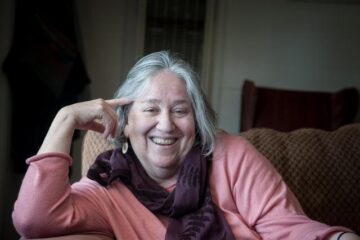 Miriam Sagan is the author of over forty books of poetry, fiction, and memoir. She is a two-time winner of the New Mexico/Arizona Book Awards as well as a recipient of the City of Santa Fe Mayor’s Award for Excellence in the Arts and a New Mexico Literary Arts Gratitude Award. She has been a writer in residence in four national parks, and Yaddo, MacDowell, Gullkistan in Iceland, Kura Studio in Japan, and a dozen more remote and interesting places. She works with text and sculptural installation as part of the mother/daughter creative team Maternal Mitochondria (with Isabel Winson-Sagan) in venues ranging from RV parks to galleries. She founded and directed the creative writing program at Santa Fe Community College until her retirement. Her poetry has been set to music for the Santa Fe Women’s Chorus, incised on stoneware for two haiku pathways, and projected as video inside an abandoned building during the pandemic under the auspices of Vital Spaces.