
by Swapna Liddle
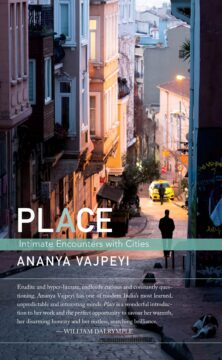 What makes a city? What gives a place its distinct character? I think of the slogan ‘dilwalon ki dilli’ – the supremely banal play on words. It works in the context of Delhi only because of a happy conjunction of the word dil, or heart, with the Hindi word for the city – ‘Dilli’. It works also because it simultaneously tells us everything and nothing. Okay, people in Delhi have hearts; though this might be disputed by many who live precarious lives in this city, the marginalized, the victims of the violence the state and citizens alike often perpetrate on them. In any event, do people in other cities not have large hearts? Still, it is a catchphrase that makes those of us who live in the city feel good about ourselves. As Delhi’s most famous poet would have said, “dil ke khush rakhne ko Ghalib yeh khayal achchha hai” – it is a thought that keeps us happy.
Among such cliches about cities, Ananya Vajpeyi’s Place comes not so much as a breath of fresh air (another banality that I might myself have been tempted to use at another time!), but a rather stronger wind that carries away not just cobwebs, but also the superficial structures through which we think. An apt metaphor for the latter would be the many large, obtrusive, signs that sprouted around many Delhi neighbourhoods some time ago – ‘I ♥️ –––‘. Civic pride reduced to garish ‘selfie points’ in the absence of any real improvement in infrastructure and any transformation in the everyday lives of the people who live there. Another in a series of sarkari ‘beautification’ projects that are supremely ugly.
Clearing away the superficialities, Ananya shows us some familiar cities through a lens that is deeply personal and yet reaches into the essence of the place. Place, subtitled ‘intimate encounters with cities’ reminds us that the cities we inhabit are about the people we meet, the particular streets we walk in, the literature we read, and our own place within these large and diverse agglomerations of people and experiences. New York, Bangalore, Istanbul, Pune, Venice, Santiniketan, Chennai, Amsterdam, Mumbai, Varanasi, and Delhi, are places that figure in Ananya’s narrative. Each, inhabited and experienced at different points of times – in the author’s lifetime, but also at specific historical moments for that city and the world.
Istanbul, its complex history, its monumental and historic architecture, its location on the Bosphorus, its streets and lanes sometimes following and sometimes cutting across the contours of its hills, familiar to many of us through the literature of Orhan Pamuk, through linguistic affinity with several Indian languages. We can imagine a woman, mourning personal loss, walking solitary among those sights, sounds and smells, alive to history, to the complicated politics of the present, and her own emotions.
These solitary explorations stand in stark contrast to the author’s relationship with New York, a city that to her gets meaning as the home of writers, artists, thinkers that she meets and interacts with. It is a place where you can encounter the world through space and time – where a Pakistani-American artist can produce art inspired by the Indo-Persian miniature painting tradition, where the genocide in Gaza can tear institutions apart.
In the early 2000s Bangalore was booming as a hub of information technology in India, a place of opportunity and the future. Ananya saw it through eyes clouded by personal troubles, and struggles in her academic career; engaging with history instead of the future through her study of Sanskrit. Another place of academic work – Pune, finds expression in the only short story in the book of essays. Yet another, Chicago, is dealt with more fleetingly, while the author’s brief residency in Amsterdam stands out as a time of intellectual stimulation and friendships.
There are other places that find meaning through admired icons. Venice is recalled through a memorable meeting with the philosopher Giorgio Agamben; drawing some parallels with a similar meeting years before, when the author’s father, the poet Kailash Vajpeyi, met Samuel Beckett in Paris. Chennai is about the vibrant music and activism of T.M. Krishna, and the beach setting of memorable musical evenings. Santiniketan and Mumbai are dominated for the author by figures from the past – Rabindranath Tagore and B.R. Ambedkar respectively – their philosophies and politics, and their impact on the making of modern India.
Varanasi and Delhi seem to hold a special place – of memories of parents, of personal life transitions, loss, but also of renewal. Delhi is in addition also the author’s birthplace and her current place of residence and work. Both are places where past and present intermingle. Transformations in the historic fabric of Varanasi threaten a rewriting of history, and qawwali at Sufi dargahs are a window into Delhi’s past.
I took my time reading this book. Like all great books, it makes us think, and pause. By opening her mind and heart to her readers, Ananya had made me think about what I find meaningful about a place, and what that tells me about myself.
***
Place: intimate encounters with cities by Ananya Vajpeyi, published by Women Unlimited Ink, pp: 239, Rs 625.
Enjoying the content on 3QD? Help keep us going by donating now.