by David Hoyt
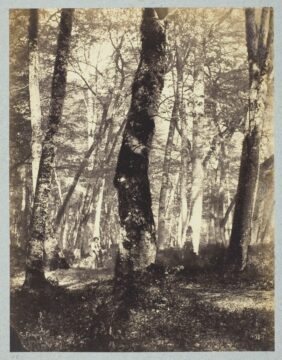
When I set out to write this essay on the ecological aesthetic of a loose group of nineteenth-century French painters associated with the village of Barbizon, I did not anticipate that it would coincide with the largest wildfire to strike northern France in over a century. The fire, in the state forest of Fontainebleau which lies not forty miles from Paris, follows on a record-breaking heat wave. This summer’s heat is itself the latest in a succession of extreme heat events over the last few years, together with several years of severe drought. Other fires have erupted in the area, and several further to the south.
French forests are estimated to absorb ten percent of the nation’s annual CO2 emissions, but this ecological service is at risk of destabilizing in the wake of repeated drought and its attendant harms, such as arboreal diseases contracted by weakened trees. With such droughts becoming increasingly common in France as elsewhere in Europe, less water is available for tree growth, and less carbon is thus absorbed from the atmosphere. The impact of global warming can thus reduce a forest’s ability to mitigate global warming over time.
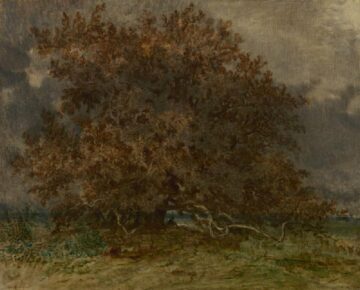
Of course, fire is a natural disturbance in temperate forests, especially oak forests such as the one at Fontainebleau. To look at Barbizon paintings of the woods from the 1830’s or 1840’s, one can discern a relative openness in the understory, together with a broad, expansive habit among the old oaks. It was the latter quality that so intrigued painterly devotees of the area, and which also indicates a long history of periodic burning. Oaks co-evolved with a regime of fire, which made them fire-resistant while the saplings of competing species were less so. Where fire is suppressed and a fast-growing understory is allowed to grow, slow-growing oaks are typically crowded out, and are unable to achieve the spectacularly wide, round form that distinguishes them.
Fires broke out at least eight times in the Fontainebleau forest from the July Monarchy of 1830 to the end of the Second Empire in 1870. Most of these were small, and more were probably undocumented. They became much more frequent, or perhaps just better documented, during the twentieth century. The fire of July, 2026, however, is of a different order. The most recent estimates are that 5,000 acres/2,000 hectares were consumed by the July fires. This is six times the area of New York City’s Central Park, and over twice the area of the Bois de Boulogne, and it happened a short train ride from the Gare de Lyon.
I hadn’t thought about Barbizon for years, not since a few survey courses in art history in which the outdoor painters of French woodlands and plains were presented as precursors to the Impressionists, or on occasional glimpses of the paintings in museums. Their dimensions struck me as somewhat small, their palettes somewhat dark, perhaps even lugubrious. Their settings seemed familiar, almost like backroads scenes from Ohio or Indiana. Pleasant enough, but when set against their supposed successors in the forward march of modern painting, they couldn’t hold a candle.
But our minds have a way of retaining images, however incidental they may have seemed on first viewing, and returning them to us when we are capable of bringing much fuller meaning to them. Such a moment arrived for me on a late Saturday afternoon in June, at a place I’ll call ‘the farm’, a few acres I tend to in far western Illinois. There is no shelter there, no electricity nor running water. About two-thirds of the land is an old cornfield restored to tallgrass prairie, and the remaining third is timber – oak, in fact – that hugs surrounding ravines. When I visit, I pitch a tent and camp half a mile off a blacktop road that gets traffic of maybe five cars a day.
This positions me well to enjoy the morning chorus of birdsong, which in June begins around 4 o’clock in the morning. In the evening hosts of fireflies launch from their hiding places in the grass, producing silent firework displays. These are both regularly scheduled events. More impromptu are the sound of a neighbor doing target practice with a semi-automatic rifle, the yipping of coyotes in the small hours of the morning, or the whistle of a freight train along tracks that lead out across the nearby Mississippi and into Iowa.
Unlike much of the rest of the world, we had up to then enjoyed a comfortable, cool, and even wet spring. A local beekeeper related that he was a week or two behind in production this year because the bees were unable to forage in the rains. Vegetation was lush, the double-track leading onto the farm overgrown and verging on impassible. But the humidity was low, the bugs scarce, and the clouds moving across the sky like a heard of proud beasts in no rush and under no threat. In the tranquility of such an afternoon, the sky presents a continental wildness that seems to still carry a memory of what was once below.
The birds making the most noise in early evening were the treetop dwellers – a scarlet tanager, singing like I’ve never heard before, and a rose-breasted grosbeak. My attempt to spot them was futile, but drove me to search the high branches of the trees along the edge of the field – a few oaks, a cottonwood, and some hackberries. The woods are choked with a few decades’ worth of invasive shrubbery, but nonetheless the whole of it stood across from me, accepting and releasing birds into its volume, forming a line running to the north where it ended at the neighbor’s cornfield.
Barbizon, I thought.
All these afternoons with that tall tree, at the westernmost edge of the woods, catching the evening sunlight from the west as it presides over the prairie, sheltering so many birds, not making a sound while doing all these things – this is what drew up from some deep, buried memory the name Barbizon, as if playing a matching game that had taken decades to execute. Barbizon, a small peasant village on the edge of the royal hunting grounds of Fontainebleau, which shares the name of the nearby palace built by François I and favored by Napoleon Bonaparte.
Then came the names – Jean-Baptiste-Camille Corot, whose canvases capture the heaviness and green mass of mid- to late-summer foliage, or pathways through the woods and along the edges of them; Charles Jacques, Jean-François Millet, Narcisse Diaz de la Peña, Paul Huet, and above all Théodore Rousseau, who conveys the stillness and centrality of the forest and the majesty of its giant old oaks. Before Rousseau, no one had made a tree a subject deserving of its own portrait.
The oft-told tale of realism’s emergence in European art derives its power as much from the consolidation of life-like portraiture in the works of early 15th century Flemish painters as from the simultaneous invention of linear perspective in Florentine art. The faces that shake off the anonymity of the Middle Ages in portraits aiming to show specific, idiosyncratic individuals, long-dead but once so lively, is a trick that continues to evoke wonder and fascination. That the same methods should be employed in what the Théodore Rousseau called his portraits of trees is equally astounding. In Rousseau’s paintings, what has historically been backdrop becomes motif, what was décor becomes the subject. Human presence and activity is minimized, and nature becomes narrative.
One striking example of this approach can be seen in Corot’s Ville d’Avray, entrance to a Wood (1823-25).
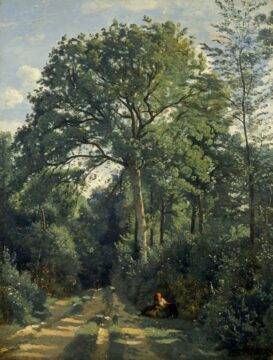
Corot, older than Rousseau and not as fully committed to Rousseau’s version of naturalism, leaves out any historical references in this painting, disqualifying it as a serious landscape by the academic standards of the time. Nor does it offer a moral drawn from rural life as would be expected from unpretentious genre paintings. Although there is a pleasant play of dappled light falling onto the forest track, suggestive of future Impressionist techniques, this serves to establish the foreground from which the majestic height of the tree (a maple? A beech?) is to be contemplated.
Far more shadow is preserved than would be in later Impressionist landscapes, most of it concentrated where the path enters the wood, and where, at the last patch of sunlit ground, an indistinct and slightly ominous figure lingers. The glory of this individual tree presides over mystery: Where does this path lead? Who is the man standing at the threshold of light and shadow? Who is the shrouded, faceless woman seated in the shadow of shrubbery, with the appearance of sheltering there from the brightly lit outer world?
All are unknown – by us, but perhaps not by Corot’s guardian tree, which alone is figured with clarity, and given a nobility and utter forthrightness. Whatever the shady dealings of the figures below, it rises to the light with wisdom and honor. To a viewer whose mind is perhaps keyed to better-known canvases of David, Ingres, and Delacroix, Ville d’Avray is a green jolt, a departure from the mannered drama of classicism or the tumultuous color of Romanticism. What caused this striking opening onto the green world, onto le vivant?
I confess that, as an American, my own surprise at the richness and generosity of such portraits stems partly from a prejudice that the modern idea of Nature is an American invention, with a lineage traceable to the New England Transcendentalists (who were, interestingly, active at the same time as the Barbizon painters) and visible in the works of painters of the American Romantic school, such as George Caitlin and his images of the frontier of the 1830’s.
Kindred, though geographically distinct, expressions of a Romantic sensibility widespread in the 1830’s? Certainly, but they have been appropriated quite differently. Whereas a painter such as Caitlin contributed to the mythology of the American frontier, of the West, and to the ambiguous place of Native peoples in the formation of American national identity, Barbizon is usually seen simply as a station on the road to Impressionism and thus left mostly to art historians. America was in the early stages of its world-historical romance with wilderness. The wildest creatures in a Barbizon painting are usually cows.
Domesticated Europe versus the American sublime? Perhaps not – for there is a surprising amount of the sublime to be found in the output of Barbizon (the Alps, of course, but also the Jura, the marshes of the Atlantic coast, the mountains of Auvergne). Yet the most frequent and superficially un-sublime of subjects is the forest of Fontainebleau.
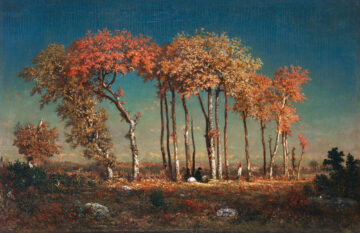
The recognized leader of those outdoor landscape painters loosely grouped together under the label “Barbizon School” was Théodore Rousseau, who more than anyone featured the oak trees of Fontainebleau in his work and there fashioned a proto-ecological sensibility based on long observation of the forest. The forest shaped Rousseau’s thinking and art in a way that calls to mind the impact of Walden Pond on Henry David Thoreau, active at the same time. Rousseau wrote of his time in the forest:
Oh! Silence is golden; when I was at my Belle-Croix observatory, I didn’t dare budge, because silence opened to me the stream of discoveries. The family of the woods would then go into action; it’s the silence that allowed me, immobile as I was like the trunk of a tree, to watch the stag in his lair and at his toilet, to observe the habits of the field mouse, the otter, and the salamander, those fantastic amphibians. He who lives in silence becomes the center of a world; for a moment, I could have believed myself the sun of a small creation.
Rousseau painted in Fontainebleau during the 1830’s, began renting a cottage there in 1847, and made it his year-round residence in 1849. He was joined there by the painter Jean-François Millet, one of his closest friends, both of them quitting Paris in the wake of revolution and cholera. Though many artists passed through the forest, Rousseau gained a reputation for sticking it out through the year, long after the leaves had fallen and other painters had departed. Like Thoreau’s Walden Pond, Fontainebleau was not far from an urban center and was accessible by rail by the late 1840’s. Like Thoreau, Rousseau was interested in the smallest and superficially most banal details of his surroundings His landscapes are often flat, littered with irregular rocks that seem to be strewn hodge-podge, and he has a fondness for the kinds of pools and marshes that an American developer would immediately seek to drain. Before all else, however, it is the trees of Fontainebleau that provide everything that is called for by a painter seeking to portray the sublime.
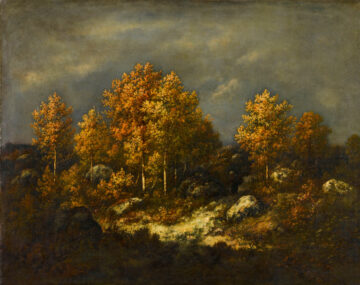
Rousseau’s “Under the Beech Trees, evening” of 1842-43, together with “The Hills of Jean de Paris” (1867) by his disciple Narcisse Diaz de la Peña both extract wildness from the familiar without need for megafauna or mountain topography. In both paintings, trees become heroic subjects. As the art historian Greg Thomas has shown, the composition of both paintings contribute to this impression of profundity that is distinct from Impressionist works. They both center their subjects as might the eye itself, allowing the foreground to blur, surrounding the field of vision with a dark margin, and eliminating the horizon as a competing field of interest. In this sense, these portraits achieve a realism of the northern European variety based less on the use of linear perspective than on close study and the use of contrasting light. De la Peña’s scene, especially, uses a focused shaft of light falling from an otherwise brooding sky to highlight a variety of fall foliage among young oaks on a ridgeline. What emerges is a sense of the individuality of the group, perhaps even of their relation and destiny.
There are generally two critical understandings of this precocious assertion of the natural subject in French painting of the period. The first is the classical narrative of artistic evolution, tied to larger narratives of progress, in which all things lead to the modernism of the European avant-garde. This story sees the Barbizon landscapes as a workshop for the refinement of certain techniques, which were then passed on and more fully developed by the Impressionists in the 1860’s and 1870’s.
The second understanding, more challenging, sees the subject of Nature and of landscape itself as a political effect of the rise of bourgeois culture in the nineteenth-century. Rather than an idealized backdrop to aristocratic recreation as in the paintings of the French rococo, or the heroic deeds of mythological figures worthy of wall space in a nobleman’s château, the naturalist landscape took form in relation to its opposite: the commercial, industrial, bourgeois city and the conflicts that it incubated. Rousseau only moved to Barbizon after the June Days of the 1848 insurrection. Following yet another uprising, Rousseau’s friend Millet wrote to a friend after the Paris Commune, “Take as much pleasure as you can in natural things, because there is always something solid there.”
Nature becomes the antidote to urban civilization, to political chaos, to the social chaos of Balzac’s France, to the loss of all the things lamented by Romanticism. Nature, in this line of thinking, is the production of a new object of bourgeois contemplation, never accessible outside the relations of economic or cultural production that strip it of its manifold contexts, or which sentimentalize its therapeutic function.
There is a degree of truth to the left social constructivist analysis. To a certain extent, it describes our own contradictory relations with the green world over a century later. But if one asks, Then what about the trees? contradictions and possibilities quickly follow. Rousseau himself played a leading role in protecting the Fontainebleau forest from exploitation in the 1850’s and 1860’s, roughly a decade before similar measures were taken in the United States at Yosemite and Yellowstone. In 1861, as a result of direct appeals by Rousseau and supporters such as Millet to the Emperor Napoleon III, the Fontainebleau forest became the first protected nature preserve in the world. The link between art and conservation was immediate and direct.
At the same time, if there is a movement in the pictorial arts at peace with bourgeois industrial civilization, it is French Impressionism.
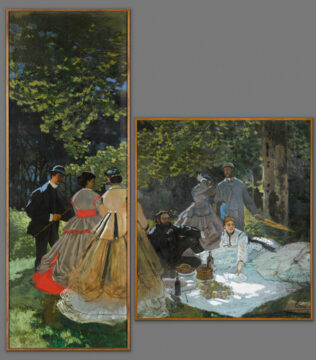
Monet’s Déjeuner sur l’herbe illustrates a point made by Emile Zola in the late 1860’s, a boom time for the French economy and middle classes.
In the country, Claude Monet prefers a view of an English park to the cover of the forest. He takes pleasure in discovering traces of humanity everywhere, he wants to live continually in a human environment. Like a true Parisian he takes Paris with him to the countryside, he cannot paint a landscape without including well-dressed men and women.
In contrast to this new aesthetic, there are few people in Rousseau’s paintings, and those there are remain cryptic and indistinct. Traces of transformations well underway in the countryside by the 1840’s are omitted. With Monet, however, the city returns to its rightful preeminence, extending its machines and commerce and culture to the countryside where it is celebrated as part of a landscape at peace with the progress of civilization. The Impressionist landscape beautifies modernity as a garden beautifies a house.
In the aftermath of the French defeat by Prussia and the fratricidal bloodshed of the Commune, the Impressionists sought out a form of light therapy in which trauma and incertitude was resolved into a shimmering analysis of surfaces. The profundity, the ‘concentrated looking’ attributed to Rousseau, was set aside, as were his lonely vigils in woodcutter’s shacks with the trees he knew by name. His portraits of trees were assessed as having projected subjective states onto nature instead of laboring to portray nature ‘as it is.’ It was the Impressionists who had finally managed to break with the Academy, who had fully modernized art and landscape, and who had resuscitated French culture after its century of political crisis.
Sitting at my desk in Chicago, my N95 mask and P100 respirator ready at hand should I need to venture into the record-breaking smoke wafting down from Canadian wildfires, I follow news on the fires in Spain and France and at Fontainebleau. I look at the Impressionist paintings and feel nostalgic towards what I see there as a Golden Age, when humans and nature coexisted, when the imprint of modernity was still relatively light upon the land, when major rivers could support anglers, swimmers, and regattas within a few hours of a capital city; when lushness was everywhere, when nature was in bloom outside every window and beyond every doorway, when fresh breezes blew from Brittany down the Oise to Argenteuil and Giverny. Of course we love these images; they are without question ravishing. They represent the Arcadia of our time, the Antiquity of our suburban, consumer civilization as we wish it would be. They are as Greece and Rome stood to the painters of the 17th and 18th centuries.
It is difficult to imagine the equivalent of the Impressionists in our time. Such a school would have to develop and optical therapy for painting the desiccation of the Loire, the disappearance of hamlets and hedgerows, the sweltering impossibility of Paris heat, and the flames of Fontainebleau. Looking now at the works of painters such as Corot, Rousseau, de la Peña and their peers, I appreciate the forcefulness of the Nature to which they bear witness, the opening of a field of perception within which a tree might disclose itself as a living individual with a history and a future.
If this sounds radical, it is. But no more so than what Jules Michelet, historian of the French Revolution, was writing in the 1850’s. After a lifetime of historical research, sent packing from his government position for refusing to swear an oath of loyalty to the new autocracy of Napoleon III, Michelet abruptly turned to natural history. The first product of this effort, L’Oiseau, was devoted to birds. He describes his journey from one interest to the other in the introduction, or “How the author was led to the study of Nature” (1856):
All natural history then appeared to me to be a branch of politics. All living things, in their humble rights, arrive at the door seeking entry to the heart of Democracy…This was my ‘renovation’, the new life that has brought me to the natural sciences … a love of the City leads me to complete it by bringing together all beings.