
by Tammy Lai-Ming Ho
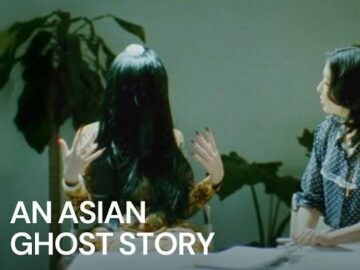
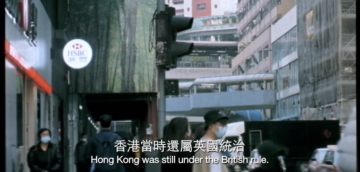
There is a ghost in Bo Wang’s 2023 short film An Asian Ghost Story 九龍東往事.[1] “It was a strange time,” the narrator laments, “with strange things and strange people.”
She is the spirit of a Japanese woman who died in northern China; after her death, her hair was cut and sold, woven into a wig, and carried westward through the trade networks of Cold War Hong Kong. She drifts through Kowloon City, through factory floors, karaoke bars, the thoroughfares of a city built to mediate other people’s transactions, and narrates her displacement: “Commodities are always transformed to conceal their past. But the past never dissipates.”
The commodity in question was embargoed by the US Treasury in 1965 under the category “Asiatic hair.” The ban targeted Communist China specifically, part of a wider embargo enacted under the 1917 Trading with the Enemy Act, since Chinese hair exports were funding a government the United States refused to trade with. Hong Kong itself was not the target, but its wig industry ran almost entirely on Chinese raw hair, and customs officials, unable to distinguish communist from non-communist Asian hair by sight, cut off the supply regardless. It was a decision that restructured the global wig industry without consulting the women whose bodies had supplied it.[2]
*

The film was originally commissioned as a single-channel video installation by the Centre for Heritage, Arts and Textile (CHAT) in Hong Kong before entering the festival circuit. At 37 minutes, it operates as hybrid docufiction, combining archival newsreel footage, acted sequences, and oral histories, including factory testimonies, a therapy session, and karaoke performances. It also introduces a pseudo-scientific apparatus called the EVPL (Electronic Voice Phenomena with Linguistics),[3] a device invented for the film that purports to decode communications from the dead through severed hair. The lo-fi VHS aesthetic and 4:3 frame lend it the appearance of the news footage it incorporates, while the image and voice-over often deliberately refuse to correspond, a formal choice that gives the narration a haunting quality.
The jury at CPH:DOX, where An Asian Ghost Story won the New:Vision Award, described the wig as “a phantom limb, an amputated part of the body that exists beyond human life and, unlike many people, has the privilege of traveling across borders and living multiple lives.” This is a disturbing formulation: something was cut from the body and it went on living.
*
In Wang’s film, the wig is made hair by hair, each strand drawn through the base and knotted, every one placed by hand. It is among the most labour-intensive manufacturing processes in the textile industry, largely unchanged in its fundamentals across centuries.
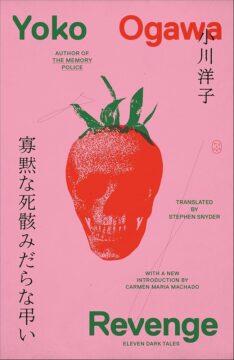
Consider, then, what the Japanese writer Yoko Ogawa does with this fact in her story “Welcome to the Museum of Torture.”[4] In it, an old man leads the story’s narrator through the entire house, the living room, kitchen, bathroom, and study, all converted into exhibition space, each room crammed with instruments of torture. Near the end of the tour, he holds up what appears to be an ordinary pair of tweezers, stained where the fingers would have held them. The torture they enabled, he explains, was the extraction of hairs from the victim’s scalp, one strand at a time, in a room lined with mirrors, until the scalp was completely exposed. “The suffering comes from the slow but steady sense of loss,” he says, “along with the tiny pain the victim experiences each time a hair is plucked. It’s nothing at first, but as it’s repeated a thousand times, ten thousand times, a hundred thousand times, it becomes the most exquisite agony imaginable.”[5]
The same attentiveness that produces a wig also produces a particular kind of torture. Creation and annihilation share a technique. Making a wig turns discarded hair into something new: hair someone else will wear. Ogawa’s torturer works in the opposite direction, undoing what the body still needed, one strand at a time. Both work hair by hair. Both require patience, precision, and total attention to a single strand at a time.
*
Hair is the body’s paradox. It grows from living tissue, yet the shaft itself is not alive. Above the skin, every strand is composed of non-living, keratinised cells that have completed their differentiation before emerging from the scalp. They are pushed upward by the rapidly dividing cells of the hair matrix at the base of the follicle, which are among the fastest-proliferating normal cells in the human body. The living part of the hair remains hidden beneath the skin. The part that is visible, touched, cut, sold, woven, or plucked is, in biological terms, non-living tissue.
This is why hair persists in ways that flesh cannot. The ancient Egyptians who styled their hair with fat four thousand years ago left strands that we can still analyse. And because it is non-living, the hair does not require the body to go on existing. It survives the body. It can be detached and kept, traded, displayed, incorporated into other objects, stolen, weaponised. It can end up on a stranger’s head in a city its original owner never visited. It can end up behind glass in a museum. It can, in the hands of the right researcher, yield a genome.
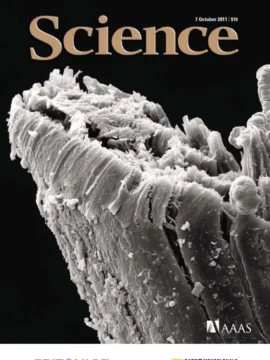
In 2011, a single lock of hair that had sat in a Cambridge archive since 1923 appeared on the cover of Science. The hair had been collected from an unnamed Aboriginal Australian man at a remote railway stop in Western Australia by British ethnologist Alfred Cort Haddon, who placed it in a tin and shipped it to England, where it remained unexamined for 88 years. Then a Danish geneticist named Eske Willerslev extracted its degraded DNA and sequenced what was announced as the first Aboriginal Australian genome.[6] The man at Golden Ridge Station had no idea he was providing his genetic future to science. His descendants were not consulted. The hair waited and carried him through nearly a century into a world he never knew.
Emma Kowal, whose 2023 book Haunting Biology: Science and Indigeneity in Australia reconstructs this history, argues that the persistence of biological material is never merely a physical fact. The hair did not only preserve DNA. It preserved the circumstances of its collection: the racial science, the colonial encounter, the assumption that an Indigenous man’s body was available for study without his consent.
*
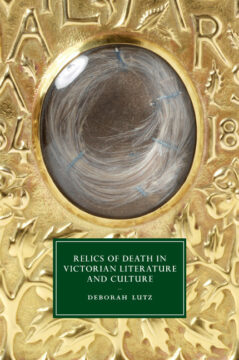
Hair was, for the Victorians, the most commonly preserved relic of the dead, the object most often placed in lockets, woven into bracelets, framed under glass, set into rings. In her 2015 book Relics of Death in Victorian Literature and Culture, Deborah Lutz writes that “Victorian relic culture sees death, and the body itself, as the beginning of stories rather than their end.” One chapter of Lutz’s book is titled “Hair Jewelry as Congealed Time,” a phrase that captures what the non-living shaft makes possible.[7] Hair is time that has stopped. It is the body’s most natural relic, because it is already, on the strand, partway toward the condition of an object.
Queen Victoria owned several pieces of jewellery made from Prince Albert’s hair after his death in 1861. In Emily Brontë’s Wuthering Heights (1847), Catherine dies married to Edgar Linton but loved by Heathcliff, the man she grew up with and never stopped loving. As the housekeeper Nelly Dean prepares her body, Heathcliff swaps Edgar’s lock of hair in Catherine’s locket for his own. Nelly finds the discarded lock and quietly twists the two together before returning both to the locket, so it is both men’s hair, entwined, that descends into her grave with Catherine. The gesture is necromantic, erotic, and logical: if hair carries the person, then placing it with the beloved is a form of permanent accompaniment.
*
The logic intensifies when the hair has been taken by force.
When the Nazis brought prisoners to the concentration camps, the first thing they did was shave their heads “to strip them of their humanity.” This is the fact that Yoko Ogawa’s old museum guide invokes before describing his torture device: “In reality, it does no physical harm, but we seem convinced that our very existence is somehow bound up in our hair.” He is right, and the Nazis understood it too. The shaving was an act of ontological violence: an assault on the sense that one’s existence is in some way located in one’s body, and that the body extends as far as the hair.
At the Auschwitz-Birkenau State Museum, almost two tons of hair are on display, salvaged from the warehouses where the SS had been storing it for shipment to textile factories in Germany, to be made into rope, ignition mechanisms, stuffing for mattresses, socks for submarine crews.[8] When Soviet soldiers liberated the camp in January 1945, they found seven tons in those warehouses. The hair was already disintegrating then. The debate over whether to preserve it or bury it is not merely an ethical argument about the dignity of the dead. It is a response to what hair is. Photographs can be reproduced. Documents can be photocopied. Hair cannot. It is not evidence of the person. It is, in whatever irreducible way, the person. There is no copy. The strand on display is the strand that grew on a head, that was shaved from that head.
This is why Ogawa’s torture device is so precisely conceived. The mirrored room is essential: it forces the victim to witness her own diminishment as it happens, rather than enduring it out of sight. It is not simply the accumulation of small pains that creates the most exquisite agony. It is the watching. Each plucked strand is a subtraction from a visible self, performed with the same slow, hair-by-hair patience that a wig worker brings to the work, but running in reverse, unmaking instead of making.
*

Wang’s ghost in An Asian Ghost Story drifts through Kowloon. The Cold War that embargoed “Asiatic hair” in 1965 was trying to punish a state; it also punished the workers and traders and hair-sellers who had built an industry around that state’s most exportable surplus. Hong Kong wigs were the colony’s fourth-largest export, employing more than 30,000 workers, most of them young women. Local newspapers at the time described these workers as the industry’s backbone, and reported on girls leaving domestic work for wages on the wig-assembly floor, a shift significant enough to be treated as news.
South Korea, whose domestic hair supplies could be certified as non-communist, seized the moment and overtook Hong Kong as the global wig-export leader by 1971. Hong Kong never recovered that position. The knowledge and networks built across a decade of rapid industrialisation dissolved into a reorganised supply chain. Historian Jason Petrulis, in “A Country of Hair,” documents how the industry the embargo accidentally created in South Korea was eventually carried to the United States by Korean American entrepreneurs, who opened wig and beauty-supply shops in African American neighbourhoods. By 1975, roughly 70% of Korean American wig stores in Los Angeles were located in predominantly Black areas.
Wang’s film stays with where this story started: the Hong Kong wig-assembly floor. It stages testimony for two different kinds of subject. For the dead, there is the EVPL, the fictional device described earlier. In the film, an expert runs a strand of hair through the machine and reads off the result like a lab report: which country the attached ghost came from, which language it once spoke, all supposedly recoverable from the strand alone. This is the test performed on the ghost narrating the story. For the living, the real wig factory workers of the 1960s and 70s, Wang gives them oral history re-enactments, a therapy session, and karaoke performances.
*
Wang’s speculative machine remains a fantasy. No strand of hair tells us the language its owner spoke or the ghosts that accompany it. Yet hair possesses another, stranger power. It survives where flesh does not. Whether as the source of a genome, a lover’s relic, a Victorian keepsake, a museum exhibit, a concentration-camp remnant, or a Cold War commodity, hair is biologically dead material that nevertheless refuses historical death. In “The Relic,” John Donne imagines “A bracelet of bright hair about the bone,” the surviving trace from which later generations reconstruct the lives of the dead. Four centuries later, Wang gives that relic another history. Hair is biologically dead, yet it endures as one of the body’s most persistent traces, making it an especially potent vehicle for memory and ghostly imagination. It persists, travelling through trade routes, museums, genomes, lockets, films, and poems, acquiring new meanings along the way. Perhaps the dead do not speak through hair. Perhaps hair is one of the places where the past refuses to stop speaking.
[1] Bo Wang’s An Asian Ghost Story 九龍東往事won the New:Vision Award at CPH:DOX 2023.
[2] The “Asiatic hair” embargo was enacted under the Foreign Assets Control Regulations, 31 CFR Part 500, as an extension of sanctions against Communist China under the Trading with the Enemy Act of 1917. See Jason Petrulis, “‘A Country of Hair’: A Global Story of South Korean Wigs, Korean American Entrepreneurs, African American Hairstyles, and Cold War Industrialization,” Enterprise & Society 22, no. 2 (June 2021): 380–83.
[3] Wang’s notes on the film’s EVPL conceit and VHS aesthetic can be found here.
[4] The story “Welcome to the Museum of Torture” is one of the interlinked stories in Revenge: Eleven Dark Tales, by Yoko Ogawa, translated from the Japanese by Stephen Snyder and published in English by Picador in 2013.
[5] Hair-plucking as torture appears again, without any fictional distance, in Paul Feig’s 2025 film The Housemaid (adapted from Freida McFadden’s novel), in which an abusive husband locks his wife in an attic and will not release her until she plucks a hundred strands of hair from her scalp, follicles still attached, as proof of contrition. When one strand comes back without its follicle, he makes her do it again.
[6] The Aboriginal hair sample was collected in 1923 by Alfred Cort Haddon at Golden Ridge, Western Australia, and remained stored at Cambridge until sequenced by Eske Willerslev and colleagues. Results published as Morten Rasmussen et al., “An Aboriginal Australian Genome Reveals Separate Human Dispersals into Asia,” Science 334, no. 6052 (2011): 94–98. For the ethical controversies, see Emma Kowal, Haunting Biology: Science and Indigeneity in Australia (Durham: Duke University Press, 2023), chap. 3.
[7] Deborah Lutz, Relics of Death in Victorian Literature and Culture (Cambridge: Cambridge University Press, 2015).
[8] The Auschwitz-Birkenau State Museum documents “almost two tons of hair belonging to almost 40,000 people” in Block IV. On the hair’s collection, industrial use, and current state of disintegration, see Timothy W. Ryback, “Evidence of Evil,” New Yorker, November 15, 1993.