
by Eric Feigenbaum
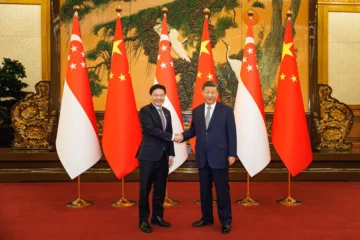
You can’t be the leader of a small island nation in Southeast Asia without a sharp focus on China. While Singapore as we know it was founded by the British and the modern Republic of Singapore by and large adopted British institutions – it no longer relies on its colonial parent for either security or trade.
Instead, Singapore – like so many countries in Southeast Asia – finds itself preoccupied with the United States, its largest security partner – and China, its largest trade partner with particular respect to exports. Singapore built a thriving economy based on its unique position of culturally and linguistically straddling East and West. Its people understand not just the words, but the ideas and minds of both Orient and Occident.
Singapore’s long-governing, founding Prime Minister, Lee Kuan Yew was an ardent anti-communist who in 1965 said things like:
I cannot in all honesty say that communism is a diabolical evil, because I can imagine certain human societies where it was a great relief to have the communists displace a ruling power. That is another of the very difficult problems we face in this country. To some 600 million Chinese, that philosophy was the answer and is the answer to a decadent, a corrupt and an evil society which has become evil because men have lost their self-respect and lost their values.
Yet, later in his career he became a consultant to Deng Xiaoping, helping China plan reforms that would transform it from its former truly communist self to the more capitalist, albeit authoritarian state we know today. To Lee, moving China toward capitalism and participation in the world economy was a net positive. China being part of a cooperative global order was the attainable win that would make the world safer.
China’s history of over 4,000 years was one of dynastic rulers, interspersed with anarchy, foreign conquerors, warlords and dictators. The Chinese people had never experienced a government based on counting heads instead of chopping off heads. Any evolution towards representative government would be gradual.
The difficulty arises from America’s expressed desire to make China more democratic. China resents and resists this as an interference in its domestic matters. Outside powers cannot re-fashion China into their own image. Let us not forget that even China’s conquerors like the Mongols in the 13th and 14th centuries, and the Manchus in the 17th to 19th centuries, could not change Chinese culture. Instead, China changed them and they were absorbed and assimilated.
How did Lee become the man who had Deng Xiaoping’s ear?
The wild success of Singapore’s development including its cultural multipolarity and large ethnic Chinese population made Singapore a fascinating experiment. China knew it needed to develop, but had no intention of returning to what it saw as an already failed experiment in adopting democracy and republicanism in the early 20th Century. Lee’s conservative, stable, adroit and thriving Singapore provided a potentially useful model – or at least set of ideas – to examine.
For decades, China was slowly and quietly changing – beginning to catch up. Lee’s many thoughts on how to bring capitalism and more personal freedoms into China’s system without triggering political upheaval or dissidence were well received among Chinese leaders. And they worked.
Of course, that meant Singapore had to contend with the results of a rising China – some of which are beneficial to it, others which are worrying.
In March 2021, Lee Hsien Loong – Prime Minister from 2004 to 2024 and Lee Kuan Yew’s eldest son – summed up China’s increasing power:
It is a problem for many countries, which is why we are all hoping and encouraging the two large powers to think very carefully before deciding that the other one is an adversary which has to be kept down, if not put down.
What we would like to see is China being a country where its prosperity, development and growing strength is welcomed by other countries in the world, who see this as an opportunity for them to prosper together and live in a stable world together.
This is a world of rules-based, free-trade globalism, which Singapore has not only benefitted from, but deeply believes is the best path for humanity. It takes the position that currently America, more than China, is straying from the path that creates the maximum global stability.
As recent as June 8, 2026, current Prime Minister of Singapore Lawrence Wong said:
It is in the interest of both America and China to maintain this strategic framework and to have that stability in their relations
To this, Southeast Asian nations want to keep both major powers engaged in the region, while also maintaining and growing relations with other players such as the European Union and the Gulf Cooperation Council (GCC).
From Asia’s point of view, we also don’t want to see a world that’s divided into competing spheres of influence, where there is one sphere dominated by a single power here in Asia, another sphere in the Western hemisphere, and then another sphere in Europe, and so on.
I think that arrangement and configuration will be unstable. It will lead only to more competition and rivalry, and eventually may even lead to conflict. That’s not our preferred arrangement.
For many Americans assessing the exact nature of the Sino-American relationship, let alone China itself, is extremely difficult. We get pieces, whispers and snapshots in the press. Talking heads and podcast hosts voluminously opine. We receive fragmented perceptions.
Not only does the average American have less contact with China than the average Singaporean, but our governments are less close than Singapore’s is to China and the average Singaporean is more likely to communicate with Chinese businesses, travel to China and engage with Chinese nationals working or doing business in Singapore. Singaporeans have much more first-hand access to China and its workings in the world.
Understanding both China and America are essential to Singapore’s present and future – economically, geopolitically and for domestic security.
Following the October 2025 Xiangshan Forum, Singaporean Associate Research Fellow Henrick Tsjang of the S Rajaratnam School of International Studies at Nanyang Technological University felt China was making a pitch to become leader of the Global South – presenting a multilaterism the US was no longer offering.
The opportunity for China presented itself with the advent of the second Trump
administration. Since assuming the presidency earlier this year, President Donald
Trump has been challenging the global rules-based order by imposing punitive
reciprocal tariffs on adversaries and allies alike. He has also been demanding that US
allies increase their defence spending.
In such circumstances, it is not surprising that China’s offer of leadership would attract
some Southeast Asian countries. Reeling from reciprocal tariffs, observers are
claiming that some in Southeast Asia increasingly view China as a “more reliable and
predictable” trade partner than the United States. There has been speculation that
ASEAN was attempting to prepare for a “post-America” world, and part of this plan
involved greater economic engagement with other countries, including China. For
example, ASEAN recently agreed to sign the upgraded ASEAN-China Free Trade
Area agreement.
That said, even with a less predictable America under Trump, Tsjang doesn’t believe China has taken the lead in Southeast Asia. Territorial aggression in the South China Sea and elsewhere as well as failed attempts at peacemaking in Myanmar and between Thailand and Cambodia have not shown China to be a reliable partner.
Most of all, China has a track record of using coercive tactics, including economic
intimidation and grey zone tactics, against ASEAN member states that were deemed
to have infringed on China’s core interests. The Philippines has experienced the bulk
of such tactics in recent years due to its more proactive approach to asserting its rights
in the disputed areas. Beyond that, there have been allegations that China has used
disinformation campaigns to support its claims over the South China Sea.
Ultimately, most Southeast Asian states are using the opportunities offered by the
SCO, the Victory Day Parade and the Xiangshan Forum to rebalance their foreign
relations in China’s favor as US influence declines in the region. Yet, the majority of
Southeast Asian states are also likely to seek deeper engagement with other external
players like Australia, India, Japan and South Korea, rather than put all their eggs in
the Chinese basket.
But not everyone agrees that America’s influence is on the decline, including Lawrence Wong:
While the world is now multipolar, not all the poles are the same.
The US remains a dominant power in this multipolar configuration for the foreseeable future and continues to have significant interest in this part of the world.
There are some who think that America is on the decline and is going to withdraw, and that it will just pull back into its own hemisphere. We don’t think that’s happening.
Yet China and America’s increasing perception of one another as competitors, even enemies, is likely to cause losses for everyone. In the Singaporean view, ideological agreement between the two great powers is unlikely, but also unnecessary so long as there’s a practical and fair way to cooperate that benefits not only China and America, but their trade partners and neighbors. In fact, Sino-American cooperation, if not collaboration, is essential to everyone’s success and well-being.
Lawrence Wong feels a bipolar, Cold War scenario between China and America is not only avoidable, but undesirable to all involved:
In fact, there continue to be significant differences between the two countries. But increasingly, both sides, I feel, will have to recognize that they have to coexist with one another. The two economies are just too deeply intertwined.
It reminds me of what happened during the Cold War, when people talked about MAD – mutually assured destruction. Perhaps now there is a similar dynamic happening, a different type of MAD – mutually assured disruption.
Enjoying the content on 3QD? Help keep us going by donating now.