
Karl Ove Knausgaard at the Paris Review:
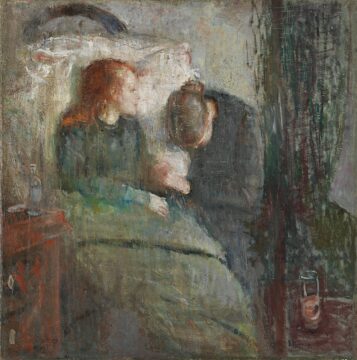
The Sick Child by Edvard Munch is undoubtedly a highlight of Norwegian painting, still compelling and touching, still unsurpassed. The odd thing is that the painting seemingly came out of nothing: Munch was twenty-one years old when he painted it, he had hardly any education, hardly any experience as a painter, and he painted it on the very outskirts of provincial Europe, in a Kristiania where, only a few decades before, cows could be seen ambling through the streets. Equally odd is the fact that this painting, which marks the beginning of Munch’s artistic career, his first masterpiece, is also an end point: he never again made anything that came close to it. The Sick Child is an anomaly—it resembles nothing else from that period, and nothing else in Munch’s long life as an artist. He worked on it for a year, adding layer upon layer, then, scraping the paint off, added new layers, scraped them off, as if he were burrowing into something, or toward something. When he exhibited it at the Annual Autumn Exhibition in Kristiania in 1886 he still considered it unfinished, and titled it Study. At the exhibition the painting was ridiculed, people laughed and pointed at it, the newspapers slammed it. Nowadays this is difficult to understand. How could anyone ridicule something so palpably heartfelt and vulnerable, and so existentially threatening, for isn’t it the very image of deep emotion and existential threat?
more here.
Enjoying the content on 3QD? Help keep us going by donating now.