
by Jim Hanas
There is a room at the Museum of Modern Art where you can stand with a Henry Darger at your right shoulder and look at Robert Rauschenberg’s Rebus on the perpendicular wall. It feels like an important position, this corner, where one can see—or imagine that one is seeing—naive immediacy and cultivated immediacy at once, though this immediately leads to questions. Was Darger, perhaps, more self-conscious than we imagine, and might Rauschenberg have been more intuitive, despite his credentials? How can you tell the synthesis from the thesis, once the former has become the latter and is ready for another go ’round? Maybe you can’t, any more than the Athenians could distinguish Socrates from the sophists.
In this corner, between the two paintings, there is a doorway with a glowing, code-mandated “Exit” sign above it. The doorway leads into the next gallery, but I like to think that the door itself is Ray Johnson.
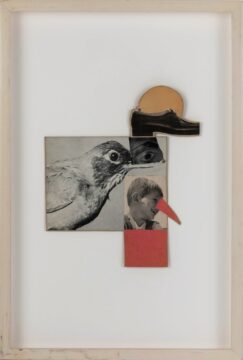
Johnson—the inscrutable collagist and mail artist—is part Rauschenberg, part Darger. Part insider, part outsider. It’s been possible in recent years to see a wide range of Johnson’s work in New York. There was an exhibition at the Morgan Library that focused on Johnson’s late use of photography—which took in a lot of his other mature work as well—and one at the Craig Starr Gallery that showcased his surviving Bauhaus-inspired paintings and traced his movement into assemblage and collage. I’m also lucky enough to have a friend who managed to get on the mailing list for Johnson’s New York Correspondence School as an art student growing up on Long Island. Examining the mailings she received, still in their original envelopes, was a thrill—one of these things you move to New York hoping to experience.
Two weeks ago, my wife and I headed to Ashville, North Carolina, to the Black Mountain College Museum, for the opening of Black Mountain COLL(A)GE, an exhibition—running through Labor Day—focused on collage work produced by artists associated with the college. Black Mountain, though a relatively short-lived institution, was among the mid-century’s most fertile hubs for the emerging American avant-garde. As European artists fled to America, Josef Albers brought Bauhaus practices to the Blue Ridge Mountains, where he taught from 1933 to 1949, hosting a who’s who of interdisciplinary artists, including John Cage, Merce Cunningham, Willem de Kooning, Jacob Lawrence, Robert Rauschenberg, Susan Weil, Cy Twombly, and—of course—Johnson.
Johnson arrived there in 1945, straight from his hometown of Detroit, and—in retrospect—seems to have been its ideal student. His early works were meticulous color studies, very much in Albers’ Bauhaus style, though ultimately the matière—material studies using found objects that were primary exercises at Black Mountain—became the dominant note in Johnson’s idiosyncratic career. That this was the case for many at Black Mountain is the premise of the current exhibition—which features work by Rauschenberg, Weil, and others. I went hoping Johnson would be well-represented, as indeed he was.
The most mischievous piece on display—Johnson’s best work (like that doorway) takes up a position between outsider naivete and art world knowningness—reproduces Johnson’s response when asked to corroborate Rauschenberg’s claim that he had asked Johnson to contribute to a painting in 1955, alongside Jasper Johns, Stan Venderbeek, and Weil, who at the time was Mrs. Rauschenberg. In 1967, Johnson wrote to a curator:
I have no remembrance of being asked by Robert Rauschenberg in 1955 to incorporate my work in any work of his incorporating the work of Sue Weil and Jasper Johns.
I do remember at that time a small orange tree Bob and Sue had. Also, on a small island off the coast of Connecticut, Sue’s mother had a large house, I carried a book on Taoism and quoted lines to them about emptiness and nothing. Years later the house burned.
This text reappears in the untitled collage from the late ’70s/early ’80s, now addressed to the director of the Whitney, Tom Armstrong, whose name appears backward.
Given Johnson’s commitment to ephemerality, his work benefits from being seen in person, particularly the few sets of mailings on display, which feature tiny collages (for which he invented the grammatically challenging neologism “moticos,” which is singular in number), buttons, and scraps, packaged together and mailed to friends. It is difficult to describe why these works “work,” and why it helps to be with them. This is an open problem for modern (and post-modern) art in general. The challenge was evident in the Life magazine article covering Rauschenberg’s controversial triumph at the 1964 Venice Biennale. In explaining the artist’s famous Angora goat combine, Monogram, to a general audience, the magazine offered:
Today Monogram is one of his most admired works, exercising an eerie and totally inexplicable fascination on viewers. Critics speak of its “rightness” but are unable to explain the goat’s allure. It remains one of the most bizarre art objects ever created, an extreme instance of the juxtaposition of unlikely objects.
So after the beautiful and the sublime, “the right?” A question-begging aesthetics if ever there was one.
I had an unexpectedly powerful experience in this same gallery a few years ago. (While I was hoping for more Johnson, perhaps I was also seeking more Black Mountain?) I was in Asheville for a family Thanksgiving—no one lived there, we had all converged—when I stumbled in for an exhibition devoted to John Cage. At the time I knew what everyone knows about John Cage and only a bit more about Black Mountain College. Enough to draw me in.
They had staged an installation of Cage’s 33 ⅓, which calls for eight to twelve unattended turntables and a supply of random records. My wife and I were the only ones in the gallery, save for the receptionist, and I was surprised to find how hard it was for me to put records on the turntables without confirming with the receptionist that this was their intended use. There were records and there were turntables, but there were no instructions—of the kind to which we’ve all grown accustomed and perhaps dependent upon—so I felt both in a murky area and chillingly like a well-heeled totalitarian subject. In the end, I resisted the urge to seek permission and got The Stooges’ Fun House and John Lennon’s Imagine spinning at the same time. No security guards arrived and the two records drifted pleasantly in and out of phase as we tour the rest of the exhibit.
In an essay written in 1997, two years after Johnson’s meticulously planned suicide, the artist’s long time correspondent and collector William S. Wilson described a similar emancipation brought about by Johnson’s work and his long friendship with the artist. He writes:
I have made for myself a few statements about the feeling I experience with some art—not theoretical statements, but a home-made aesthetic or theory of art—statements about emancipations and about energies to use as scaffolding for my thoughts. In words which work for me, the moments I value and preserve are the moments I experience as emancipations. I often laugh with glee when looking at even somber paintings, feeling that I have been freed from an oppression I can’t quite name, and which I haven’t noticed until being freed from it. Ray and his work immediately contributed to the sum of such freedoms. He was convincing because he acted on his belief that art should be free, liberated from money as well as from repressions. Certainly he used the art of friendship to free his friends from oppressive conventions and general unfreedoms.
“Oppressive conventions and general unfreedoms.” Weber’s iron cage swung open. Johnson is the door, as I suspected, but the “Exit” sign is not needed.
***
Enjoying the content on 3QD? Help keep us going by donating now.