
by Dilip D’Souza
What is it about ants? No, I mean it. In all my writing over the years, ants have been a frequent and nearly beloved subject. Some, when set down in a maze and faced with a choice, tend to turn left. Some have walked on stilts while compatriots have had their legs (sadly) trimmed. The late great myrmecologist, EO Wilson, described a charming experiment in which a live ant, smeared with pheromones only exuded at death, was promptly ferried – frantically waggling limbs notwithstanding – by his mates from the nest and dumped outside.
All in the service of science, and all just fascinating – fANTscinating, I can’t resist – to me.
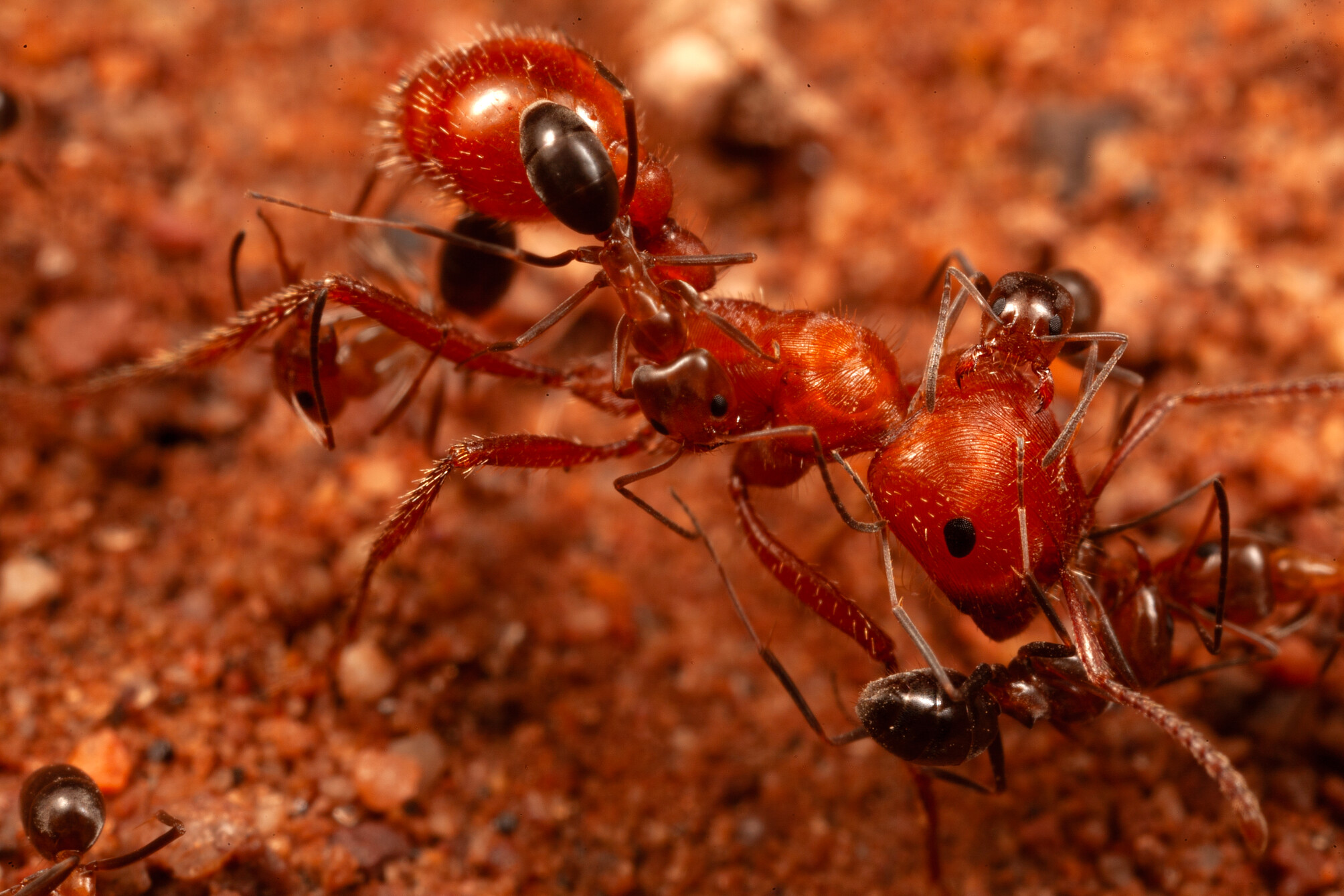
And over the last few days I’ve been reading about … well, it’s like this. Out in the Arizonan desert, some large harvester ants (Pogonomyrmex barbatus) left their nests and stood still. I don’t mean this happened all of a sudden, nor am I suggesting this is unusual behaviour for these ants. But a researcher from the Smithsonian Institute, observing these ants one morning, found them doing just this. (“The First Cleaner Ant? A Novel Partnership in the Arizona Desert“, Mark W Moffett, Ecology and Evolution, 12 April 2026.)
Why would these members of an otherwise frenetically active family of animals cease movement? No, they hadn’t dropped dead … but hold that thought.
This particular stillness, because several members of a much smaller “undescribed” species in the genus Dorymyrmex, known as cone ants, climb onto these unmoving ant Goliaths and … groom them. For which favour, the harvesters stand there with their jaws helpfully wide open. I should say, ant Amazons, because the harvesters that leave their nests and roam about are workers, and worker ants are always female.
Understand that a harvester is large enough to devour the cone ants that clamber over her – and her jaws are open, after all. But she doesn’t devour. She simply stands and waits, then submits to the cone ants’ ministrations, a process that might take up to five minutes. Kind of like queueing up at a carwash. Or, continuing the car metaphor, F1 racers pulling into a pitstop for a change of tyres. (I’m not the first to draw either parallel.)
And the cone ants? I might have thought they’d be suspicious of (“is this a Trojan Ant?”) or aggressive towards these large visitors. Moffett wondered in another direction: “Were the cone ants burgling morsels from the mouths of another species, as some ants do?” Apparently this happens with two species of ants in Florida; the “robbed ant stiffens briefly but fails to defend herself.” But this was not the case with these two Arizona species. The cone ants “were not stealing from their cousins.” Here, the harvesters wait for their cousins to climb on, after which the smaller ants appear to lick tiny particles off the harvesters. They nibble at certain spots. They even reach inside the harvesters’ jaws, cleaning out those maws. On any given harvester, Moffett noted up to five cone ants.
The whole spectacle, wrote Moffett, is behaviour “remarkably parallel to the actions of cleaner fish that clean other species of fish”. “As I watched the ants interact,” he also wrote, “I became increasingly convinced that this [cone ant species] was the first recorded ‘cleaner ant’.”
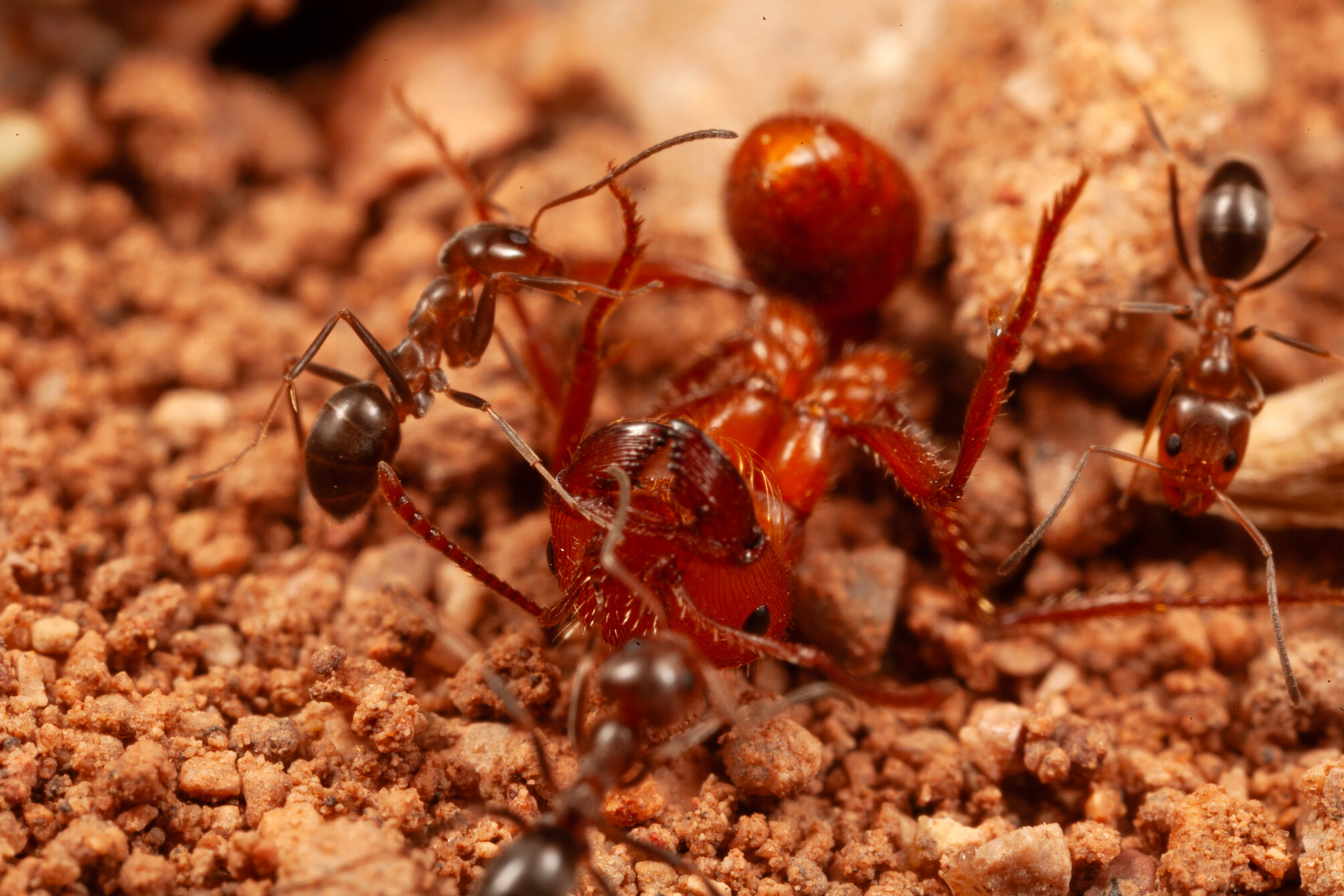
But if this so far seems like calm and friendly behaviour from both species of ants, matters seem to deteriorate towards the end of these brief encounters. Moffett observed that eventually, “the cone ant appeared to annoy the Pogo: perhaps one bit too hard, or too many had climbed aboard, or the client ant had received a sufficient scrubbing.” Whichever it is, the harvester suddenly decides she has had enough, and convulses to get rid of the cone ants. This is an effort violent enough to fling off the clingers, though she – the harvester! the Amazon! – sometimes ends up on her back. “Any remaining passengers were knocked to the side as she righted herself and hurried away.”
Nor should we blindly assume that the cone ants are paragons of altruism. Another species, Dorymyrmex bicolor, is known to greet foraging competitors by dropping pebbles on them.
So yes, why would these Arizona ants behave like this? How, if at all, are they mutually benefiting? Those are hard questions. Moffett has some speculations. The cone ants may be able to “access tighter corners” on the harvester body, thus “removing hard-to-reach pathogens”. An Australian colleague suggested that the two species are “exchanging valuable microbes”, thus mutually improving each others’ health. There are more theories.
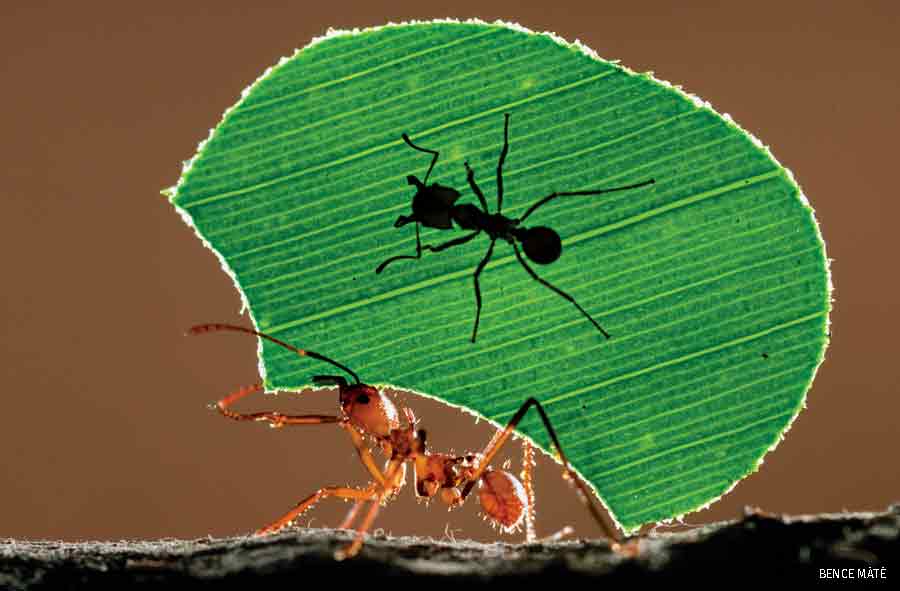
There are also other ant partnerships. Costa Rica’s leafcutter ants (Atta cephalotes and others), for example, famously and diligently carry bits of leaves to their nests. Riding shotgun on those patches of green are tinier ants (“minims”) from the colony, there for a very specific task. A particular fly likes to lay its eggs inside the heads of live leafcutters. Rushing about on the leaf fragments, the minims snap at these parasites to keep them at bay. Lives depend on how well they perform this “micro-foraging” effort.
Yet interestingly, Moffett admits that he’s not persuaded that the Arizona interactions are “mutually advantageous” at all. With fish, for example, it’s true that the client fish (the ones that get cleaned) actually look for cleaners and let themselves be cleaned. But while there are over 200 species of cleaners, only one of those (Labroides dimidiatus) has been studied enough to show “an improvement in client survivorship”. There need to be similar detailed studies done with the ants, to discern how the harvesters actually benefit from the attentions of their smaller cousins. Might there be a tiny parasite, like the fly in Costa Rica, that seeks to attack the harvesters?
In fact, it is these doubts about mutual benefits that kept Moffett from writing up his observations – for he actually saw these ants in 2006.
Or maybe it was guilt because he killed some of these harvesters, by freezing them. All in the service of science again, of course. He wanted to know what the cone ants would do with dead harvesters. Not much, as it happens. When he placed the dead ants in front of the cone ants’ nests, the smaller creatures merely examined the corpses and moved on.
Be that as it may. Moffett ends his paper with this thought: “In a world where most ants steal, fight, and outmaneuver one another … two species in an Arizona desert leave room for an unexpected collaboration.”
There’s hope there. Perhaps even for a larger species called Homo sapiens.
***
Postscript: Moffett’s research is supported by a grant from the Templeton Foundation. I’d love to hear thoughts/opinions about that.