
by Bill Murray

1
One of the most memorable images from Vladimir Putin’s war on Ukraine was that 40-mile traffic jam of tanks, armored vehicles and supply trucks headed south from Belarus, backed up on the M07 highway in a futile lunge toward Kyiv.
Ukrainian civilians took down road signs, used tractors to tow abandoned vehicles over to their own army, gave Russian troops bad directions and guided them onto roads that turned to mud. Where they sat for a week or more.
Today, Russian tanks rarely approach the front lines. For this war, at least for now, the battle tank has become obsolete. We now compare the evolution of warfare not to the storming of Iraq 35 years ago, but to 35 months ago.
Ukraine deployed some 3.5 million drones in 2025. Their projected capacity this year is seven million. Drone swarms, now under intense development, are coming next, before ethical concerns have been thoroughly vetted.
Racing toward deployment, too, are autonomous fighting systems, in which military judgments involving life and death can be made by artificial intelligence instead of people. AI is already creeping onto the battlefield.
Against the backdrop of this sort of accelerated change, NATO’s requirement for unanimous agreement across 32 countries before commitment to action looks downright quaint. So it’s time to consider what might work better.
2
To negotiate with Russia today is to seek appeasement of an expansionist, autocratic regime. Ask the leaders of Estonia, where a NATO F-16 shot down a drone involved in Russia’s war on Ukraine in May.
Ask Latvian officials, who have repeatedly scrambled NATO aircraft against drones, one of which struck an oil facility. On three consecutive days in May at least one drone entered the country’s airspace. Train service has been temporarily suspended.
Ask civilian Finnish and Norwegian pilots. Last summer a pilot for a Finnish airline called Russian GPS interference at Inari and Kirkenes airports in northern Finland and Norway “a daily nuisance.”
Ask Swedish military leaders, who “took down a drone of unknown origin” in Swedish territorial waters “in the proximity to the French aircraft carrier Charles de Gaulle” in late February. Sweden’s Defense Minister confirmed the drone’s Russian origin.
Or most dramatically, ask Lithuania’s political leadership. When radar detected a potentially hostile drone in May, air traffic at Vilnius airport was suspended, trains were halted, schools moved children to shelter and the president, prime minister, cabinet officials and Members of Parliament were moved into bunkers.
These examples show the threat is clear and present. Eastern NATO airspace no longer enjoys secure domestic tranquility. Indeed, it increasingly stands watch as NATO’s front line. This is happening now. This is real.
As the challenge grows more serious, leaders have been speaking more plainly. Here is Poland’s President Donald Tusk on April 24th:
“For the whole eastern flank, my neighbors . . . the question is if NATO is still an organization ready, politically and also logistically, to react, for example against Russia if they try to attack.”
Tusk tried not to imply that he was skeptical of American commitment to NATO’s Article Five, but stressed he was looking for “practical ways countries would support each other in the event of attack.” He said his “mission is to reintegrate Europe,” and that he sought “a common effort to protect our eastern borders.” Regardless of Washington.
The Trump administration has shown, with rhetoric and action, that the United States will no longer guarantee defense of the NATO alliance. The loss of European leaders’ fundamental trust — see Greenland — is a separate, and complicating, question.
But back to the Polish president:
“This is something really serious. I’m talking about short-term perspectives, rather months than years,” Tusk said, in reference to a potential Russian attack.
Listen to the leader of Poland when he says “This is something really serious.”
Yet Europe is perennially unable to organize its own defense without American help. As ever, there is vast, general agreement on three basic steps, all the natural province of European organizations, or individual governments acting together:
A. Standardize weapons manufacturing within Europe to avoid duplication of effort and to establish economies of scale.
B. Establish a joint buying pool for armament procurement.
C. Consolidate national financial markets into an integrated European whole.
All are longstanding needs that won’t be solved by this paper, or soon. Yet they must be solved. It is not hopeful that they are no closer to resolution, even as from Trump I to Trump II, the alliance moved from a rhetorical ‘will Article 5 hold?’ to the working assumption that Donald Trump won’t be there for Europe.
NATO was created at a particular historical moment, as an expression of solidarity against a perceived threat to North Atlantic democracy by the communist Soviet Union. A foundational feature of the new alliance was its promise of a durable American commitment to Europe’s defense.
Today the alliance appears to be losing the American guarantee around which it was built. That may not be as catastrophic as it is usually framed.
Waiting for a 32-member defense alliance to achieve political unanimity before lumbering into action no longer makes sense. In a world undergoing profound, rapid change, situational agility matters more.
In any coming conflict with Russia, a fractious NATO, where consensus is elusive, should be supplanted by a roster of groups with shared stakes, groups that provide overlapping circles of competence and security. The Cold War rewarded solidarity. A more fragmented world rewards adaptability.
3
Northeastern Europe has been preparing for war since Moscow’s full-scale invasion of Ukraine in 2022, making it the natural place to forge real-world, practical solutions to the problem of Europe’s defense.
Donald Tusk and his fellow frontline leaders no longer have the time to constantly affirm Madrid’s (or Washington’s, or anyone else’s) commitment to Article 5. They need faster, better and more responsive mechanisms to grapple with the challenges on their doorstep.
Today, frontline states think in terms of operational coalitions rather than alliance-wide unanimity. Smaller, faster, more agile regional defense groupings can operate within or alongside the shell of the NATO treaty left behind by an indifferent America.
NATO won’t disappear. The United States still needs European bases, if only for force projection elsewhere in the world. So long as it does, an appropriately scaled-down NATO is a logical vehicle to manage that presence.
And useful new NATO initiatives are underway. NATO’s Eastern Flank Deterrence Initiative, for example, is designed around just-learned battlefield lessons and taught by Ukraine, even as it adapts and learns, in real time and under pressure.
4.
Various post-NATO defense schemes are already in operation. The policy shop term for this type of group is “minilateral.” At least three different groups of frontline states already function, and during the second Trump administration all have gained strategic momentum. They are:
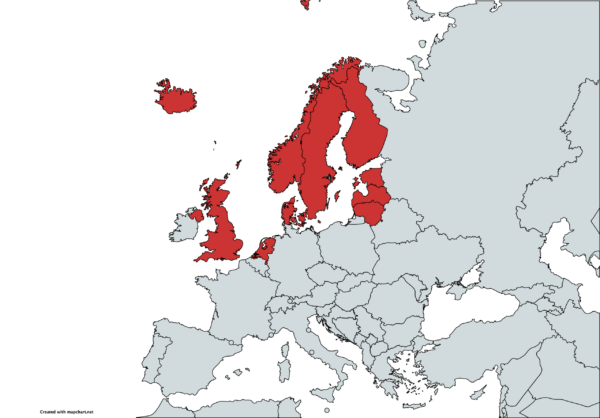
First: the Joint Expeditionary Force, created in 2014 and initially comprised of Denmark, Estonia, Latvia, Lithuania, the Netherlands, Norway and the United Kingdom. Finland, Iceland and Sweden joined later.
This group grew out of a concern we’ve seen borne out — that NATO’s formal structures might be too cumbersome in fast-developing crises. Its quick buy-in from the Russian-threatened Baltic states makes it a natural starting point to build up defense against Europe’s most likely adversary.
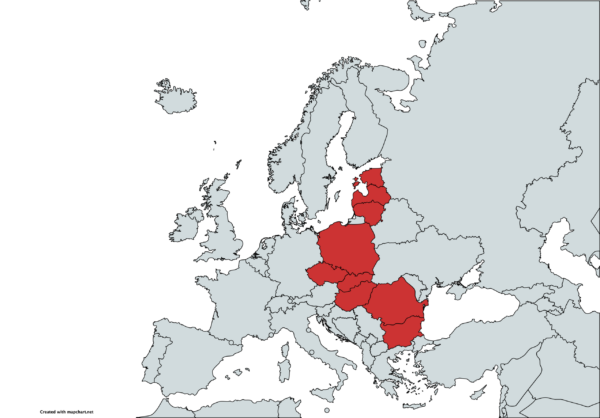
Second: the Bucharest Nine, founded by Romania and Poland, includes the three Baltic states, as well as the southeastern flank countries Bulgaria, Czechia, Hungary and Slovakia. Like the JEF, it was created as a reaction to Russia’s seizure of Crimea.
Third: the so-called Nordic-Baltic Eight, Denmark, Estonia, Finland, Iceland, Latvia, Lithuania, Norway and Sweden, is a natural complement to the other two. The name, shortened to NB8, sounds like think tank jargon, but the geographic idea is clear on a map:
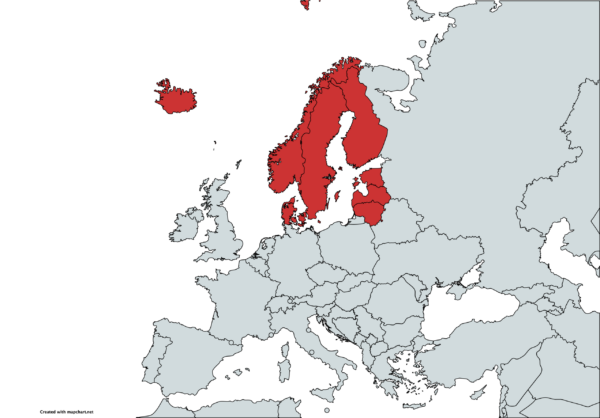
The NB8 is different from the other two in that it was not created as a reactive military coalition. It evolved organically out of geographic proximity, shared political culture, post-Cold War integration and simple practical cooperation among small northern European states.
There are also natural allies outside these budding organizations. Opposite NATO’s southeastern flank, Moldova, a frontline state to Russia’s aggression against Ukraine, has a government eager to align with the West. And Ukraine itself is already a close de facto ally, whether inside NATO or not.
It’s been an eventful fourteen months since the ‘you don’t have any cards’ Oval Office encounter between Volodymyr Zelenskyy and Donald Trump. Ukraine’s military innovations are now sought after worldwide, including by the Trump administration. In some areas critical to warfare today, Ukraine’s new war-fighting prowess far exceeds America’s.
Ukrainian instructors are teaching drone warfare in Britain and Germany. Ukrainian experts work with Saudi Arabia, Qatar and the UAE on maritime security and drone threats.
Last summer in Estonia, Ukrainian teams acted as “opposing forces” in NATO exercises and “successfully simulated the destruction of 17 armored vehicles and conducted 30 strikes in half a day, effectively neutralizing two NATO battalions before dinner.”
•
If proto-organizations like the JEF, B9 and NB8 and new and eager allies form a post-NATO future, they will only be a part of it. Agility and new-found vigor alone are not enough.
Frontline states will still require the political legitimacy, industrial capacity, and financial backing of old-line Europe. There is no substitute for the expertise and institutional memories of Brussels, the defense ministries, the European Central Bank and the bond markets.
Newer coalitions can bring adaptability, speed and new focus. But the continent’s deepest reserves of power and competence still lie in the traditional manufacturing and commercial centers of Europe: the Rhine-Ruhr valley, northern Italy, the English Midlands, and the financial markets of London, Paris, and Amsterdam. Here, too, in a role that could grow less military than political and financial, could help coordinate that support.
Throughout the process of change, frontline leaders will still require steadfast diplomatic backing from like-minded allies beyond Europe. There is no longer time to convene continent-wide festivals of diplomacy in pursuit of ideologically perfect consensus. But neither can Europe’s newer security groupings operate alone.
5.
It all sounds just about plausible, and the times demand that the Western alliance give it a try. Still, time is short, the road ahead is poorly marked and the challenges are many, real and dangerous:
The very multiplicity of new “minilaterals” concerns many, who worry about potential duplication of effort. Two of these proto-organizations have existed since 2014, yet neither has formal treaty obligations, standing forces, or integrated command. The JEF has ‘frameworks.’
The Bucharest 9 serves a membership that reflects geography more than political harmony, and the Nordic Baltic 8 is looser still. All this despite twelve years of worsening European security conditions since the Crimean invasion.
But these are procedural questions, for which answers can be found. The biggest obstacle facing a post-NATO West is deeper, cultural and harder to change. That problem is Germany, and it warrants a good look.
6
It’s everybody’s cliché that the German economy is the economic engine for the continent, and Germany’s economic problems are forever blamed for whatever Europe can’t get done.
It’s a problem that Europe’s economic engine has experienced extremely weak growth since 2018, with multiple years of outright contraction or stagnation.
Real GDP today is only marginally above pre-pandemic levels. Germany has been one of the weakest-performing big European economies since the late Merkel years.
In a fit of almost magical conjuring, Chancellor Merz finagled himself a €500 billion “special fund for infrastructure and climate neutrality” before he assumed office last spring. And here we sit, a full year later.
If you have a half a trillion Euros to push out the door, how do you fail to move the needle on growth? That much money is enough even to overspend a bit in the service of getting things moving.
Even as vastly changed times cry out for new approaches, Germany’s governing culture clutches for the Cold War virtue of stability. The German system is surely the West’s best at caution. And consultation. And incrementalism. And procedure.
At times like this Germany is wont to use its “special history” card. But the Cold War ended more than thirty years ago. The Third Reich fell in 1945. Dear Chancellors Merz, Scholz and every last twenty-first century German leader: adaptability is now a virtue. It’s stasis that’s the problem.
A healthy state facing a perceived civilizational shock like Russia invading Europe does not spend the next four years explaining the problems it has building railways or power lines or a military quickly. A healthy state changes some rules. It turns out Germany is not a healthy state.
Merkel clung to her Russian pipelines. Lindner brought down a government rather than ease his debt brake. Scholz, hardly a theatrical man, tried drama, declared a zeitenwende just three days after Russia launched its full-scale invasion of Ukraine, and then … nothing happened.
In Scholz’s case, if the zeitenwende speech was a missed opportunity, the follow-through was German managerial majesty: squeezing a turning point through procurement rules and committee procedure.
Defense Minister Boris Pistorius wears a media-conferred mantle of competence. He may be the first Bundesminister der Verteidigung in years to strike the public as actually serious about defense.
When Ursula von der Leyen served Angela Merkel in Pistorius’s current role, German troops trained with broomsticks instead of machine guns. Under Chancellor Scholz, Defense Minister Christine Lambrecht sent 5,000 helmets as Russia drove toward Kyiv. (Kyiv Mayor Vitali Klitschko wondered if they might send pillows next.)
Pistorius seems to understand that Germany has entered a more dangerous era. But has he transformed the Bundeswehr? Germany wants the strongest conventional army in Europe and dramatically increased troop numbers, but it struggles with recruitment.
Judged against the low baseline of late Merkel and early Scholz defense policy, Pistorius and the Merz government look dynamic. But against the scale of the historical challenge?
7.
NATO no longer inspires the confidence required to defend the North Atlantic alliance. Some combination of the new initiatives we’ve considered today should begin to replace NATO’s original defense structure.
Relevant new organizations are already taking shape and finding their way toward one another. This mixing and matching illustrates both the logic and the promise of Europe’s emerging minilateralism. Its members do not agree on everything, but neither do they need to. Rather than striving for unanimity, they should seek to cooperate where they can.
In these frightening times, geography and a shared threat perception already drive cooperation. Unlike in NATO, the new coalitions we’ve discussed here can develop and work together without requiring a rigid ideological underpinning — or continent-wide consensus — designed for an ideological struggle that no longer prevails.
An Estonian think tank sums up today’s moment this way: “the proliferation of different coalitions of the willing is a direct consequence of the deepening malaise in common institutions, above all NATO and the European Union.”
That’s true. And now a timely, effective course correction, if done right, could leave the region a more cohesive whole.
•
Examination of Western decline is nothing new. Taking a minute to rue the loss of the ‘rules-based international order’ that prevailed for four generations is understandable. But you can talk things to death.
In the Obama administration, ‘admiring the problem’ was shorthand for overanalyzing things and avoiding taking action. Consider the problem sufficiently admired. The times call out for action. It’s time to shape the future. I offer this as a modest, good-faith conversation starter with some chance of success.
•••••
I write more like this on Substack at Common Sense and Whiskey.
•••••
Enjoying the content on 3QD? Help keep us going by donating now.