
Annalee Newitz at New Scientist:
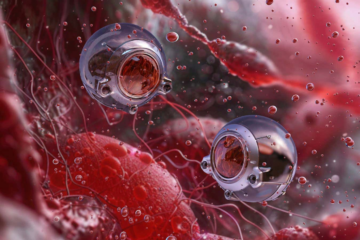 The robot army that saves the world won’t be anything like what you imagine. Nope, they aren’t little humanoids who can do synchronised martial arts like the ones who dazzled audiences during New Year’s festivities in China. And they won’t help you find a can of Coke with embarrassing slowness like the man-shaped beast known as Optimus from Elon Musk’s Tesla Inc. Instead, they will be microscopic, and mostly made of algae, bacteria and other single-celled organisms. Engineers call them biohybrid microrobots.
If you’ve read about people swallowing pills full of tiny robots to deliver medicine – or you watched the classic 80s flick Innerspace – you’ve already experienced the dream of a future. For many years, medical researchers have imagined using little machines to get medicine into the hard-to-reach parts of our bodies such as the minuscule capillaries in our lungs. Even better, these machines could actually drive around in our organs, perhaps to seek and destroy cancer cells one by one. The problem is that we can’t actually build motorised devices small enough to do it.
That’s where biomedical engineer Joseph Wang’s work comes in.
More here.
Enjoying the content on 3QD? Help keep us going by donating now.