
Mae Losasso at n+1:
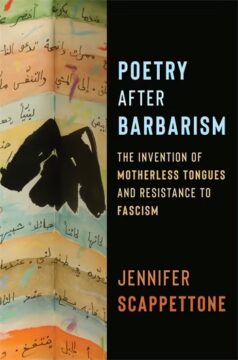 Poetry After Barbarism is a book about the “bar bar bar” of poetic language: not nonsense, exactly, not glossolalia, but the mistranslated, untranslated, and untranslatable. Or as Scappettone puts it, the “dysfluencies and awkwardnesses of grammar and of speech, linguistic jerks, hiccups, and chokes, cross-encroachments of vocabulary and syntax” that create “xenoglossic” textures in verse, a mode “poised at the threshold of the unintelligible” that Scappettone calls “pentecostal.” Not babble, then, but Babel, the ancient dream of a common language. In the Christian narrative of Pentecost as it appears in the Acts of the Apostles, speaking in tongues doesn’t mean gibbering nonsensical speech, but the miraculous ability to converse in unlearned languages.
If Scappettone is interested in the possibilities of a common poetic tongue, it is one pocked with failure and anxiety, alive to the ways that wobbly lingual switches practiced by a non-native speaker might be generative to poetic thinking—animated, she writes, by a “wistful aspiration toward communicability.”
more here.
Enjoying the content on 3QD? Help keep us going by donating now.