
Joshua Cohen at the Paris Review:
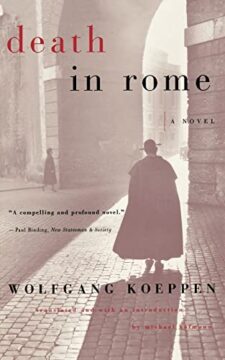
Wolfgang Koeppen, the maestro dirigent of the post-Nazi German-language novel, was born in the cold old Prussian port of Greifswald in 1906, a bastard, as they used to be called, the out-of-wedlock son of a seamstress who moonlit as a theater prompter and an ophthalmologist father, who dabbled in winter sports and competitive ballooning and refused most contact. Mother and son moved around a lot, from Koeppen’s grandmother’s house to the house of his mother’s stepsister. In 1912, the year Death in Venice (not Death in Rome) was published, the pair settled in Ortelsburg, Masuria, which is now the Polish city of Szczytno, where Koeppen attended Realschule. Mother and son fled west with World War I, heading along the Baltic coast until returning to Greifswald, where Koeppen made efforts to resume his schooling before dropping out totally and working as a deliverer for a bookstore, a cook, a ship’s cook, an assembler in factories, a theater usher, a movie theater usher, a projectionist, an ice maker and deliverer, and a tester of light bulbs. Each of these occupations, it might be argued, is a metaphor for “novelist”: delivering the books, preparing nourishment, et cetera. They certainly provided what in German industrial circles is called “material.”
more here.
Enjoying the content on 3QD? Help keep us going by donating now.