
by Ken MacVey
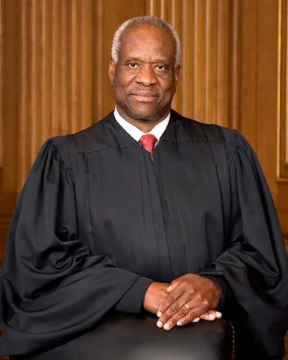 Justice Clarence Thomas recently gave a speech at the University of Texas on the Declaration of Independence in anticipation of its 250th anniversary this coming July. In giving his take on the Declaration and its ties to the Constitution, Thomas interspersed autobiographical details with commentary on what he perceives to be America’s moral failures to live up to the Declaration. Thomas attributed these failures to what he called “progressivism.”
The audience was enthusiastic and his presentation was acclaimed on Fox News. At the same time it was condemned in other circles. Renowned conservative and retired Judge Luttig described the speech as the most important speech on the Constitution that should never have been given. He condemned it as a manifesto for authoritarianism and for being anti-conservative to its core. Liberal constitutional scholar Erwin Cherminsky dismissed the speech as historically inaccurate and disturbing.
As will be shown, Thomas’ speech is largely incoherent, sometimes wildly so. What ties it together is not logic or historical fact — it is grievance. What is particularly concerning is that Justice Thomas is a powerful man; he is a justice on the Supreme Court. In fact, he has thus far served the second longest term of any Supreme Court justice and may end up serving the longest. He has played a key role in decisions that have re-shaped the United States, be it Bush v. Gore which guaranteed who would be president, the Shelby and Callais decisions which eviscerated the Voting Rights Act, the Dobbs decision which overturned Roe v. Wade, or US v. Trump, which granted Trump and other presidents sweeping immunity when it comes to committing crimes. What Justice Thomas succeeded in doing, by giving a speech while not wearing his judicial robes, was to reveal how he really thinks and what really motivates him.
Before getting into the substance of his speech, Thomas went out of his way to recognize his friendship with Harlan Crow, who was in the audience. This was not a mere acknowledgement of a friend—it was Thomas’ way of saying, “I don’t care what they say.” ProPublica and judicial watchdog Fix the Court report that over the years Thomas received hundreds of thousands of dollars in luxury goods and financial benefits from billionaire Crow, which Thomas initially neglected to disclose in his financial statements he is legally required to file. These revelations helped trigger public outcries that Supreme Court justices should be bound by a code of ethics just like other federal judges. In response, the Supreme Court recently did adopt a code of ethics, but with one catch—unlike the conflict of interest and ethics rules for other federal judges–there is no enforcement mechanism. Thomas’ heartfelt acknowledgement of Crow to the audience was undoubtedly sincere, and undoubtedly defiant.
Thomas does have a personal story to tell. In many ways, it is a really good story. Thomas is clearly a very intelligent man who broke free from the shackles of childhood poverty and racism. But what is also clear is that he failed to break free from the self-imposed chains of personal resentment.
This is illustrated by disparaging asides in his speech. He describes himself arriving as a young lawyer at Washington DC, almost like a naïve Jimmy Stewart character, only to find: “All around me, there have always been people, full of promises, claiming a commitment to some righteous cause . . . They can mouth the words of the Declaration [of Independence] and parrot its principles. . . . All too often, however, this was but lip service camouflaged by grand theories in the tall grass of big words and eloquent phrases.”
Thomas goes on: “People come to Washington and you learn who they really are. . . . They are enticed by access to things that were previously unavailable to them. They get so swept in the euphoria of acclamation and acceptance they put aside their convictions.”
The irony of saying this to Harlan Crow, who is reported to have bestowed several hundreds of thousands of dollars’ worth of luxury trips and goods upon Thomas, or saying this to an adoring audience, is apparently lost on him.
Then it gets really personal: “They water down their messages, negotiate against themselves, vote against their principles, and hide in the tall grass. They recast themselves as institutionalists [are you listening Chief Justice Roberts?], pragmatists [how about you Justice Breyer?], or thoughtful moderates [looking at you Justice Kennedy], all as a way of justifying their failures to themselves, their consciences, and their country.”
Left standing alone, a hero in his own mind, is Clarence Thomas.
Now for the incoherent, illogical and historically inaccurate parts in his speech.
Thomas’ theme is that the principles of the Declaration of Independence have been discarded in modern times and that they need to be “rejuvenated.” He doubts that those like the “young soldiers” who stormed Normandy Beach exist today. What is the solution to this lack of conviction? Thomas at least knows what the solution is not: “I doubt any amount of study or development of insights about our Constitution will make much of a difference.”
Thomas then provides the diagnosis and prognosis for this moral collapse: “At the beginning of the 20th century, a new set of first principles of government was introduced into the American mainstream. The proponents of this new set of first principles, most prominently among them the 28th President, Woodrow Wilson, called it progressivism. Since Wilson’s presidency, progressivism has made many inroads in our system of government and our way of life. It has coexisted uneasily with the principles of the Declaration. Because it is opposed to those principles, it is not possible for the two to coexist forever.”
In making this terminal prognosis, Thomas never defines “progressivism.” Nor does he mention that the word became especially prominent after Teddy Roosevelt founded the Progressive Party and ran and lost as the party’s presidential candidate against Woodrow Wilson in 1912.
Thomas declares that progressivism “seeks to replace the basic premises of the Declaration of Independence, and hence our form of government.” He claims that progressives hold “a great contempt for the American people.” In support of this proposition he says Wilson lamented that “we do too much by vote. . .”
Thomas says all of this, without batting an eye, after previously explaining why government must be limited: “Federalist No. 10 proposed the idea the great threat to our rights comes from majority faction. Human history teaches us, alas, that numerical majorities frequently seek to control government, and use the state to violate the rights of the minority.” This is apparently an acceptable version of why we must make sure we don’t “do too much by vote.” Again the irony is lost on him.
At the same time, Thomas fails to mention that during the Wilson administration the Constitution was amended to require senators be elected by voters instead of being appointed or that Wilson endorsed the 19th Amendment giving women the right to vote.
Thomas then declares: “It was a terrible mistake to adopt progressivism’s rejection of the Declaration’s vision of universal inalienable rights. Wilson’s claim that natural rights must give way to historical progress could justify the great mistakes in our history. In Plessy v. Ferguson, my Court upheld Louisiana’s system of racial segregation because ‘separate but equal,’ it observed, was reasonable in the light of ‘the established usages, customs, and traditions of the people . . .’ ”
The Plessy decision was made in 1896, sixteen years before Wilson was elected. It can hardly be laid at Wilson’s White House doorstep—there is no such thing as retroactive historical causation.
Ironically, as an originalist, Thomas believes in relying upon historical understanding and practices that were concurrent with the adoption of the Constitution and its amendments to affix constitutional meaning. As demonstrated by Thomas’ quote, this method was also specifically endorsed in Plessy. Presumably when the Supreme Court was under the sway of Wilsonian progressivism, the Court in its 1954 decision Brown v. Board of Education overturned Plessy based on the 14th Amendment’s equal protection clause. As some historians and constitutional scholars have concluded, the “historical understanding” when the 14th Amendment was adopted was that the amendment was compatible with racial segregation. Thomas’ originalist methodology– which thankfully was not followed in Brown v. Board of Education when the Supreme Court recognized the reality before everyone’s eyes that segregated schools were inherently unequal– would have been Plessy’s best bet for remaining as precedent. But the Court said instead : “We cannot turn the clock back to 1868 when the [14th] ] Amendment was adopted, or even to 1896, when Plessy v. Ferguson was written.”
Thomas further gets it wrong when he praises Abraham Lincoln for relying on the Declaration of Independence in criticizing racial segregation. In fact, in the 1858 Lincoln-Douglas debates, Lincoln endorsed racial segregation while also condemning slavery. What could have been called out under Thomas’ high standards as a “watering down of message” and “hiding in the tall grass” Thomas lets go.
Thomas’ grasp of 20th century history fares no better. He pronounces: “The century of progressivism did not go well . . . Stalin, Hitler, Mussolini, and Mao all were intertwined with the rise of progressivism . . .” This is off the rails and off the wall. Again, Thomas never defines “progressivism” but no matter the definition no one before has ever suggested that Stalin, Hitler, Mussolini, or Mao should be labeled “progressive” or that “progressives” are their adherents. That’s beside the point. What counts for Thomas is that lines are drawn: darkness versus light; progressivism versue the Declaration of Independence.
Contray to Thomas, what in fact is associated with the word “progressive” in the 20th century is the affirmation of human rights. Wilson’s hope and ultimate vision for the League of Nations did not materialize. But the United Nations was the League’s successor. In 1948 the General Assembly of the United Nations approved the Universal Declaration of Human Rights. Article I begins: “All human beings are born free and equal in dignity and rights.” When “progressivism” was supposedly infecting Americans in the 20th century, we saw the affirmation and expansion of civil rights and civil liberties and principles antithetical to what Stalin, Hitler, Mussolini, and Mao stood for, an affirmation many have called “progressive.”
Thomas’ fundamental complaint is that “progressivism” supposedly “holds our rights and dignities come not from God, but from the Government.” Again “progressivism” is undefined—it’s a label. Yet laws do come from government and laws can and do provide rights. Take the Second Amendment, for instance, whose application Thomas has enthusiastically endorsed. Not even he in his opinions expanding the scope of the Second Amendment claims that the right to bear arms comes from God.
Thomas’ implicit but fallacious syllogism is that the Declaration of Independence is based on God, the Constitution is based on the Declaration of Independence, therefore the Constitution is based on God. It is “progressivism”—Thomas argues—that is dismantling our constitutional order and “God-given equality.”
Thomas’ speech is really a plea for theologically based law, which runs counter to what the Constitution stands for when it decrees there shall be no religious test for federal office (Article VI, paragraph 3) and no government establishment of religion (First Amendment), and which in its text omits any reference to God.
It is interesting that Clarence Thomas is a fan of Ayn Rand. Thomas was known for his practice of having his new crop of law clerks each year watch with him the 1949 movie, “The Fountainhead,” starring Gary Cooper. The screenplay, based on her novel of the same name, was written by Ayn Rand. The movie climaxes with an oration by the story’s hero, Howard Roark, that sums up Rand’s philosophy of fundamental rights centered upon property rights and individualism. This speech is what Thomas must have found inspiring. Rand called her philosophy Objectivism, which held there was no God and religious belief must be rejected because it was not based on reason. Thomas makes no mention of her in his speech, maybe because it does not harmonize with his theme that fundamental rights must solely rest on theological foundations.
Nor does Thomas mention Trump. He targets Woodrow Wilson who has been dead for over a century. Yet he makes no mention of the current president who announces “I have the right to do whatever I want as president” and acts accordingly. Thomas questions the courage and moral fiber of those he thinks are infected by “progressivism.” Yet he makes no mention of the millions who take to the streets, carrying placards that echo the Declaration of Independence’s pronouncement that when it comes to America there are no kings.
Perhaps Clarence Thomas needs to lecture less and listen more to those who march today under the banner of the Declaration of Independence. Unfortunately, this is very unlikely to ever happen.