
by Anton Cebalo
In the first century AD, a passionate didactic poem was written in Latin and later bundled with Virgil’s work. However, the style is so drastically different from his that the author’s real name is likely permanently lost.
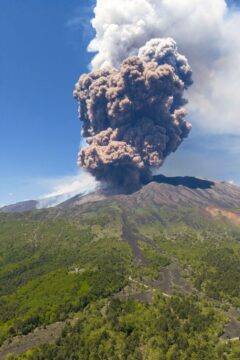
Aetna is a poem that revolves around explaining how Mount Etna (“Aetna” in Latin) on the island of Sicily erupts. Whoever wrote it must have made an altar in his mind devoted this volcano which was the most active in the region then. Mount Vesuvius had not destroyed the Roman city of Pompeii yet.
Aetna shall be my poetic theme and the fires that break from her hollow furnaces.
The poem is written romantically, as an ode to nature and to not underestimate the fiery infernos of Earth. It may be one of the few classical works that deals explicitly with the Earth as a victim and the consequences of taking from the land without paying it back in kind.
What’s also unique about the poem is that it is explicitly naturalistic. In a time of lyrical myth-making, the author spends the opening dismissing three leading myths about Aetna. No, he writes, Aetna is organic and has to be understood on her own terms. He speaks of Aetna as a body full of underground rivers, caves, and winds that carry the fire. He describes them in great detail to rationally understand how the volcano lives and moves.
This would be rare in classical poetry on its own, but the real emotional heart of the poem is what follows this naturalistic exploration. For it’s not really just about Aetna, but how by understanding Aetna, one lifts one’s head to the sky and grows closer to higher things.
Yet this is man’s more primary task — to know the earth and mark all the many wonders nature has yielded there. This is for us a task more akin than the stars of heaven. For what kind of hope is it for mortal man, what madness could be greater — that he should wish to wander and explore in Jove’s domain and yet pass by the mighty fabric before his feet and lose it in his negligence? We torture ourselves wretchedly over little things: we let toil weigh us down: we peer into crannies and upturn every depth.
And here, we are met with the climax some two thousand years before industrial society and its exploits: the author describes Earth as interrogated, tortured, ransomed off, and abandoned. Rather than morally chastise individuals and their souls for committing such acts, the Earth is instead made the object of harm.
The quest is now for a germ of silver, now for a vein of gold. Parts of the earth are tortured with flame and tamed with iron till they ransom themselves at a price; And, when they have owned their secret, they are silenced and abandoned to contempt and beggary.
Day and night farmers hasten on the cultivation of their fields; hands grow hard with rural toil; we ponder the use of different soils. One is fertile and is more fruitful for corn, another for the vine; this is the soil for plane-trees, this the worthiest of grass crops; this other is hard and better for grazing and trusty to a tree-plantation. The dried parts are held by the olive; elms like a soil more moist. Trivial motives torture men’s minds and bodies — to have their barns overflowing, their wine-casks swelling with must, and their haylofts rising higher, charged with the full reapings of the field.
So do ye tread the path of greed where sight reveals aught more precious.
The closing lines of the poem moves into a horror-like frame. The Earth revolts against its pillaging by erupting. Fire pours down and many flee, grabbing their valuables foolishly, ultimately perishing.
… fire devours them as they linger: it envelops the greedy ones in flame. They think they have escaped, but the fire catches them: it consumes its prisoners’ booty: and the conflagration feeds itself, set on sparing none or only the dutiful.
But not all succumb to the volcano. Aetna ends on two brothers who take nothing but guide their ailing parents to safety. They survive out of a “sense of loving duty, greatest of all goods.” Aetna spares them, feeling it was shameful to “touch those duteous youths.”
Enjoying the content on 3QD? Help keep us going by donating now.