
by Laurie Sheck
1.
In his 1980 essay Walking in the City, Michel de Certeau describes looking out at Manhattan from the 110th floor of the World Trade Center. Viewed from above, the city is “a wave of verticals. Its agitation momentarily arrested…The gigantic mass is immobilized before the eyes.” From that vantage point, the city lies still, unimpeded, its extremes of wealth and poverty coinciding in the vast landscape below. “To be lifted to the summit of the World Trade Center is to be lifted out of the city’s grasp. One’s body is no longer clasped by the streets.” The viewer becomes Icarus in flight or a solar Eye, in thrall of “this lust to be a viewpoint and nothing more.”
But the walker in the city is subject to all sorts of contradictions and surprises. Immersed and vulnerable, they move through seemingly-endless inversions, displacements, accumulations. Footsteps unfold within time, making possible new meanings and directions.
This immersion is a form of love.
2.
Walter Benjamin put it this way: “The power of a country road is different when one is walking along it from when one is flying over it by airplane….The airplane passenger sees only how the road pushes through the landscape, how it unfolds according to the same laws as the terrain surrounding it. Only he who walks the road on foot learns of the power it commands.”
3.
In 1980, de Certeau could not have known the crumbled ruin the World Trade Center would become. How what seemed a place of safety and remove would become its exact opposite. In the hours after the towers were hit, I watched from my window as hundreds of people, their clothes covered in white ash, walked in a ragged line on the sidewalk below, heading to whatever home they were trying to get back to. Even now in my mind’s eye they are like sleepwalkers, everything happening in silence, as if, as I watched them, I had lost my sense of hearing. As if my senses no longer knew how to be in the world; what to do with the world. They walked holding their useless cell phones, their briefcases, their ashen coats.
In the days and weeks that followed, the air smelled of a mixture of blood and burning computers. Office papers drifted weirdly down like delicate white wings, unhurt, otherworldly. There were no cars on the streets, no mail delivery, no airplanes overhead. Each day, walking my daughter to school, we passed the checkpoint at 14th street where at that boundary the world of cars and daily life would suddenly reappear, though tentative, furtive, estranged.
Xeroxed faces of the missing and the dead stared from lampposts and graffitied walls.
4.
That first year of your illness, I walked nearly every day for several hours at a time, always west to the river and down to Battery Park or past it, the waters of the Hudson edged with small glistening ridges, the Statue of Liberty in the distance a blank marker, immobile, without meaning. Now that you were unable to walk, now that even the lightest touch of the bedsheet caused you pain, my own ability to walk seemed a small miracle in itself, the way certain everyday acts, like folding laundry, or hand-drying dishes with a cloth and putting them away, can seem, from a certain angle, almost like a form of peace.
As I walked, I passed stone faces carved into the sides of buildings, their rough, blinded eyes. I passed the neighborhood florist, the supermarket, the sparse, familiar faces scattered among the faces of strangers. The farther I walked the less familiar everything became and this unfamiliarity brought with it a kind of calm, an almost-soothing unreality. I was no one, like the lithe, elongated spray-painted figures on the façades of abandoned buildings—black shadows, faceless.
Once, walking along the river’s promenade, I saw, heading toward me, a man in rumpled work-clothes who looked almost exactly like the photos of Walt Whitman.
5.
I have long loved the writings of Robert Walser. Born in Switzerland in 1878, he worked at a series of menial clerical jobs while writing short pieces for periodicals as well as several short novels. At one point he attended a school to be trained as a butler, a profession he held in high regard and felt himself well suited for. Eventually he was admitted to the psychiatric asylum at Waldau, the first of two asylums where he would spend the final twenty-two years of his life. Although he claimed to have stopped writing, in fact in those last decades of his life he had been secretly writing all along—stories and a novel in script so painstakingly small for a long time they went unrealized as texts. As it turned out, there were 526 pages of these diminutive microscripts, some on pages as small as a business card. They were decipherable only with the use of magnification and a familiarity with kurrent script.
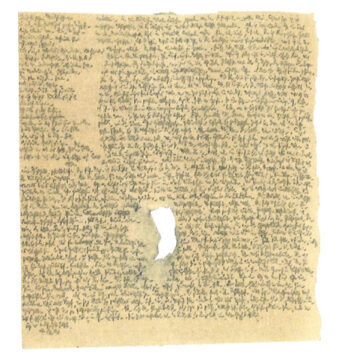 Walser wrote his book-length prose work, The Walk, in 1913. Setting out for a long walk from his writing room one morning, the narrator observes with great tenderness and interest the beings and objects he encounters while at the same time meditating on whatever thoughts arise from within. “What human being has ever seen as the years pass his hopes, plans, and dreams completely undestroyed?” he thinks to himself. Nothing he encounters is too small for his notice or appreciation: “enchanting” hats; a dog refreshing itself in a fountain; a glimpse of a baker. “Simply to tread upon the ground became a pleasure….Suddenly there came upon me an unnameable feeling for the world, and, together with it, a feeling of gratitude.”
Far from schedules, goals, or economic usefulness, Walser’s walker enacts a quiet refusal to adhere to those societal requirements and in so doing opens himself to the variousness of a world that presents itself without comment: “the old, poor forsaken man lying on the ground…so sorrowful and weary unto death that the sight of him….choked my soul,” but also the “delicious evening sun,”; “two houses that lay like kindly neighbors close together”; “a fragrance of most beautiful flowers.”
By the end of the book it is night. Picking flowers, the walker lets them fall from his hands and heads home from his wandering. In a world increasingly organized by rigidity and efficiency, he had given himself to digression, delay, the humility of seeing.
6.
When I was in my early twenties and living in the city after years away, I hadn’t yet grown accustomed to keeping a blank stare on my face as I walked. Disheveled men with wild eyes, hungry or on drugs, often approached me, usually asking for money but at other times telling some urgent indecipherable story. Frightened, I learned to turn away and to keep a stone look on my face. I had learned to be self-protective, but I also wonder what I lost.
7.
In 1980, the French artist Sophie Calle was invited to create an artwork for a gallery in the South Bronx. Soon after she arrived, she noticed that many of her peers from the downtown art world and others who would normally attend, were afraid to travel to that part of the city with its reputation for drug-dealing and danger. She decided to scrap her original idea and create instead a piece that implicitly confronted and refuted those blanket assumptions. Standing on the street outside the gallery, she “stopped passersby and asked them to take me to a place that if one day they were to leave the South Bronx they would remember.” They could lead her anywhere they wanted. One woman took her to the school where she had studied as a child; a man took her to a bank— “he told me he had once worked there.” Another took her to a vacant lot where the Pope had blessed him during a visit. Each destination was captured in a black and white photograph, with a brief caption below. The South Bronx is revealed through its paths of attachment, and the trust involved in walking with a stranger. Memory endures and flourishes in the empty lots, the seemingly abandoned and demolished places.
8.
A few years passed and slowly you could walk again, though never like before, your gait more tentative, less steady. We decided to walk to a small, nearby exhibit of Morandi’s still lives of bottles that seemed to huddle with quiet dignity at the edge of the vast, unpredictable world. It was the first time you had been outside in many months.
But a few weeks later, you woke one morning to find you could no longer walk. That was several years ago. What are the streets to you now, as you look out the one small window where you live?—those streets where you once walked like Robert Walser’s narrator whose thinking moved to the rhythm of his footsteps, whose freedom was hurt and partial as most or even all freedom is, who picked flowers and let them fall from his hands.
9.
Step by step
The path I follow
Disappears
–Matsuo Basho