
Robert N. Watson at the Los Angeles Review of Books:
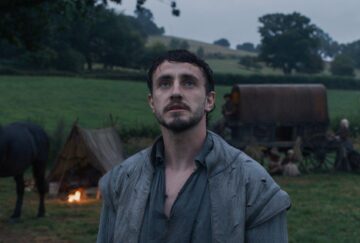 No doubt Paul Mescal, playing Shakespeare, wanted to say “To be, or not to be”—what actor wouldn’t want his turn? And it’s not surprising that Hamnet’s director, Chloé Zhao, wanted to include it for general audiences that might not recognize any of the movie’s other Shakespearean lines. But it’s nowhere in Maggie O’Farrell’s 2020 novel on which the movie is based. And here it’s a mistake.
The scene from the film seems designed to assure us that Mescal’s Shakespeare actually feels as guilty as his wife wants him to feel for being away when (spoiler alert!) his son Hamnet dies of plague. The playwright stands in blue-black darkness on a jetty overlooking the River Thames, on the brink of a suicidal leap. Whether such a jump would actually suffice seems doubtful, given an earlier scene in which Mescal swims an impressive freestyle crawl. His main peril in this plunge would be illness from the fecal filth in the Renaissance-era Thames.
The more serious problem is that the scene assumes—as most people do, including most Shakespeare scholars—that the “To be, or not to be” monologue shows Hamlet deciding whether to kill himself. But if we understand what two key words in the speech meant in Shakespeare’s time, instead of what they are now commonly assumed to mean, that line actually signifies something quite different—and so does the rest of the soliloquy.
More here.
Enjoying the content on 3QD? Help keep us going by donating now.