
by Ashutosh Jogalekar
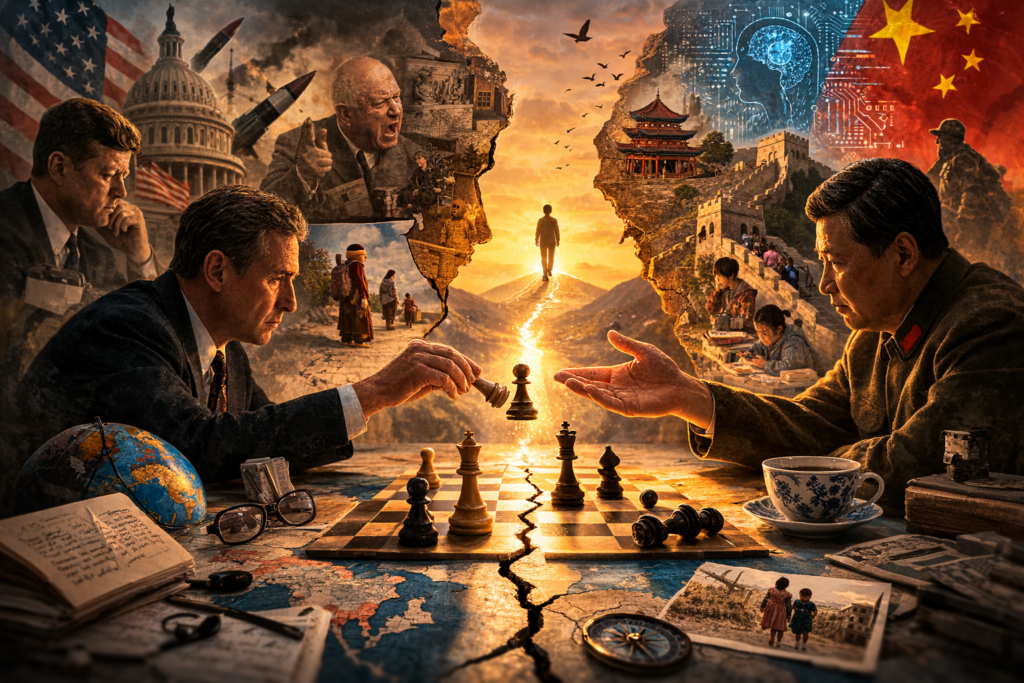 When people hear that we should empathize with our adversaries, the reaction is often uneasy. Empathy sounds like softness. It sounds like moral compromise, even capitulation. Why should we try to understand those who compete with us, oppose us, or even threaten us?
The confusion lies in a simple mistake. Empathy is not sympathy. To empathize with someone is not to agree with them, excuse them, or endorse their actions. It is only to attempt to see the world as they see it, to understand what they fear, what they value, and what they believe they must defend. As Ralph White of the United States Information Agency put it, it’s the ability to step into someone else’s skin and experience the world through their eyes. We rarely need to exert ourselves to empathize with friends; shared assumptions do most of the work. It is with adversaries that empathy becomes difficult, and therefore essential. When trust is low and stakes are high, misunderstanding becomes dangerous. Two Cold War episodes make the point, in opposite ways.
The Cuban Missile Crisis in October 1962 brought the United States and the Soviet Union to the brink of nuclear war. We now know that the Soviet missile deployment in Cuba was larger and more advanced than American officials understood at the time. A small miscalculation could have triggered catastrophe and the deaths of hundreds of millions. During those tense days, Nikita Khrushchev sent President Kennedy two communications. One was public and defiant. The other was private and conciliatory in tone. The instinctive response that Kennedy was considering was to answer the public challenge directly, to demonstrate strength.
At that moment, one man in the room possessed something rare: lived familiarity with the adversary. Tommy Thompson had served as U.S. ambassador to the Soviet Union. He spoke Russian. More importantly, he had spent extended time with Khrushchev, not only in formal meetings but socially, even staying with Khrushchev and his wife. He had observed him outside the carefully constructed theater of diplomacy. He understood his pride, his insecurity, his political constraints. It was Thompson who urged Kennedy to respond to the private letter and had the courage to disagree with the president. He recognized that Khrushchev needed a path out of the crisis that would not humiliate him. A public confrontation might trap and embarrass him. A private exchange might allow him to retreat while preserving authority. As Thompson put it, Khrushchev should be able to save face, to say, “Kennedy was going to destroy Cuba, and I prevented it.” That sentence captures the entire logic. Thompson was thinking about what Khrushchev would need to say to his own people. Kennedy followed that advice. The crisis de-escalated.
No one in Washington sympathized with Soviet communism. But they understood enough about Khrushchev as a human being to avoid cornering a nuclear adversary. That this kind of empathy – grounded in personal knowledge – played a decisive role in preventing disaster is undisputed.
Vietnam shows the opposite, it shows what happens when that depth of understanding is absent. During the Cold War, the United States invested heavily in understanding the Soviet Union, in its language, culture, history, political psychology. State Department specialists like George Kennan and Charles Bohlen had lived experience of Russia. In Vietnam, such understanding was far thinner. American leaders tended to interpret the conflict primarily as a front in a global ideological struggle. They thought the Vietnamese were a pawn of the Chinese. But for Ho Chi Minh, it was fundamentally a nationalist effort to unify a country shaped by decades of colonial rule; his country had been fighting the Chinese for a thousand years.
There was no sustained equivalent of Tommy Thompson in the deliberations over Vietnam, no one whose deep familiarity with Vietnamese history and culture consistently translated Hanoi’s perspective into American strategy. Vietnamese actions were often interpreted through assumptions about Moscow or Beijing rather than evaluated on their own terms. Similarly, American intentions were interpreted through the lens of colonialist France, whose yoke the Vietnamese had recently overthrown. It is entirely plausible that deeper empathy could have materially altered the course of the war. A clearer grasp of how the Vietnamese leadership defined its core objectives might have opened space for negotiation earlier, clarified which demands were symbolic and which were existential, and reduced the tendency to treat every development as a test of credibility. Empathy does not guarantee peace, but its absence can prolong conflict. The contrast between Cuba and Vietnam is instructive. In one case, personal familiarity created an exit from crisis. In the other, insufficient familiarity narrowed the range of perceived options and deepened the crisis.
A third example, smaller in scale but revealing, comes after 9/11. At the very moment when cultural and linguistic understanding of the Middle East was most urgently needed, many Arabic-speaking American citizens who applied to intelligence agencies were treated as potential risks. At one point, the CIA had fewer Arabic-speaking case officers worldwide than the FBI had Italian-speaking agents in New York during its campaign against organized crime.
In fact the FBI case is interesting. The agency had learned that dismantling the Italian mafia required more than surveillance or legal authority. It required cultural intelligence. Italian-American agents were often especially effective because they understood the internal code of the organization – the primacy of family, the force of loyalty, the hierarchy of respect, the meaning of honor, and the consequences of humiliation. They understood how obligations moved through kinship networks and how critical reputation was. To defeat an adversary, the FBI first learned how that adversary understood himself. They internalized his thoughts and emotions. There are few better examples of “Know thy enemy.”
There is an even more ordinary example from Afghanistan about cultural empathy that I find just as compelling. After the U.S. invasion of the country in the wake of 9/11, American troops and development officials observed that women in certain villages had to walk long distances to fetch water from wells. Wanting to help, they dug wells closer to the village. The expectation was straightforward: easier access to water would be welcomed and gratefully used. Instead, many women continued walking the long distances. Why? Because those walks were the only socially acceptable opportunity they had to gather away from men; to talk, to exchange news, to share stories. In other words, to gossip. The journey to the well was not merely a chore. It was a social space, and a critical one in a male-dominated society like Afghanistan. By “solving” the “problem” without understanding the social context, well-meaning efforts became largely irrelevant. No hostility was involved. No ideology. Just a failure to ask how the people involved understood their own cultures and routines.
Even in cases where extreme hostility is involved, like the Pacific theater of World War II, empathy had enormous practical consequences. Early American appeals for Japanese surrender largely failed because the language used clashed with deeply embedded notions of honor and surrender. Thousands of Japanese civilians on islands like Saipan committed suicide because of Japanese propaganda that painted the enemy as merciless demons who would pillage, murder and rape. Women strapped their babies to their chests and jumped off cliffs. By the time of Okinawa, the Americans understood. The messaging shifted. Leaflets no longer included the word “surrender” but instead encouraged soldiers to survive so they could help rebuild Japan after the war. They praised the enemy’s courage. As a result, thousands laid down their arms, more than ever had during the entire conflict with Japan. The battlefield conditions had not softened, but the cultural understanding had sharpened.None of these examples suggests that empathy dissolves rivalry or reconciles incompatible systems. The Soviet Union remained an adversary. Vietnam remained divided for years. The Pacific war remained brutal. Empathy does not eliminate conflict. What it does – and this seems to me crucial – is reduce the risk that misunderstanding will drive escalation or render good intentions useless. At the very least it encourages listening and a more measured tone which can open the way to negotiations.That lesson feels particularly urgent today. The United States and China are engaged in sustained competition; economic, military, technological, and increasingly in artificial intelligence. It is easy to frame the relationship purely as a race: build faster, deploy sooner, outcompete at all costs. Competition is real. But competition without serious effort to understand the other side’s strategic culture can become both mindless and dangerous. China’s leadership sees its national trajectory through a long historical arc that includes humiliation and resurgence. American policymakers operate within a different narrative, grounded in liberal institutions and technological ambition. These narratives shape how each side interprets threat, prestige, and security. To ignore them is to misread intentions.
Empathy in this context does not mean concession. It does not mean abandoning our own values and commitments. It means asking how the other side interprets our actions, what pressures its leaders face, what historical lens they see our actions through and what outcomes they consider intolerable. In his book “Breakneck”, author Dan Wang says that more than like or dislike each other, Americans and Chinese simply need to understand each other. Such empathy does not guarantee agreement. It may not prevent rivalry. But it reduces the probability of catastrophic miscalculation by just being a good listener. And in complex systems – whether nuclear standoffs, insurgencies, intelligence operations, or even village development projects – reducing miscalculation matters enormously.The greater the divergence between perspectives, the stronger the case for deliberate understanding. Empathy is not weakness. It is clarity under strain. And sometimes, whether in a crisis between Great Wars or in a remote village in Afghanistan, clarity is the difference between success and failure.