
Barbara Black at Salmagundi:
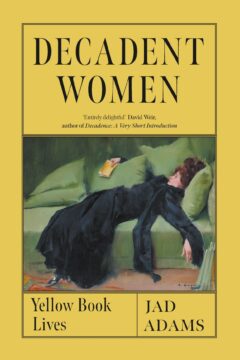 Jad Adams’s Decadent Women: Yellow Book Lives tells the story of the Yellow Book, a magazine that was “a force and famous” during the late nineteenth century in England. Here I quote writer-musician Elizabeth Pennell, who was associated with this magazine named for its signature hue. Scholars of Aestheticism and Decadence as well as historians and literary critics interested in late-Victorian culture more broadly have long recognized the centrality of this magazine for the period. Adams’s distinctive approach is to conceptualize his study of the Yellow Book as a group biography focused on the journal’s most courted contributor, the woman writer. In its best moments, this book brings a vibrant world to life, articulating in readable fashion the artistic and cultural mission that animated that world. Evelyn Sharp’s effusion—“I knew it was very heaven to be young when I came to London in the nineties”—captures the sense of novelty, wonder, and promise in the air that fueled the enterprise of this vanguard magazine. Aiming to people a world, Decadent Women explores the network of connections that sustained that world. Adams’s readers will learn about the lives and writings of individual authors, set in the intellectually vibrant milieu they inhabited. The first chapter of the book journeys back 130 years, focusing on the launch of the magazine in April 1894. We quickly come to appreciate the key involvement in the magazine of George Egerton, the “keynote” writer of the 1890s. We learn of the magazine’s backstory situated in early conversations among editor Henry Harland, publisher John Lane, and others.
more here.
Enjoying the content on 3QD? Help keep us going by donating now.