
by Dilip D’Souza
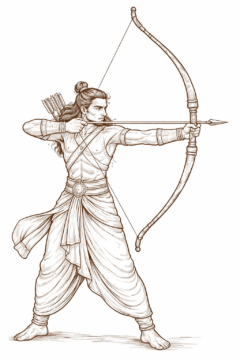 My friend Arjuna is an archer in the army. He has been on several campaigns, always victorious. His bow is as tall as he is. It is made of wood but strengthened with sinews. The combination makes it firm, supple and elastic. I say that, and marvel at the expert ease with which he handles it, and I know I – man of letters and numbers as I am – would never be able to pull the string back as he does.
At rest, the string is taut, straight, and twangs a healthy, satisfying note when idly plucked. When Arjuna needs it, he pulls in one strong, long motion, as if he is to the string born. Shallow pull if his target is nearby. Deep if he wants to shoot far. To pull it at all needs training and strength. To watch Arjuna pull it so effortlessly is a treat.
Watching him at his craft – for what else is it? – over and over again, I’ve started to obsess about how the bow shoots the arrow forward. Why is a shallow pull enough for close targets, but Arjuna must pull longer for distant ones? Pulling the string back seems to confer a strength of a kind on the bow, and the degree of pull determines the degree of strength. Actually, the more I thought about this, the more intuitive it seemed to me. So I became obsessed with another question. Is there some way to correlate the length of the pull to how much force the arrow gets, to how far it travels when released?
And so … I visit Arjuna when he’s practicing his skills. I watch him shoot arrows over and over, hundreds every day. When not in use, the bow makes a graceful curve, its ends joined by the taut line the string forms. But when Arjuna strings his arrow, the one straight line becomes two, each half as long, and the bow bends. I look carefully at the shape the strings make with the bow. It’s like a slice of what will come to be known, in my country as across the world, as pizza. (Maybe you can tell that I have the gift of seeing into the future.)
The smaller the slice, the more the strength in the bow. There’s my first lesson. But how am I to understand, or describe, “smaller” in this case? Eventually, I decide that the best measure is the distance in a straight line between the ends of the bow. That distance is greatest when the bow is not in use: any arrow fitted to the string then simply falls to the ground. But it decreases steadily as Arjuna draws and readies to fire. That is, as the string pulls on the ends of the bow, bringing them closer, the distance between them decreases. The straight line shrinks.
The shorter the line – of course, relative to the size of the bow itself – the greater the strength that gathers in the bow, ready to be transferred to the arrow. So I begin thinking about that straight line.
What if I imagine the bow as part of a circle? The word for this that will later come into common use is “arc”, which in fact derives from the Latin word for “bow”, “arcus“. So Arjuna’s arc’s ends are connected by a straight line – the string itself when at rest, an imaginary one when he is ready to shoot. I call this line “jya“, and I must note here that I can see that future men of numbers will label it a “chord” of the circle.
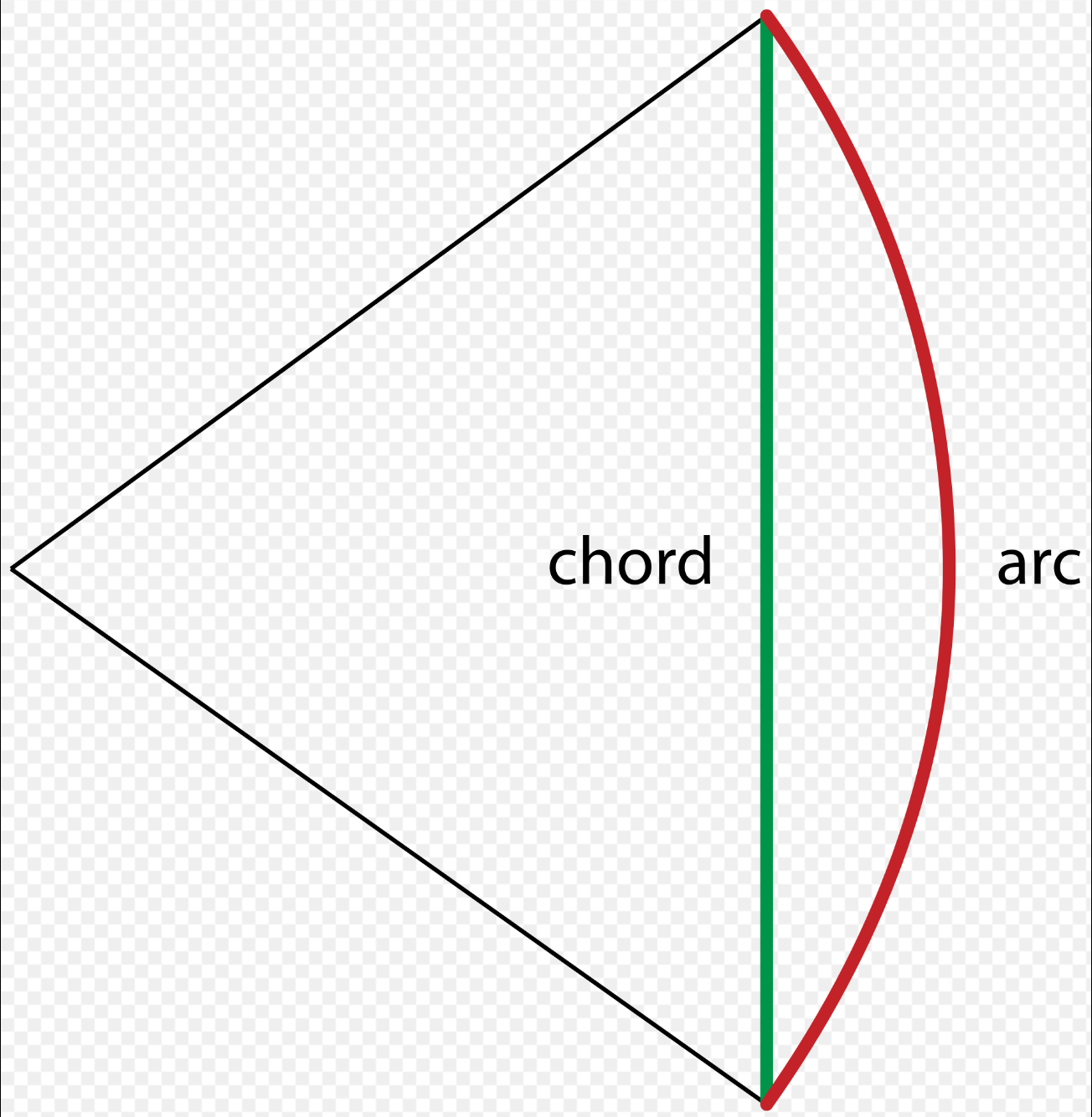
(Courtesy Fred the Oyster, Wikimedia Commons)
You’ll note that I refer above to the jya‘s length “relative to the size of the bow”. In effect, that is the size of the circle of which the bow forms a part. A small circle has short jyas; a bigger one will have longer jyas. In thinking this through, it seems to me that if I want to understand this idea of strength, it must be independent of the size of the circle. Certainly a larger bow will shoot an arrow more fiercely than a smaller one. But to simulate that, I don’t need to find a circle the same size as the bow.
But I do need, to make clear in my and others’ minds what I’m seeking to understand, to choose a circle of a particular size and speak of its jyas. If I do that, the length of the jya alone will be a measure of the power of the bow as Arjuna shoots his arrow. Now if I take a string, hold one end steady and, keeping the string taut, trace the path the other end makes, I have a circle corresponding to the length of that string. For astrononomical reasons I won’t get into here, I chose a string 3438 units long. Again, I know that my distant descendants will deal in units called, variously, “inches”, “metres”, “microns” and more, and that they will refer to the string as the “radius” of the circle.
But it doesn’t matter what the units are. Once I have drawn a circle whose radius is 3438 units, I measure the length of its jyas. By now, I’ve actually started thinking in terms of the “ardha-jya“, or half the jya – and to make matters simple, I call that half-chord itself jya. And I have put together a series of jya lengths that correspond to different extents to which the bowstring is pulled back.
At rest, the jya is also 3438 units long. Pull it back a little and the jya shrinks, for example, to what I call “pha” (फ in my language Sanskrit), or 3431 units long. Pull some more and the jya shrinks more to “kigra” (किग्र), or 2728 units. Even more, and it will be at “hasjha” (हस्झ), 1719 units, half its rest value. Needless to say, the lower the jya is, the more eagerly the arrow will leap from the bow. Though there is a limit, of course. As skilfully as Arjuna bends his bow, I know hasjha is almost certainly beyond even his splendid muscles.
I work out 24 such numbers, taking jya all the way from 3438 to 225 (“makhi“, मखि).
Where am I going, telling you all this? Quickly into the future, again. Arabian traders take the idea of the jya to their shores and it becomes part of Islamic mathematics. Mathematicians like Muhammad ibn Musa al-Khwarizmi call it “jiba“, the closest they can get, phonetically, to the sound of the word I use. In their Arabic that lacks vowels, they write it as “jb“. At some point, the idea travels further west. In the 12th Century, six centuries after I have died, Gherardo of Cremona translates al-Khwarizmi’s Arabic texts into Latin. Doing so, he reads “jb” as “jaib“, which can mean “pocket”, “fold” or “bosom”. He translates that, therefore, as the Latin word “sinus“, meaning “fold”, “bay”, “pocket”, or even the way a toga folds across the breast.
And now I trust you see where I’m really going with this. For thus was born the word “sine“, that staple of trigonometry. In a specific kind of triangle, the sine of an angle is defined as its opposite side divided by the longest side, or hypotenuse.
I like to think of it as my jya divided by the radius of my circle.
My jya. Thank you, my archer friend Arjuna.
—
This has been the great 6th Century Indian mathematician Aryabhata, explaining the etymology of the word sine, and possibly how he came up with the concept. A young man whom Aryabhata would have liked to call a friend has this nifty tool that allows you to play with jya.