
by Laurie Sheck
1.
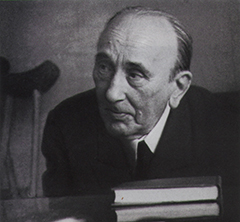
Always when I think of him, I picture him alone in a room, bedridden for months at a time. How from late childhood on, he suffered from osteomyelitis, an incurable infection of the bone that set flame to raw nerve fibers, induced recurring fevers, skin lesions, intense, crippling pain. And how in that enforced solitude he wrote about the ways the self is not isolate but comes into being through contact with others. How this is its beauty and its freedom. “I become myself only when revealing myself for another, through another, and with the help of another.”
In his great work on Dostoevsky, he wrote, “Every thought…senses itself to be from the very beginning a rejoinder in an unfinalized dialogue. Such thought is not impelled toward a well-rounded, finalized whole. It lives a tense life on the borders of someone else’s thought, someone else’s consciousness.”
Bedridden and alone in his room, far from the clamor of everyday life, he wrote of how language moves through one body to another, one mind to another, and in that movement changes and is changed.
2.
These are some of the rooms he lived in:
An apartment in Kustani, a town in northwestern Kazakhstan where he was sentenced to internal exile for “subversive activity.” Its climate was so harsh and its winds so strong there were cables to grab onto while walking. Here he reported once a week to the security police and was forbidden to teach school; the charges against him involved corrupting the thoughts of the young. He found work as a bookkeeper. His only known publication from this period was an article for the periodical, Soviet Trade, where he discussed economic indicators, including such minutiae as how many pairs of galoshes were ordered by the local collectives. This sentence lasted from 1930-1934.
A repurposed jail cell in Saransk. The building retained the jail’s long corridors with small rooms on either side. He lived in Saransk twice, from 1936-1937 and then again from 1945-1969. Here he taught at the Mordovia Pedagogical Institute during one of the most intense purges of the Soviet era. When the Institute itself became a target he resigned in fear for his safety.
A room in the small railway town of Savelovo, on the Volga. Because of his political record he had to live at least 100 kilometers from Moscow. The town consisted of a few streets in the middle of sparse woodland. The locals made their living from factory work and fishing. Here he remained unemployed, relying on contributions from family and friends. In 1938, after a particularly bad flare of illness, in a regional hospital he underwent the amputation of his right leg.
3.
In our age so rife with polarization and the cruel abuse of power, I find his thought moving. All is questioning, openness, porosity, receptivity, becoming. How one comes to oneself partly through the gaze and words of others. “Nothing conclusive has yet taken place in the world…the world is open and free.” “Dostoevsky always represents a person on the threshold of a final decision, at a moment of crisis, at an unfinalizable and unpredeterminate, turning point for their soul.” “Truth is not born nor is it to be found inside the head of an individual person, it is born between people collectively searching for truth, in the process of their interaction.”
“To be means to be for another, and through the other for oneself.”
“I cannot manage without the other, I cannot become myself without the other.”
4.
“When he closes his book on Dostoevsky by exhorting his readers to renounce their old monologic habits, his gesture is a commentary on a political situation which increasingly permitted only a single authoritative voice to be heard and which sent those such as Bakhtin himself into exile.”—Katerina Clark and Michel Holquist
5.
To think of Bakhtin is to think about the ways the human mind is impure, eruptive, conflicted, emancipatory, tender. How it wants to be hurt and challenged into being and can’t know itself apart from the ways it is unfinalized, porous, striving, decentered. Thought is comfort and danger both. Recognizable but at the same time strange. Distant and close at the same time. This is its beauty.
6.
Often he has fevers. The bacteria S aureaus has lodged in his bone marrow where it adheres to bone matrixes, carves out necrotic tracts encased within still-living tissue. If threatened, the bacteria slows its metabolism in order to stay alive inside him, develops a slick, slime-like coating, clings to intracellular spaces. Within the entrapment of illness, he comes to love words that signify entrapment’s opposite, a kind of freedom: unfinalized, threshold, becoming.
He likes to think of Copernicus removing Earth from the center of the universe, an Earth no longer still but spinning on its axis. And how words spin like moving planets among galaxies of other words. He stresses “My love for variation, diversity, the multiplicity of focuses.”
7.
His friend the concert pianist, Maria Yudina, often played for him for hours on end. Similarly, in the 1930’s, when the poet Osip Mandelstam was forced into internal exile in Voronezh, she arranged for concerts there so she could visit him as well. When Pasternak’s poems were banned, she read them at a concert between her performance of Beethoven and Bach, which caused her to be temporarily banned from Leningrad. But Stalin loved her playing and was especially enthralled by her performance of Mozart’s Piano Concerto no. 23 which he heard on the radio and then insisted she record for him. It’s said he was so pleased with the recording he sent her a large gift of money, and that she wrote in her reply, “I will pray for you day and night and ask the Lord to forgive you your great sins before the people and the country.” Nevertheless, Stalin left her untouched, and her record was reportedly found on the turntable in his dacha when he died.
8.
There is a Substack I’ve been reading lately by a woman who calls herself Maalvika, “your fav gen z philosopher nerd.” In a recent post she wrote this: “We’ve created a culture that treats depth like inefficiency. One that wants love without awkwardness, wisdom without confusion, transformation without growing pains that crack us open and rebuild us from the inside out. And in doing so, we’ve accidentally engineered away the most essentially human experiences: the productive confusion of not knowing, the generative power of sitting with difficulty, the transformative potential of things that resist compression.”
Bakhtin: “The hero is constantly challenged, destabilized, changed, by the intense anticipation of another’s discourse.”
Dostoevsky puts his heroes on “the narrow space of the threshold, a boundary, where it is not possible to settle in, to find comfort.”
“In every voice Dostoevsky could hear two contending voices, in every expression a crack, and the readiness to go over immediately to another contradictory expression….he perceived the profound ambiguity…of every phenomenon.”
9.
Often I think of Dostoevsky’s The Idiot. How his character, Prince Myshkin, comes to himself through the intense beholding of and openness to others. How this beholding partly heals him. When he is sent from Russia to a sanitarium in Switzerland after a long series of epileptic attacks that have left him muddled and with “no logical power of thought”, part way along the journey he comes upon a donkey in the marketplace in Basel. He has never seen a donkey before, and the sight of this animal brings him out of his torpor, “I awoke from this state for the first time in Basel, one evening; the bray of a donkey aroused me, a donkey in a town market. I saw the donkey and was extremely pleased with it, and from that moment my head seemed to clear….Since that evening I have been specially fond of donkeys…one of the most useful of animals—strong, willing, patient, cheap…and my melancholy passed away.” In his porosity, Myshkin responds to this beast of burden, its voice, its plight, its dignity, and is changed.
So, too, when Myshkin witnesses an execution; the life of the condemned man penetrates and changes him. Several times he uses the word “probably” when imagining what the condemned man is feeling. He is aware of the limitations of his knowing. Recounting how the condemned man was being lead to the scaffold, he says, “Probably he thought, on the way, ‘Oh, I have a long, long time yet. Three streets of life yet.’” And later, imagining into the condemned man’s mind when he is led up to the block, “…the brain is especially active, and works incessantly—probably hard, hard, hard—like an engine at full pressure. I imagine that various thoughts must beat hard and fast through his head—all unfinished ones, and strange, funny thoughts, very likely!- like this, for instance: ‘That man is looking at me, and he has a wart on his forehead!’” Myshkin feels deep empathy but also his own humility, the limits of his knowing.
And finally, toward the book’s end, in one of the most beautiful and radical scenes ever written, Myshkin holds the distraught murderer Rogozin in his arms and comforts him. He sits in Rogozin’s room near the dead body of Nastasya who he has loved and Rogozin has just killed, and shaking with horror and terror, nevertheless, “with painfully beating heart and still more painful breath” he watches Rogozin’s face intently, and then: “Rogozin began to wander, muttering, disconnectedly, then he took to shouting and laughing.” Although horrified, Myshkin stretches out a trembling hand to the murderer “and gently stroked his hair and his cheeks….his legs trembled again and he seemed to have lost the use of them. A new sensation came over him, filling his heart and soul with infinite anguish.” When finally the police arrive in the morning, Myshkin can no longer speak. He is sent back to the sanitarium in Switzerland. There is no way to know what might be going on inside him. What can be known is that he stayed close to another who was suffering and, though horrified, held him and did not turn away.
10.
Distraught, overgrown with bacteria, skin and bone turn into febrile incoherence. Meanings grow ambushed, hurt and scarred with longing, distrust the progression of time. Nothing is safe or innocuous, not a streak of sunlight, not a leaf-shape on the wall, not a pebble. Pain is a derangement of kindness. Every cell withdrawn from the object-world, alert to its reinvention as enemy, victim, soldier, heretic, stranger. In the mind all bridges burn. They crumble over and over. Minutes incinerate justice.
And yet, and yet….
Bakhtin: “The self is an act of grace, the gift of another.”