
by Ken MacVey
 Several years ago I was the moderator of a bar association debate between John Eastman, then dean of Chapman University School of Law, and a dean of another law school. The topic was the Constitution and religion. At one point Eastman argued that the promotion of religious teachings in public school classrooms was backed by the US Constitution. In doing so he appealed to the audience: didn’t they all have the Ten Commandments posted in their classrooms when growing up? Most looked puzzled or shook their heads. No one nodded or said yes. Eastman appeared to have failed to convince anyone of his novel take on the Constitution.
Eastman since has resigned as dean of Chapman Law School and has faced criminal charges and disbarment proceedings regarding his role as a lawyer in the attempted overthrow of the 2020 presidential election that Trump lost. California State Bar judges have recommended Eastman be permanently disbarred, a recommendation that is now pending before the California Supreme Court. But one of Eastman’s constitutional views that once seemed far-fetched may very well be upheld by one court and ultimately the Supreme Court. The Fifth Circuit US Court of Appeals in January heard oral arguments on challenges to statutes in Texas and Louisiana that require displaying the Ten Commandments in every public school classroom in their respective states. By some accounts the oral argument by the challengers was not well received.
Many think it is likely the Fifth Circuit will uphold the constitutionality of the Texas or the Louisiana statute, or both, and that ultimately the matter could be taken up by the Supreme Court. Several Supreme Court justices could be very receptive to their constitutionality despite a 1980 Supreme Court precedent finding mandatory classroom displays of the Ten Commandments unconstitutional. If the Fifth Circuit or the Supreme Court upholds their constitutionality, almost certainly it will be based on an “originalist” interpretation of the Constitution.
The Religion Free Constitution
At the same time, an “originalist” interpretation could be urged to reject their constitutionality. One starting point is the text of the Constitution itself. As a moderator of the Eastman debate, I asked Eastman how he could harmonize his general position that the Constitution promoted religion, when before it was amended, its only textual reference to religion was that there should be no religious test for federal public office. I further noted that the text of the Constitution, unlike the Declaration of Independence, made no reference to the “Creator” or “ Nature’s God,” which could not have been a mere accidental oversight.
Eastman quickly responded that this was not quite right. Article I Section 7 of the Constitution provided that a bill presented by Congress to the President if not returned by the President within ten days became law. Eastman, with a smile, noted that the Constitution qualified the ten-day period with “Sundays excepted.”
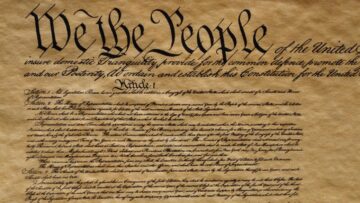
Despite Eastman’s qualification, when ratified in 1789 the Constitution was strikingly religion free. For this reason historian Garry Wills called the Constitution revolutionary in his book Head to Head– American Christianities: “Disestablishment was a stunning innovation. No other government had been launched without the protection of an official cult. This is the only original part of the Constitution. . . Disestablishment was not a thing with precedent. Our Constitution never mentions God—an omission that was startling, and highly criticized at the time.”
Contrary to Ronald Reagan’s claim, the delegates to the Constitutional Convention of 1787 who were drafting the Constitution never prayed for divine guidance. Benjamin Franklin’s motion to commence deliberations with prayer failed with no more than four in support. On the other hand, the convention did vote to include in the Constitution the no religious test clause, which as Article VI, clause 3 of the Constitution, reads: “. . . no religious Test shall ever be required as a Qualification to any Office or public Trust under the United States.” To top it off, wherever the Constitution required public officials to swear they would uphold the Constitution, they could swear either by “Oath or Affirmation.” An “oath” was before God–an “affirmation” was secular.
Ratification of the proposed Constitution was debated in state conventions. In a pivotal debate in the North Carolina constitution ratification convention in 1788 some expressed concerns the ban on religious tests meant it might be possible to force the nation to adopt the “Roman catholic religion” by treaty or that “Pagans, Deists and Mahometans” or “Jews” or “Atheists” could ascend to federal office. James Iredell, later to become a Supreme Court justice, in response argued that “under the colour of religious tests the utmost cruelties have been exercised.” Iredell declared the “no religious test” clause was the strongest proof of the intent “to establish a general religious liberty in America.” After initially declining to ratify the Constitution, North Carolina in1789 became the twelfth state to do so.
The Establishment Clause was Added to the Constitution When States were also Disestablishing Government Sponsored Churches
The Constitution was ratified by the states in 1789 with the only reference to religion being the “no religious test” clause. But many believed the Constitution gave too much power to the federal government. The Bill of Rights was added to quell their fears and was ratified in1791. Included in the Bill of Rights was the First Amendment, which began by saying “Congress shall make no law respecting an establishment of religion, or prohibiting the free exercise thereof . . .” This clause was principally written by James Madison who had already battled against government establishments of religion in Virginia.
In the 1700’s, several states sponsored churches propped up by taxation and legal restrictions. Baptists might be taxed to pay for Congregationalists. Ministers might be licensed but only for favored denominations. Failure to pay or comply could result in fines and jail. These impositions reached a boiling point. States started “disestablishments” of religion in the late 1700’s. Most notably in Virginia, Patrick Henry proposed a tax to support Christian sects. This triggered James Madison’s now famous “remonstrance” in1785 against religious assessments and establishments. He argued that religion was not “an engine of civil policy,” that government establishments of religion generated persecution and bigotry and corrupted both government and religion. Madison urged the Virginia legislature to pass Thomas Jefferson’s bill “for religious freedom,” which was passed in1786.
Madison and Jefferson’s efforts became foundational to the idea of separating church and government from each other. States continued to “disestablish” government endorsed and tax supported churches and denominations. Massachusetts in 1833 was the last state to disband government sponsored churches when it ended its tax to support the Congregation Church. Massachusetts had come a long way from its days in the 1600’s when “witches” and Quakers were hanged.
The Establishment Clause Binds the States
By its own terms, the First Amendment originally only applied to the federal government, not the states. With the ratification of the 14th Amendment in the 1860’s, which required the states to provide all persons with due process and equal protection under the law, the Supreme Court in the late 1800’s began applying the Bill of Rights piece by piece to flesh out what due process and equal protection meant. In1925 the First Amendment right to free speech was applied to the states. And in1947 the Supreme Court applied the First Amendment’s Establishment Clause to the states. In that decision, the Supreme Court recounted the American history of jailing, fining, and taxing people to force compliance with favored sects and religious doctrines, which the Court asserted generated so much abhorrence it helped give birth to the Establishment Clause.
In a letter to the Danbury Baptists in 1802 addressing their concerns about government interference, President Thomas Jefferson wrote the First Amendment built a “wall of separation between Church & State.” This phrase became the defining metaphor for the Establishment Clause in Supreme Court and lower court decisions.
The Supreme Court Grapples with the Ten Commandments and the Establishment Clause
In 1980 the Supreme Court addressed the issue of the Ten Commandments in the classroom. Kentucky enacted a statute that required the Ten Commandments be displayed in every public school classroom. Required to be appended to the display was a disclaimer that the display was only for “secular” purposes. The Supreme Court in a 5 to 4 decision (Stone v. Graham) found the disclaimer pretextual and that the real purpose of the required display was religious and therefore violated the Lemon test under Lemon v. Kurtzman that considered whether the practice in question had a secular purpose or instead a religious purpose advancing or inhibiting religion.
In 2005 the Supreme Court on the same day issued two decisions revisiting the issue of the display of the Ten Commandments at state government owned facilities. Kentucky state courts were displaying the Ten Commandments in court rooms. Texas’ capitol grounds had displays of several large monuments, including one of the Ten Commandments. Both decisions were 5 to 4 with Justice Breyer providing the swing vote in each. The Kentucky courtroom displays were found to violate the Establishment Cause. (McCreary County v. American Civil Liberties Union of Kentucky.) The monument at the Texas capitol was found not to violate the clause. (Van Orden v. Perry.) Justice Breyer in his book Active Liberty later explained his reasoning that the display in the court rooms was clearly religious in intent whereas the Ten Commandments monument mixed in with several other monuments was not, and that he sought a pragmatic balance between accommodation and drawing a line. Justice Scalia in his concurring opinion in Van Orden wrote “there is nothing unconstitutional in . . . a nonproselytizing manner, venerating the Ten Commandments.” Justice Thomas expressed the view the Establishment Clause does not apply to the states, only to the federal government.
In 2019 the Supreme Court addressed the Ten Commandments again, although it was not the principal subject matter before it. (American Legion v. American Humanist Association.) What was before it was an Establishment Clause challenge to a 40-foot-high cross in Maryland that had been planned and erected on public land between 1918 and 1925 to honor fallen soldiers in World War I. The Supreme Court reversed a lower appellate court and found that although the cross initially had been erected primarily with religious purposes in mind that “as time goes by” the purposes associated with “a monument, symbol or practice” may “multiply” so as to take on a broader non-religious meaning.
The Supreme Court opinion, authored by Justice Alito, cited the Ten Commandments as an example of evolving purposes. The opinion described how the Fraternal Order of the Eagles in the 1940’s launched a campaign to place the Ten Commandments into public forums in order to promote religious but also civic values. It discussed how the Eagles collaborated with movie producer Cecil B. DeMille’s marketing of his 1950’smovie “The Ten Commandments.”
The Supreme Court concluded that the 40-foot cross in question over time evolved to serve wider purposes and gained meaning beyond religious ones, and thus the cross did not run afoul of the Establishment Clause. Justice Breyer also authored a concurring opinion. In his opinion he observed that if the cross had recently been erected the outcome might have been different but because the cross’s broader meaning had evolved over several decades the cross was now compatible with the Establishment Clause. He added that he did not understand the Supreme Court to be adopting a “history and tradition test” for the Establishment Clause.
In 2022, after Justice Breyer had retired, the Supreme Court decided in a 6 to 3 decision to throw out the Lemon test. (Kennedy v. Bremerton School District.) It held that the Establishment Clause must instead be interpreted by reference to “historical practices and understandings.”
New Texas and Louisiana Statutes Require Posting the Ten Commandments in Classrooms
Emboldened by the fact that the Lemon test was thrown out, Louisiana and Texas in 2024-25 passed laws that required the posting of the Ten Commandments in public school classrooms. The Texas statute requires that the commandments be on a poster or framed with a minimum size of 16 by 20 inches. It requires that it be displayed in a “conspicuous space” visible to anyone in the classroom with average vision. Louisiana requires the commandments to be a minimum size of 11 by 14 inches, but as counsel for Louisiana in oral argument before the Fifth Circuit noted, this is only a minimum and for that matter it could be 11 by 14 feet.
But what versions of the Ten Commandments are to be displayed? For example, Jewish traditions may have one version, the Eastern Orthodox and Anglican Church another, the Roman Catholic Church its own. In turn, there may be multiple, differing versions in the larger text from which they are taken. The King James Bible has at least three versions of the commandments, all of which differ in some respects. (Exodus 20: 2-17; Ex. 34:11-28; Deuteronomy 5:6-21.) The versions in the Texas and Louisiana statutes required to be posted in classrooms are not to be found in any religious text. They are based on a version propagated by the Fraternal Order of the Eagles, which in turn appears to be a heavily edited version of King James Exodus 20:2-17. Both the Louisiana and Texas texts begin the same: “I AM THE LORD thy God. Thou shall not have any other gods before me.” But they differ in punctuation. Both are titled “The Ten Commandments” but with the punctuation under the Louisiana version the unnumbered commandments add up to eleven, not ten commandments. (Apparently, they didn’t check with Cecile B. DeMille’s version as presented by Charlton Heston.) The Louisiana statute also recites a quote from James Madison that no one can authenticate.
We will see how the Fifth Circuit sorts this out, but it will be a surprise if it doesn’t uphold the constitutionality of at least one of the statutes. If it does uphold the constitutionality of either or both, it will be in the name of originalism, probably backed by a selective reference to “historical practices and understandings.” Self-described originalist Justice Scalia in one of his opinions regarding the Ten Commandments gave his blessing to “an Establishment Clause jurisprudence that is in accord with the Nation’s past and present practices . . . the central relevant feature of which is that there is nothing unconstitutional in a State’s favoring religion generally . . .” (Concurring opinion, Van Orden v. Perry.)
The Oddness of “Originalism”
The current Supreme Court conservative majority now officially embraces constitutional originalism. But the problem is there is not just any one version of originalism. It’s a doctrine that has evolved over time. It has mutated from focusing on the framers’ purposes and intent, to focusing on the plain text while also discarding the text’s drafting history, to focusing on what the “original public understanding” was at the time of the Constitution’s ratification –with these versions having their own sub variations.
As one commentator put it, “originalism” is really a family of concepts. One currently dominating concept is the semantic theory of originalism. For example, in the case of Shakespeare’s Hamlet, what the play’s words mean are not necessarily what we understand them to mean today but instead mean what Shakespeare and his audience took them to mean. This is the semantic content and meaning of the play. The meaning is affixed by the fact that there is a writing that was written and circulated at a specific time.
Likewise, it is said in the case of the Constitution its semantic content was fixed when it was ratified. The task of the courts is therefore to look at historic practices and understandings at the time the Constitution or its amendments were ratified to ascertain the “original public meaning.” Some originalists even argue this is purely a matter of empirical fact just like the determination of the meaning of a piece of literature written hundreds of years ago can be a question of fact.
But is the determination of what the Constitution means and how it should be applied centuries later to situations and problems never contemplated at the time of ratification really a question of fact? Perhaps you could claim it is a fact that the ratifiers of the Establishment Clause 230 plus years ago would have had no problem with a law requiring bowdlerized versions of the Ten Commandments being thrust in front of school children’s eyes.
To get there you might have to define, configure and survey what you mean by “ratifiers.” And further you might have to ignore the fact that taxpayer funded public schools populated by students subject to compulsory attendance laws didn’t exist at the time of ratification of the Establishment Clause. Then you might also have to account for the fact the clause was to be applied later to the states via the 14th Amendment. And then you might have to decide which “historical practices and understandings” do you look at–those at the time of the ratification of the Establishment Clause or of the 14th Amendment or both? If you do both, you might have to decide which group of ratifiers count more in fixing the what and when of the “original public meaning”?
In any case, there is something odd about a doctrine that asserts the “original public meaning” of the Constitution was permanently fixed at the time of ratification when that doctrine and its varying configurations themselves did not exist at the time of ratification.
There is also something odd about a doctrine that suggests there is one true meaning of the Constitution when there is not one true “originalism” but multiple “originalism’s” that have developed since 1980 when the word “originalism” was first coined in a Yale Law Journal article.
It gets even odder. As the Constitution addresses situations and crises totally beyond the wildest imagination of its drafters and ratifiers, originalists declare that the meaning of the Constitution was fixed centuries ago and therefore its meaning cannot and must not evolve with the times.
On the other hand, the meaning of sacred monuments like crosses and sacred texts like the Ten Commandments can evolve with time so as to make them compatible with the Establishment Clause. And when it also comes to the Establishment Clause, in the name of “originalism” the historic secular nature of the US Constitution and the historic stands taken by founding fathers like Madison and Jefferson against government backed establishments of religion may very well end up being discarded and dumped into the dustbin of history.