
Rabah Arezki in Nature:
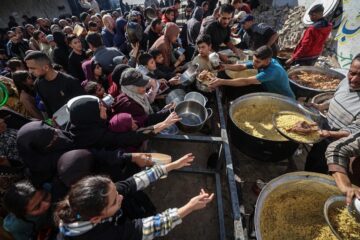 The unravelling of the aid industry must force a reset of the nexus between peace and economic development. The international-development model has changed little in eight decades. In 1949, at his inaugural address as US president, Harry Truman introduced a linear concept of development — in which countries progress from ‘under-developed’ to ‘developed’ — and recognized that poverty was a “threat” to both less- and more-prosperous areas. Since then, the proportion of the world’s population in extreme poverty has plummeted, from 50–60% to about 10%. Yet, conflicts have surged. Clearly the relationship between economic development and conflict is a complicated one, which is being explored in empirical research.
My own studies point to an asymmetry: it takes at least a decade for a society to rebuild after a conflict, whereas a burst of economic development (including that through aid) barely affects conflict intensity. Quantitatively, the half-life — or how long it takes the cumulative effect of a shock to decay by half — of the adverse effects of conflicts on development goals is around eight years. By contrast, shocks to development performance — be they improvements or deteriorations — exhibit only transient effects on conflict, with a half-life of around two years.
This finding challenges the premise that peace is a byproduct of economic development and carries sobering implications for the global aid industry.
More here.
Enjoying the content on 3QD? Help keep us going by donating now.