
by Mary Hrovat
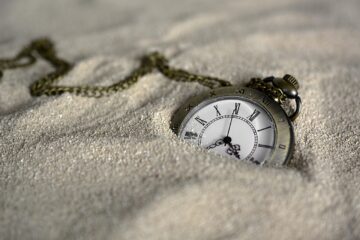 We sometimes say that someone is living in the past, but it seems to me that the past lives in us. It lives in our houses; it lies all around us. As I write this, I’m sitting on the couch under two blankets crocheted by my grandmother, who was born around the turn of the 20th century. The laptop sits on a folded blanket that came from Mexico via a friend years ago. And that’s just the surface layer. My closets and file cabinets are also full of the past.
I’ve thought about the ways that objects can keep the past alive, to some degree, by conjuring other times. Even as a child, I was inclined to save things that seemed to mark a particular moment that had meaning for me. As Mary Oliver put it, I’ve tried to “keep as I can some essence of the hour, even as it slips away.” I do this in part by keeping journals, but I’m also fond of saving things that call to mind certain times or places or people.
A friend who retired last year expressed a conundrum that’s familiar to me. He has time now to sort through the things in his house, and he’s thinking about which emotionally meaningful books and art he wants to keep, and which he’d like to pass along to others. “I don’t want to lose the fondness,” he said, “but I’m not sure if I need the things.” I understand the need to sometimes let go of things that have meant a lot to me, and the need to leave space (physical and emotional) for growth and change. Some things, though, are so charged with meaning that it’s hard to imagine ever letting them go.
∞
I have a few of my old vinyl albums, including a recording of Shostakovich’s Fifth Symphony performed by the Philadelphia Orchestra conducted by Eugene Ormandy. I heard that symphony at the first live classical concert I attended, Ormandy and the Philadelphia Orchestra in Tempe in the summer of 1977. I’d just graduated from high school, and I’d asked my parents if they would take me to the concert to celebrate. They rarely went out in the evening, and I was thrilled when they said yes. I loved the concert, and later I bought the album, probably with money I earned on my first job, a summer job at a public library. So many of the threads of my life come together in that one object.
Sometimes I wish I’d kept a few more of the albums I used to own—for example, a recording of Van Cliburn playing Tchaikovsky’s first piano concerto. I found it in a thrift shop when I was with my mother; it was made of an older kind of plastic that was thicker and more brittle than the vinyl albums I knew in the 1970s as a teenager. There’s no practical reason for wanting that record back, or for keeping any of my old vinyl. I don’t even have a turntable. But being able to look at those old albums reminds me of the world they came from and the person I was.
I’ve saved all of my projects for the two semesters of lab classes I took in astronomy. The lab class on astronomical techniques was probably the most enjoyable class I’ve ever taken. The work I’ve saved includes sunspot drawings from 40 years ago and 5″ × 4″ negatives of photographs of the moon. My lab partner and I used a simple old camera, which we loaded with glass plates or film sheets in a darkroom. I don’t know what happened to the glass plates, but I still have some of the film negatives, as well as the prints I made from them. I loved learning how to use older tools such as glass plates and an iris photometer, as well as newer instruments such as a photoelectric photometer and a CCD camera. I cherish these tangible reminders of that time.
I had only brief work experience in the world of professional astronomy, a summer job at a solar observatory in New Mexico while I was still an undergrad. I have a binder of photographs and papers from that time, in which I did rewarding work in a beautiful place. For a long time I regretted not being able to find a permanent home in academia, but those regrets have faded considerably with time. Even so, I like to be able to go through these old things that remind me that I really did get that degree and learn those things and do that work, and how those experiences felt.
I also have my mother’s hairpin box, a small square wooden box containing mostly the hairpins she used when she put her hair up in pin curls when I was a child, but also (surprisingly) a pair of dice (one red, one green, provenance unknown) and a wooden Monopoly house. Mom would put her hair up on Saturday night so she’d look nice for church on Sunday. For a while when I was roughly middle-school age, I put my own hair up in pin curls. Seeing the box evokes a complicated set of feelings and experiences having to do with femininity and church and beauty and who I thought I was supposed to be. Some of the memories associated with this small intimate memento are uncomfortable, because tensions around these topics were part of my relationship with my mother.
∞
I’m not sure how some things have become as valuable as they are. About 30 years ago, my mother wrote a brief sweet note and slipped it into the box of Christmas goodies she sent that year. For some reason, I put the note in the box where the Christmas ornaments live. Now it’s a very small part of my annual holiday rituals to re-read the note. She wrote it on the back of a flyer for a restaurant in Phoenix called Hal O. Peño’s, a bit of frugality that was characteristic of her. After I read the note each December, I turn it over to look at the flyer, which features a drawing of a jalapeño pepper that has a human face and is wearing a sombrero. It’s a rather silly representation of one aspect of my home town. The passage of time has burnished this sweet but absurd object into a treasured keepsake. I’m not sure how that works.
On the other hand, some of the things I’ve saved are mute, representing someone else’s memories and not my own. I have photos of my mother’s family that go back to before her own birth and unfortunately are not well labeled. They came to me after Mom died. I’ve thought for years that I would try to identify at least some of the people in them by comparing these photos to a smaller batch of photos that Mom photocopied and included in a short memoir she wrote, with captions describing who everyone was.
I might do that yet. However, with or without names, the people will never be alive for me. I never met most of them, and they’re all gone now. My mother’s mother, the one who made the blankets under which I sit, lived with us when I was a child. Other than that, I haven’t spent much time with either my mother’s or my father’s family. The connection represented by those photos is quite tenuous, but for some reason I want to hang onto it. When I’m gone, I expect it will be easier for my children than it is for me to let those photos go. That’s as it should be.
I would remember my past selves, of course, even without all the things I’ve saved. I’d remember my grandmother even if I didn’t have the blankets she made. But they’re warm and sturdily constructed and comforting on cold days. I used to spread them on the floor for my grandchildren (Granny’s great-great-grandchildren) to play on when they were very small, before they learned to walk. It’s good to have the things of the past around me and to carry them a little way into the future.
I can picture time as having strands that are braided together. We’re surrounded by the things of the past, and the future is at least latent in the people and things around us. The past overlaps the future, and the future grows from the past through the present. I like to think that the people I love, and my house with its books, and my grandmother’s blankets, will continue into the future after I’m gone. The people who know me will carry their memories of me, as I carry the memories of people I
know. It comforts me to think that I’ll always be part of the braid.
∞
The Mary Oliver quote is from her essay “Sister Turtle,” which appears in the collection Upstream.
You can see more of my work at MaryHrovat.com.
Enjoying the content on 3QD? Help keep us going by donating now.