
by Thomas R. Wells
Democracy is the theory that the common people know what they want, and deserve to get it good and hard. —H. L. Mencken
Neoliberalism is doomed because everyone hates it. They are mostly wrong about the reasons they think they have for hating it. But explaining what neoliberalism actually is – classical liberalism updated for the era of big centralised government – only presents new and clearer reasons to hate it. For liberalism itself has always been a minority view: most people have always viscerally rejected the idea that other people – the wrong people – deserve freedom and rights. Its influence came not from convincing the majority of its principles, but from offering the arena within which more powerful political doctrines and cabals could safely compete with blunted weapons for a reduced prize. Now the political tides have turned back against moderation, and liberalism’s gift of proceduralist constraints has itself become the target of our rage.
I. Neoliberalism is not what you think you hate about it
The term ‘neoliberalism’ was successfully expropriated by the left shortly after its coining and now functions in public, political, and academic discourse as an exonym: “a term for another group, which signals that the speaker does not belong to it” (Moira Weigel, quoted out of context). The left’s success here has been so great that almost the only people talking about neoliberalism these days are those trying to explain why they hate it.
On the one hand this means that there is near universal agreement that neoliberalism is terrible and should be overthrown. On the other hand, there is rather less agreement about what neoliberalism means and hence what needs overthrowing – except that it has something to do with capitalism and controls the world somehow. In the absence of opponents willing to call themselves ‘neoliberal’, everyone is free to make up their own version of neoliberalism to hate. Activists and academics have created dozens to hundreds of different theories of neoliberalism as projections of their pet peeves about what’s wrong with the world and what should be done about it.
Naturally these theories contradict each other. After all, they aren’t about the same thing. Some identify neoliberalism with globalisation, or with US ‘imperialism’ in particular (David Harvey) Others say neoliberalism is really selfishness masquerading as meritocracy (George Monbiot). Some say it has to do with how neoclassical economics looks at the world (e.g. Michel Foucault). Others identify it genealogically, as a conspiracy by a small group of economists against the world (e.g. Philip Mirowski)
The degree of variation and bizarreness in these theories of neoliberalism loosely correlates with how long it has been since the people complaining about neoliberalism have felt any need to read what someone calling themself that has written. (Foucault’s 1978/9 lectures, for example, are relatively interesting and engage seriously with original self-proclaimed neoliberals.) However, once enough people have spent enough decades writing and discussing their opinions on something, an infinitely persisting scholarship machine is created that will never run out of material and never have to check back in with reality. This is the kind of hermeneutic cul de sac that the humanities have always been prone to.
So anyway, the main way in which you will have heard of neoliberalism is to call out things that people don’t like about modern capitalism, or want to blame it for, like inequality, climate change, biodiversity collapse, social media, AI, Elon Musk, Donald Trump (basically all US politics), the WTO, intellectual property, house prices, free trade (and also, when trade isn’t free), Gulf War II, etc. It is also widely used in combination with other toxic exonyms like colonialism, racism and sexism. Any rational person faced with such a wall of universal if inchoate condemnation would think they should hate neoliberalism too.
II. Neoliberalism is just liberalism revamped
After what I just said, attempting to revive the term ‘neoliberalism’ may seem rather quixotic. But I am going to have a go anyway because I think the original idea was important and it has been influential in creating and sustaining the modern world. I will, however, skip over the millions of pages that humanities scholars have ‘contributed’ to the understanding of neoliberalism over the past decades and jump straight to what seem to me the core ideas of its original proponents. Friedrich Hayek and Milton Friedman were concerned with reasserting classical liberal principles, particularly the priority of individual freedom, in the context of the 20th century development of large centralised governments and their collectivist ‘common good’ tendencies.
Hayek’s particular focus was on the rule of law: the simple idea that the government should also obey the law, and that this also applies in its dealing with civil society organisations like corporations. In other words, people – and the organisations they create – should be able to do what they think best so long as they stay within the boundaries created by the laws. Citizens in a free society do not work for the government: we do not have to do what the government tells us just because the government says so. The rule of law ensures not only the security and predictability that citizens need to successfully go about their own lives and projects, but also that the tremendous concentrated power of government is itself constrained by the mild but significant requirement to consistently follow the rules it itself makes up.
Friedman’s particular focus was on the separation of the political and economic spheres. Very like America’s classic separation of church and state, this was necessary to protect the integrity and proper functioning of both. Friedman thought that business people and intellectuals were the greatest threats to a free and prosperous society. Business people because they want to coopt the government’s powers to free them from the exhausting, relentless, and existential competition of free markets, forced to compete against each other to better serve consumers. When business people persuade the state to meddle in the economy to benefit political insiders, the economy always suffers and so too will the ordinary people and eventually even the insiders too. Intellectuals are a threat because they mostly despise both individual liberty and material prosperity – the two amazingly valuable things that a liberal market society provides its people. Intellectuals tend instead to have a collectivist impulse towards a nebulous ‘common good’ (which they believe they have a special ability to discern by talking to people very similar to themselves); and a control fetish – an inordinate belief in the powers of government, if ruled by them, to make better use of society’s resources than ordinary people would. Placing a firewall between the political and economic domains greatly reduces the damage these two groups can do to ordinary people’s lives and freedoms.
Put together these two simple points nevertheless add up to a distinctive proposition, and one that was indeed influential in mainstream politics in richer countries from the mid-1970s (though never triumphant). Specific policies followed, such as the privatisation of national airlines and utilities, the re-institutionalisation of free trade, and the move to managing the economy by arms lengths rules rather than government chivvying. The particular merits of these policies, in theory and execution, can be debated on a case by case basis. But the plausibility of neoliberalism as a principled position that puts freedom first does not stand or fail on particular cases.
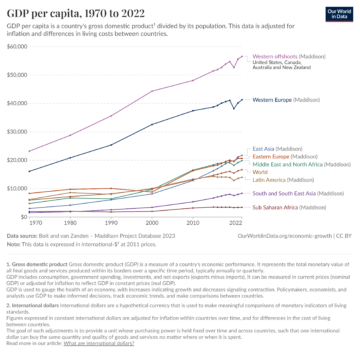
Unfortunately, most people don’t really care about freedom – certainly, not equality of freedom for those they disapprove of. Fortunately neoliberalism is also a recipe for economic success. It has presided over a doubling of rich country economies and even faster growth of many less rich countries. World average per capita GDP is now higher than the UK’s in 1970.
III. The real objection to neoliberalism is the constraints it places on power
As I said, the reason people think they hate neoliberalism is that leftists took over the word and throw everything they doesn’t like about capitalism into it. However, a great many of the particular things that neoliberalism is blamed for are ones that actual neoliberals would oppose – such as corporate lobbying for government subsidies and special privileges. A particularly obnoxious complaint is that neoliberalism is in favour of deregulation – letting businesses to whatever they want to people and the environment in the name of maximising profits. Neoliberalism is in fact committed to the regulatory state approach to managing the economy as part of its commitment to the rule of law. Governments should not be permitted to manage the economy directly (by waving executive orders around), but rather must pass and enforce general laws calculated to induce businesses to make choices that create social value rather than harm. Again, one can always question particular rules, or their need for updating to changed circumstances (such as to allow affordable housing to be built again at scale!), but it is simply ridiculous to claim that regulation of the economy has gone down since the 1970s.
Does all this mean that once neoliberalism is properly understood people will see that they were wrong to hate it?
Unfortunately not. At most they will see that their real reason for hating it is something else. For actual neoliberalism is directly at odds both with the left and right of the political spectrum, and with the populist fury of our times.
Both the left and the right are instinctive collectivists (allowing the honourable exception of anarchists/libertarians). Most wish to collapse the fragile experiment of diversity of life and values permitted by liberal democracy into harmonious, organism-like community in which we will be free to live only the kind of lives they think people should want to live. JD Vance, for example, the last intellectual of the MAGA coalition, appears to be a proponent of post-liberalism – a species of ‘common-good’ fantasising about restoring a lost Eden of social harmony and homogeneous Christian values that thrives on the Catholic right. (Yes, that should remind you of Iran’s theocratic experiment, and its tremendous success.)
In terms of political economy, both the left and the right believe that the whole society’s resources should be deployed to serve the ‘common good’ (as they interpret it), with an unconstrained government as society’s executive. So obviously they do not like the idea that people and the organisations they form can have rights against the government, rights – rather than magnanimously granted privileges – to use their time and resources for the things they want to do within the limits created by impartially administered laws. There is no space for ‘civil society’ in such utopias.
Then there is populism. Populism was long a scourge of poorer democracies, keeping them unstable and hence poor and unfree. It is now overwhelming much richer countries with no such excuses. The central claim of populism is that the institutions that claim to be serving us are actually the cause of all our problems and the main block on solving them. Even the idea of counting votes and reporting the numbers accurately has been reconceived as an outrage against the true people’s will. The rule of law and separation of economy and politics are central targets for such movements, both on the right and the left.
What does the fall of neoliberalism look like in practise?
In America, in under 2 years, Trump 2.0 has effectively suspended the rule of law and is instead attempting to rule by law, using the government’s powers to terrify businesses and other organisations into submitting to his will. Examples include leveraging the FCC to ‘persuade’ media companies to be more favourable to him or lose their licenses (that Melania movie!); launching criminal investigations of political opponents; threatening the Ivy League universities with a revision of the tax rules for endowments (haven’t they gone quiet lately); and punishing Anthropic for trying to respect US laws and constitutional protections.
Whether you knew what neoliberalism really meant or not, the world will still be a very different place without it. And not a better one.
***
Thomas Wells teaches philosophy in the Netherlands and blogs at The Philosopher’s Beard
Enjoying the content on 3QD? Help keep us going by donating now.