
Eric Schliesser at Notre Dame Philosophical Reviews:
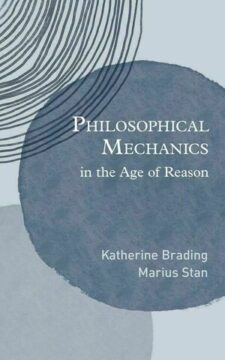 During the last quarter century, there has been an explosion of scholarship by philosophers of physics and, especially, historians of philosophy on Isaac Newton and his reception in philosophy. This growing interest is prima facie puzzling because Newton did not write a major philosophical work. And while he clearly elicited important philosophical responses (e.g., by Du Châtelet, Kant, Hume, etc.) and engendered important philosophical debates (e.g., Leibniz-Clarke), this does not justify or explain the growing attention. After all, not every person who was a significant interlocutor to philosophers in his own day should be subject of study by a community of historians of philosophy today. (We largely don’t do this for Digby, Mersenne, Riccioli, William Harvey, Kepler, Hooke, Halley, or De Volder, etc.) That Newton was seminal to the history of science and mathematics is insufficiently explanatory (because there is relatively little philosophical scholarship on Euler, the Bernoullis, etc.).
For a long time my own preferred explanation for the renewed philosophical interest in Newton was that the reception of Newton decisively changed something about the way philosophy was practiced in two closely related ways: first, a certain kind of argument from authority often associated with ‘naturalism’, which could block or silence certain philosophical arguments or positions, became popular in philosophy—the authority was Newton’s works in mathematical physics or how they were taken by others. This move was diagnosed early by Berkeley (critically) and Toland (ironically). And detestation of this move animates much of what is great in (say) Hume’s more epistemological work.
more here.
Enjoying the content on 3QD? Help keep us going by donating now.