
by Tim Sommers

In an ordinary classroom at a typical American university, two teams of four students sit across from each other in front of small audience, waiting. A judge stands and says, “The first question will be based on Case 15 which is concerned with the Supplemental Nutrition Assistance Program” (better known as SNAP).
The gist of the case is this. “Some people have advocated reforming the SNAP program to prevent these funds from being used to purchase unhealthy food. One proposal, for instance, is to stop people from purchasing soda with their benefits. Soda is not a necessary part of a healthy diet and is linked to obesity.” The more specific question the judges are asking this round is, “Is it morally permissible for the government to forbid people from buying soda and candy with SNAP funds.”
The presenting team says, “We believe it is ethically permissible to do so, but we would oppose it. Yes, obesity is a problem. And yes, there is a restriction now on alcohol. But alcohol is a very different case. And there are other ways to address obesity. It is infantilizing to treat people as unable to make their own choices simply because they are currently relying on assistance. While the government has the right to put limits on the assistance they provide, that does not mean they should. SNAP beneficiaries are rational actors as much as anyone. However, they often live in food deserts. Soda is sometimes cheaper than water. And there is nothing wrong with buying candy, for your children for example, sometimes.”
Later the other team will ask them a whole slew of questions about their case. It will ask them to justify their claim that alcohol is a very different case, for example. They will also say that for at least fifteen years now, “nudging” – using insights from behavioral science to subtly influence people’s choices and guide them toward certain decisions – has been widely advocated and aimed, not just at people financially struggling, but everyone. How is this different?
Among other things, the first team will later point out that while nudging, as it is normally conceived, aims to steer people toward certain choices, it typically refrains from explicitly limiting those choices.
At the end of the first case, the judges will ask their own questions.
Then a judge will stand up and say, “The question for the second team will be based on Case 1 which points to a bill from 2023 where Massachusetts lawmakers proposed…allowing incarcerated individuals to donate organs or bone marrow in exchange for sentence reductions ranging from 60 days to one year.’” They might ask, “Is a program like this consistent with informed consent?” Or “Does such a program violate the wide-spread principle that, while you can donate organs or bone marrow, you cannot sell them?”
This is Ethics Bowl. Students on the presenting side offer a view on the case, discuss various ethical frameworks to address it, and defend their view. Students on the questioning side offer questions and comments aimed at improving the case or raising doubt about it. Then they switch places. Neither team ever has to disagree with the other. In fact, total disagreement, as much as total agreement, is rarely seen. The point is to develop a better understanding of the issue.
Speaking as someone deeply involved in academic debate for many years, this is a huge improvement. It prevents the forced sophistry of having to artificially and categorically defend opposing answers from round to round. Debate encourages brusk rivalries, fast talking (often nearly incomprehensible to outsiders), and taking extreme, even ridiculous positions, to gain the advantage of being unanticipated (and therefore unprepared for). What goes on in an Ethics Bowl round is much closer to what goes on in a classroom. It is much closer to what goes on when someone presents an academic paper. I would like to think it is much closer to what goes on when policy gets discussed by policy makers.
It is also entertaining. Debate is rarely entertaining, unless you are an insider with a mercenary interest in the outcome. Don’t believe me that Ethics Bowl is entertaining? You can see rounds on YouTube, if you are interested.
If you are a high school or college student, you can participate at your school – or even start a team if there isn’t one already. (Many teams (maybe, most) start that way, including the team here at William and Mary.) If you are a teacher or faculty member, you could start one. If you are none of these, you could volunteer to judge competitions near you. There are no official qualifications for being a judge and Ethics Bowl is meant to be aimed at everyone.
Alright. I admit it. I have a vested interest here. As implied above, I am the faculty advisor to the Ethics Bowl team at William & Mary (see photos). Our success at a regional tournament at Northeastern University in Boston recently earned us a spot at the National Tournament in St. Louis in March. So, if you don’t want to get involved, you can still wish us luck. Thanks.
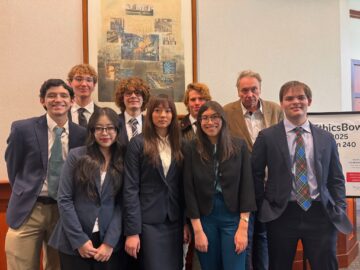
William & Mary’s Teams for the Northeastern Regional Ethics Bowl
(First row left to right: Chaewon Kang, Victoria Phinizy, Alana Lopez, Griffin Bennett-Nguyen , Middle left: Coach/Bowler Bernardo Jimenez, Back row left to right: Calvin Atkins, Teddy Friesz, Nicholas Leonard, Faculty Advisor Tim Sommers)