
Andrew Gelman at Statistical Modeling, Causal Inference, and Social Science:
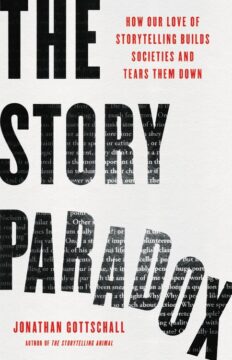 I just read the above-titled book by Jonathan Gottschall. It was really interesting–he convincingly argues that (a) stories are a central part of lives and always will be, and (b) stories are dangerous and we’re living in a world of dangerous stories. The book isn’t perfect–the author is a bit too credulous for my taste in citing dubious social-psychology studies–but no book is perfect, and I got a lot out of it, and now that I’ve read it, I feel pretty much in agreement with its arguments.
Some ideas in the book reminded me of things we’ve discussed before, so I thought I’d share them with you.
On p.56, Gottschall writes, “persuasion isn’t the same as instruction–as taking a blank slate and filling it up. You have to move a mind from one place to another, which means overcoming inertia with some kind of force.”
This reminds me of the idea that Thomas Basbøll and I have raised, that good stories are anomalous and immutable. The “immutable” bit refers to true stories, and it’s the idea that they present some facts, some things that really happened. “Anomalous” refers to the twist in the story, the idea that any good story contains a surprise. That’s why I think of storytelling as predictive model checking (see also here). Gottschall’s “overcoming inertia” sounds to me like what we do in statistics when we encounter data that contradicts our existing model of the world. The existing model is the inertia, and a key insight is that this existing model–this inertia–is always there. It’s central to the story. To the extent that the story is surprising–and I’d argue that every good story has surprises–these are relative to some expectations. A good way to understand a story is to consider the (often implicit) assumptions it’s working against. It’s the revelation that the assumptions are wrong that is the force that persuades.
More here.
Enjoying the content on 3QD? Help keep us going by donating now.