
by Philip Graham
 Archipelago, the third novel by Natalie Bakopoulos, ranges among the Cycladic Islands of Greece, the coast of Croatia, and crosses the borders of various Balkan states until finally—temporarily?—settling in a small town in the Peloponesian peninsula. All this traveling echoes (and is echoed by) the inner journey of the unnamed (and yet named) narrator of Archipelago, a translator who, as the novel progresses, seems to allow her own self to be written, to be translated.
Archipelago is a heady read, deceptively quiet and yet rife with private risk-taking and minute transgressions. It’s a novel that sets its own pace and sets its own rules as the narrator, in the process of discovering herself, must also learn how to remember herself.
*
Philip Graham: I have so much to say and ask about this beautifully-written house of mirrors that is Archipelago, your latest novel, that I don’t know where best to start. Perhaps the novel’s own beginning? The narrator, a translator of Greek literature on her way to a literary conference, has a brief but disturbing encounter with an aggressive man. A case of mistaken identity? She has no recollection of this man, but somehow she has become a character in his angry imagination. The possibility of being a “someone else,” seems to cling to her in different ways as the novel progresses.
Meanwhile, she decides to forego reading a novel—titled Occupation—before beginning to translate it, a new professional process for her. “I wanted to try translating something as I was coming to know it,” she says, in order to “tell a story before I knew its ending.” Her translating “blind” sets the stage for another thread in the novel, an acceptance of “unknowing” how her own story will move forward.
As she notes near the end of Archipelago, “the beginning is often many places at once.”
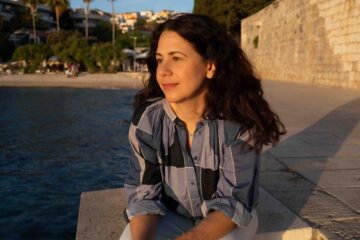 Natalie Bakopoulos: Thank you so much, Philip, for starting this conversation, and for these wonderful observations and connections. You’re absolutely right, I was indeed playing with the idea of “beginnings.” “Here in Greece,” the narrator says, “the rivers rarely have a single source: They spring from the mountains at several places.” I also wanted to think about the arbitrariness of origin and a way of thinking about belonging that wasn’t necessarily about “roots”—but instead rhizomes, as Edouard Glissant, and others, might say.
Joan Silber, in The Art of Time in Fiction, writes: “A story is already over before we hear it. That is how the teller knows what it means.” I really appreciate this sentiment, and I even echo it in the book, but I also think the actual telling of the story helps the teller to understand it, and that each telling, or translation, might privilege different things. I fact, I might say that in Archipelago, her narration is as much the story as any other elements of the work.
The act of the telling creates a new story too. I like the way Sarah Viren puts it in her memoir, To Name the Bigger Lie. She’s discussing Virginia Woolf’s distinction between the I who writes and the I on the page: the “I then” and the “I now.” But Viren notes that this divide “assumes the ‘I now’ remains static, that nothing ever happens to us while we are writing an essay or a book.” I love this!
It’s certainly the case that the narrator of Archipelago is changing as she tells the story, and is also being changed by its telling.
As for the man, no, she doesn’t know him, yet in another way she deeply recognizes him—she recognizes a particular kind of male anger, one that’s directed at a woman. Your point about her becoming a character in “his angry imagination” is really interesting—and in the novel I was definitely thinking about the infinite number of narratives that can exist around any given situation. In the novel, the narrator does realize she’s a character in someone else’s story, and this realization is unsettling, to say the least.
PG: Some people ascribe the enduring power of the film Casablanca to the way it was written and filmed. The scriptwriters were working day by day and apparently delivered a new sheaf of pages to the actors and director each morning. Nobody knew how the film would end until mere days before the final scene was shot. Ingrid Bergman felt especially unsettled, and when she asked the director Michael Curtiz (himself in that same daily dark) who she was really supposed to be in love with, he always replied, “Just play it down the middle.” Bergman and Bogart responded to this indeterminacy with some of their most nuanced performances. Learning of this tidbit of film history, I realized that one of the greatest challenges of an actor is to pretend that their character doesn’t know what is going to happen at the end of the movie—the actor, after all, has already read and studied the script!
So there’s a kind of quiet, wild bravery to your narrator’s decision to not only translate a novel she hasn’t read, but also her decision to accept the invitation of the writer Lukas to become “a long-term guest” in his as-yet unfinished novel.
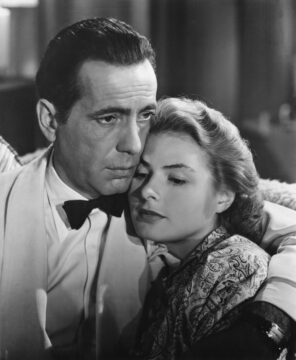
NB: This story about Casablanca is wild. I didn’t know this, and I have never really thought about this particularity of acting: the performance of surprise, of unknowing, of uncertainty, to allow the story to happen as it’s happening. To allow for that uncertainty to be embodied—so interesting. “Play it down the middle!”
I love your idea of the narrator’s “wild bravery,” because the underside of bravery of course is fear. I think if I could explain this strange decision she makes I would not have been able to write the novel; it would not exist. I recently listened to Torrey Peters’s Tin House talk on “Strategic Opacity,” where she discusses these strange, puzzling things in life that make people gossip, or befuddle their loved ones, things that seem out of character or have no motive, and that these are the things that make life interesting and mysterious. The reason they become interesting is the very fact of their mystery, their inexplicable quality. Sometimes in fiction there are absolute action/reactions, cause/effect, motivations that explain—of course! But I think I’ve grown more interested in the enigmatic and unexplained. I’m often skeptical of one motive, one reason, for anything, and that often the demand to know, the demand for legibility, the demand for certainty, is a demand for control. And I want the narrator to have the narrative control. I suppose these are some of the larger things the novel is working with.
I’d love to touch on something you mentioned in the earlier question, her translation of a novel called Occupation, which she hasn’t yet read. She’s never agreed to translate a project before having read it before, and she certainly hasn’t embarked upon the translation before having read it. Part of the way I learn Greek, and continue to learn Greek, is trying my hand at translations. I know the best way to understand a language is not to translate but to live and think in that language. Yet for me, I’ve found it so useful to translate while reading: to be a part of the way the sentence snaps into meaning for me, to really look not only at what is being said but what is meant, to allow meaning and subtext and voice to more slowly emerge. To recognize something.
This is not the case for the narrator, yet there was something about that project—an instinct— that made her say yes. A knowing without knowing. And in many ways, the story she’s translating is a sort of shadow text to the novel itself, a stranger that’s a part of her too (and this also makes me think of your character of Jenny in your novel What the Dead Can Say, which makes me think of Ferrante’s line about being “a crowd of others”).
Ferrante writes:
“Our entire body, like it or not, enacts a stunning resurrection of the dead just as we advance toward our own death. We are, as you say, interconnected. And we should teach ourselves to look deeply at this interconnection—I call it a tangle, or rather, frantumaglia—to give ourselves adequate tools to describe it. In the most absolute tranquility or in the midst of tumultuous events, in safety or danger, in innocence or corruption, we are a crowd of others.”
I used part of it as an epigraph to my second novel, Scorpionfish, and I continue to think about it.
PG: I admire your unnamed narrator of Archipelago for choosing to be attentive to receiving that mystery you speak of. Lukas calls her by the name of his main character and implies that this fictional character is at least in part inspired by the narrator herself. In embarking on an intimate relationship with Lukas, she is in a sense allowing him to translate her, in order to help him explore a character who remains as unfinished as his novel is unfinished, as its ending is unknown. A kind of echo of her own translation project.
As Lukas and the narrator travel together and deepen their relationship, two other narratives are also unfolding, though largely offscreen: his novel, and her translation of a novel. I imagine the two of them working away in separate rooms, traveling internally into the unknown. And something of those two novel projects in-progress are influencing the journey of the novel that we are reading.
NB: Yes, layers of story, layers of beginnings, layers of narrative control—but I don’t mean it completely literally; I don’t think of them spending days together and then writing about it. In fact, that literalization is exactly what I was trying to work against. I like the way you put it: “traveling internally into the unknown.” That’s great! Your comment brings up so much and has me thinking in several directions.
I think the concept of “allowing” is really interesting too, as opposed to possessing or controlling or claiming. Or inviting. But even this I think is complicated, and I did want to think about “allowance” in various ways.
But she is realizing she has some sort of narrative control, a dual authority. Though as I say it I think it’s putting it too plainly or legibly; maybe it’s another reality playing out elsewhere. On this note of “authority,” though, I think literary translation has not been as respected in the academy as other scholarship or art because of the academy’s insistence that all good intellectual work be a sort of individual intervention, a claiming and staking out of territory. So I was trying to play with that a bit too: what happens when those boundaries blur; what happens when knowledge is not claimed but collaborative?
Though we don’t see his novel, maybe it’s both something she recognizes—what does she know?—yet something she doesn’t; that has to do with her but also doesn’t. That his narrative of her is also his own shaping of a story, perhaps his own desire, his own fictional creation of a woman like her—but of course not her at all. How could it be? That’s what fiction is, after all, right? Where she enters in his writing process is impossible to know or map. The novel is the thing, not about a thing, and its explanation is the novel itself. And so much goes into it, a process that is impossible to explain. Once again: a crowd of others!
On a more thematic level, though, I wanted the book to engage with ideas of hospitality and tourism and being a guest. I was also playing with the idea of being a guest in a story, a guest in a country, a guest in a life. What are the burdens of hospitality? To be a host and to be hosted. What does it mean to be a good guest? Odysseus builds his own raft and in Archipelago, Luka also provides the narrator with, or at least gestures toward, a way to leave (the concept of pompe in the Odyssey. A sending off).
PG: Yes, could you say a little more about the “raft” that Lukas provides? You’re speaking of the car, which in a way becomes a character in its own right.
NB: Sure! I’m interested in what you say about the car as a character but first I’ll recap what happens in the novel. There’s one scene where the narrator is in the car with Luka, who’s driving, and they go through this really long tunnel together, after which he seems a little rattled. They stop for a while, and he says to her: Maybe you want to drive. She realizes he needs to get himself back together, so she does. Later, he mentions to her he’d like to get a new car, and offers her his old one, though he quickly takes it back. Not out of generosity but out of the fear that it might break down on her. And, later, after Luka has left unexpectedly—disappeared, really—she finds his car unlocked, with several of his plants inside, as well as some of her things. Here, it’s not clearly an offer—the offer of the car came earlier, and with nothing to do with this departure—but she decides to take it anyway.
Another question Luka poses to the narrator is this: Do you want to narrate or be narrated? And without making the always clunky attempt of a writer to try to explain something in their own work, something I was thinking a lot about was the idea of a sort of dual authority, something that happens in translation too. In my second novel, Scorpionfish, I tried to explore the idea of two narratives winding around one another. In Archipelago I may have been trying to take that even further.
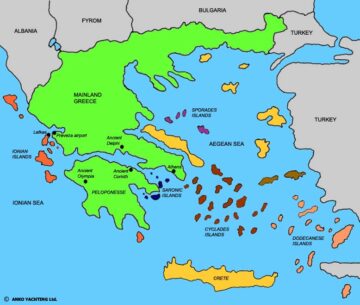 PG: She takes the car—though not without some misgivings—and then drives through several Balkan countries (increasingly haunted by “the strangeness of borders” and their “arbitrary lines”) on her way to what might be regarded as her family’s ancestral home in Greece. But her full circle in the novel to this home is only one of her many “Ithacas,” and even as she begins to settle in, her story refuses to end.
NB: I really like this reading of a story that refuses to end: without limits or borders or definitions, continuing off the page, but of course also limited and defined by the bound book itself. The narrator says in the middle of the novel: “I am trying to impose a linearity on an experience that felt recursive, or even fractal: weeks nestled within weeks, stories within stories, bodies within bodies, words within words.”
I wanted to challenge the rhetoric of home and homecoming, possession and belonging, while also playing with those themes. I also wanted the novel itself to literally cross borders, which Lauren Markham calls “fictions of great consequence,” so I don’t mean to erase them. I wanted to write against discontinuity and into a sense of connectedness. And, because this is a novel about a translator, and because I was working on my own translations, I was also thinking about the metaphorical borders crossed when carrying works over from one language to another, and the “seams” or “scars” that remain.
PG: And then the car is taken from her! Someone steals it while she’s swimming in the sea. Her belongings, however, have been carefully left behind. And something has been added: “Strung over a bush, as if someone had been changing and hung it there to dry, was a long, navy-blue dress.” The dress that might be the one that Lukas had once given to her, to “Natalia.”
NB: Yes! It befuddles her for sure. Though I think I’d like to leave this one up to reader interpretation. Because it’s an instance of the meaning being absolutely clear to me and the reader is asked to figure it out; I’m not interested in that sort of winking withholding or vagueness, which is different, to my mind, than ambiguity—where the details of the moment are clear but the interpretation can be varied. (I always hated, when I was a kid, watching Scooby-Do, when they explained the entire episode, always a rational explanation. It depressed me! I wanted mystery and strangeness and an admission of those things that we cannot explain.)
Of course, if there were a clear explanation here I’d definitely incorporate it into the narrative; I’m not interested in quirkiness or cleverness. I wanted one of the preoccupations of the book to be this very juxtaposition of, and tension between, the familiar and strange, the mundane and the surreal. Between what she recognizes and what she does not.
PG: Throughout our conversation I’ve been meaning to mention that “Natalia” is the name of the main character in Lukas’ novel-in-progress, it’s the name he playfully (or not-so-playfully) “gives” (it’s not actually her name) the narrator of your book, Archipelago, and it also happens to be your own name, of course. So many Natalias sharing space in a single novel, though in different dimensions. Yet somehow appropriate, in this fiction of mirrors upon mirrors.
NB: All these Natalias, all these Ithakas! In Greek, I usually go by Natalia, and the pronunciation is Na-tah-LEE-yah. In Ukrainian, the stress shifts: Na-TAH-lya. In English, though, I go by Natalie. She doesn’t recognize that name as her own, though, or even close. And though I grant that names are politically charged and significant, they’re also another kind of bordering, a limit, a definition. Maybe at this point in her life she wouldn’t recognize any name as her own.
***
Natalie Bakopoulos is the author of the novels Archipelago (Tin House, 2025), Scorpionfish (Tin House, 2020) and The Green Shore (Simon & Schuster, 2012), and her work has appeared in Ploughshares, Ninth Letter, Mississippi Review, Tin House, VQR, The Iowa Review, The New York Times, Granta, The Kenyon Review, O. Henry Prize Stories, and other publications. She received her MFA from the University of Michigan, has received fellowships from the Camargo and MacDowell foundations and the Sozopol Fiction Seminars, and was a 2015 Fulbright Fellow in Athens, Greece. She’s an associate professor at Wayne State University and has taught at the Helen Zell Writers’ Program at the University of Michigan, the MFA Program for Writers at Warren Wilson College, College Year in Athens, and Writing Workshops in Greece.
Author photo credit: Jeremiah Chamberlin.