
Lyndie Chiou and Joseph Howlett in Quanta:
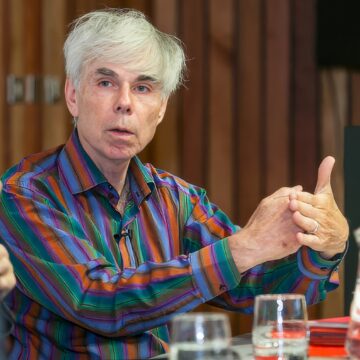 In 1974, five years before he wrote his Pulitzer Prize–winning book Gödel, Escher, Bach: An Eternal Golden Braid, Douglas Hofstadter(opens a new tab) was a graduate student in physics at the University of Oregon. When his doctoral adviser went on sabbatical to Regensburg, Germany, Hofstadter tagged along, hoping to practice his German. The pair joined a group of brilliant theoretical physicists who were agonizing over a particular problem in quantum theory. They wanted to determine the energy levels of an electron in a crystal grid placed near a magnet.
Hofstadter was the odd one out, unable to follow the others’ line of thought. In retrospect, he’s glad. “Part of my luck was that I couldn’t keep up with them,” he said. “They were proving theorems, but they had nothing to do with the essence of the situation.”
Hofstadter instead decided to test out a more down-to-earth approach. Rather than proving theorems, he was going to crunch some numbers using an HP 9820A(opens a new tab) desk calculator — a computerlike machine that weighed nearly 40 pounds and could be programmed to perform complex computations.
Hofstadter needed it to solve a particular formulation of the Schrödinger equation, which lies at the core of quantum mechanics.
More here.
Enjoying the content on 3QD? Help keep us going by donating now.