
by Ed Simon
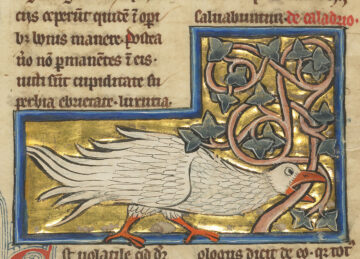
Demonstrating the utility of a critical practice that’s sometimes obscured more than its venerable history would warrant, my 3 Quarks Daily column will be partially devoted to the practice of traditional close readings of poems, passages, dialogue, and even art. If you’re interested in seeing close readings on particular works of literature or pop culture, please email me at [email protected]
Poetry is nothing more than the arrangement of words on a page. Verse’s defining attribute is the line-break. Obviously, there are sharp objections that could be made to those two interrelated contentions, not least of which is the incontrovertible fact that before poetry was a written form it was an oral one, and line breaks make no sense in the later medium (though the equivalent of spoken pauses certainly do). Nonetheless, written poetry has existed for millennia, and it’s impossible not to interpret “poetry,” as a form, through its primarily written permutations. Oral and written poetry now exist in tandem, and it’s a psychic nonstarter to imagine the former without the existence of the later. Furthermore, the revolution in first blank verse and then free verse that forever allowed for the possibility of writing poetry without all of the standard accoutrement of rhetorical defamiliarization which defines the form, from assonance to consonance, meter to rhythm, and of course rhyme, had led to the visual arrangement of poetry on a page as the standard indication that what you’re reading is indeed verse and not prose.
Arguably line-breaks, particularly in the form of enjambments, provide a particular form of linguistic defamiliarization that distinguishes poetry from prose because it heightens readers’ expectations concerning meaning. Russian Formalist critic Viktor Shklovsky in his 1917 essay Art as Technique writes that poetry serves “to make things ‘unfamiliar,’ to make forms obscure, so as to increase the difficulty and the duration of perception.” Shklovsky defined poetry as being that which makes language unfamiliar through a variety of conceits, only some of which could be considered traditionally “poetical” (though all of those methods can be excellent in achieving that defamiliarization). Line breaks work to “increase the difficulty and the duration of perception” precisely because they disrupt the normal reading of a line; by deferring meaning between lines, and altering the conventional and expected rhythms of meaning one would encounter in prose, a poem is able to imply particular questions or intentions in one line that are answered in the next, so that as Shklovsky writes “it is our experience of the process of construction that counts, not the finished product.”
A good example of how this particular process works is in American poet Denise Levertov’s 1958 poem “Illustrious Ancestors” from her collection Overland to the Islands. The free-verse poem (only eighteen-lines) is organized into three implied stanzas through indentions at the ninth and thirteenth lines, and concerns Levertov’s spiritual inheritance from the two widely divergent sides of her family. Levertov’s father was a Russian Jewish convert to Anglicanism (indeed he became a priest), descended from a long-line of Hasidic rabbis, including Rev Schneur Zalman, founder of the Lubavitch sect. Her Welsh mother’s grandfather was Angel Jones of Mold, a nonconformist Methodist mystic known for his eccentric preaching and visions.
Separated by religion and theology, denomination and sect, both her paternal Jewish and maternal Christian inheritance share a deep pietistic exuberance, an attraction to devotion as contemplative as their worship was ecstatic. “Illustrious Ancestors,” whose title should very much be read literally, isn’t just an encomium to her rabbinic and ministerial great-grandfathers, or even as a devotional poem (though it’s both), but as a lyric which intentionally mimics the process of religious introspection, the curvature of thought from doubt to sudden epiphany.
Levertov begins the poem by writing that “The Rav/of Northern White Russia declined.” Across seven words, split after only the first two, Levertov has already deployed the central technique and conceit of enjambment – readerly confusion. “The Rav,” that short, two-word and two-syllable staccato line standing almost as a title, is isolated and imperious, while choosing to break the line at the word “declined” generates an ambiguity because the nature of that verb is unclear until the third line. Did the Rav himself decline, mentally or physically? Did he experience a loss of authority? Rather what we learn as we continue to read the grammatical line, disrupted as it is by the dictates of poetic line breaks, is that he “declined, /in his youth, to learn the language of the birds.” Thus, what we quickly discover, albeit after our minds have already had time to contemplate how the word “decline” itself is actually working, is that the narrator is referencing not a decline imposed by outside conditions, but rather the Rav himself refusing to do something. If confusion is the operative coinage of enjambment, so too is surprise (and perhaps its near sibling delight). Having read “The Rav/of Northern White Russia declined,” who could have predicted that the “answer” to that line would be “in his youth, to learn the/language of birds, because/the extraneous did not interest him?”
To decline learning the language of the birds necessarily implies that the language of the birds is something that you could assent to learning, indeed that there is such a thing as a language of the birds in the first place. And Levertov informs us that when the Rav “grew old it was found/he understood them anyway, having/listened well, and as it is said, ‘prayed/with the bench and the floor.” A pithy definition of poetry itself – whether the writing or reading of verse – is that it is a form of having “listened well.” In this section, or perhaps pseudo-stanza, of “Illustrious Ancestors” there is another example of the internal call-and-answer nature of enjambment, one which mimics the very process of religious illumination that Levertov takes as her main theme. At the end of line eight when she writes “it is said, ‘prayed/with the bench and the floor,’” the ending of that line with that particular verb framed by a quotation mark not yet closed necessitates that the reader contemplate what exactly will be added to the word “prayed,” while for that matter the quotation marks generate the (unanswered) question of who exactly said this. One could envision a punctuating end-stop to this line – i.e. “it is said that he prayed.” That, however, would be a very different conclusion to that line, because Levertov has implied through enjambment that the Rav has done more than just prayed, but the reply to what else he did awaits the reader (briefly) until they get to the following line.
She writes that the Rav “’prayed/with the bench and the floor.’ He used/what was at hand – as did/Angel Jones of Mold.” A conspiracy of two men unknown to each other, that enjambment after the concluding two words of line ten – “as did” – signaling that we’re about to be introduced to another character in the poem. Here again the process of surprise is central to the defamiliarization of language which is the trade of a poem. A lesser work could follow up “as did” with a more expected figure, say an acolyte of the Rav or another Russian rabbi, but instead we’re introduced to Angel Jones, a contemporary who lives a continent away and follows an entirely different religion. Yet what Levertov connects them with is a sense of materiality, of embodied faith. If the rabbi prayed with the “bench and the floor,” the language implying an engaged, physical form of worship (perhaps striking the bench, writhing on the floor), then Jones also has an estimably fleshy form of prayer. Levertov writes that Jones’ “meditations/were sewn into coats and britches.” Again, by breaking the line after “meditations,” the reader experiences the incongruity of the poem’s sentiments that so effectively simulate the experience of being a Rav or a Jones. A reader could assume that “whose meditations” will be followed by something less tangible than what Levertov actually writes, that we’d be presented with an image of Jones deep in contemplative prayer, an abstracted faith of clenched eyes and silent murmuring, as opposed to the physical act of prayers being “sewn into coats and britches” (the later noun particularly profane). Ironically, it’s precisely that image presented after the line break that serves to make Levertov’s poem more ethereal, more otherworldly, than if the more prosaic and expected image had been recounted.
Jones occupies less space in the lyric than does the Rav; there are eight-to-nine lines dedicated solely to the later, while after the indentation at line ten which signals the beginning of a new “stanza,” Jones has only three dedicated lines. There is a kind of syllogism here, or maybe a thesis being merged not with its antithesis but another thesis so as to generate a conclusion, which is supplied in the final “stanza” of six lines. Levertov writes “Well, I would like to make, /thinking some line still taut between me and them,/poems as direct as what birds said,/hard as floor, sound as bench,/mysterious as the silence when the tailor/would pause with his needle in the air.” This beautiful conclusion is a summation of the argument (or “argument,” because this verse very much felt more than declared) as it runs through the poem. Levertov is concerned with relationship between the abstract and concrete, the material and the spiritual, but this relationship is more mysterious than our binary perceptions might assume. She has made the writing of poems as embodied as the sewing of britches, where a line could be as taut as thread. To describe “poems direct as what the birds said” is from one perspective a call for the tangibility and materiality of something often thought of as abstract, but at the same time the line itself is contradictory, or at least purposefully self-abnegating. When are birds direct, after all (even if the Rav could understand them)? And if a poem is “hard as a floor,” does the adjective mean that they’re as immediate and real as the floor or that they’re difficult? If they’re as “sound as a bench” does that mean that they’re as stolid, solid, and reliable as a bench, or is the first word a play on that which we hear, or are capable of hearing?
One could imagine a hypothetical essay of Levertov’s sharing all of these same concerns and interests, a piece goes through her background and her spiritual concerns, explicating the nature of fervency and ecstasy in worship, the tangible and the ethereal in prayer, the nature of spirit and matter. It could be an excellent essay, even a brilliant one. But as a poem, “Illustrious Ancestors” is capable of doing something else, precisely because it’s a poem. When she concludes with that “mysterious… silence when the tailor/would pause with his needle in the air,” Levertov is conveying precisely the substance of a man like Jones’ thoughts. Poetry slows you down and purposefully confuses you with ambiguities, so that when “Illustrious Ancestors” reconciles you in subsequent lines it conveys the experience of epiphany that’s her subject. That silence is the same silence experienced briefly by the reader at the end of the line, the end-break after the word “tailor” pausing ever so slightly like his own needle in the air right before a type of enlightenment comes.
Ed Simon is the editor of Belt Magazine, an emeritus staff-writer for The Millions, a columnist at 3 Quarks Daily, and Public Humanities Special Faculty in the English Department of Carnegie Mellon University. The author of over a dozen books, his upcoming title Relic will be released by Bloomsbury Academic in January as part of their Object Lessons series, while Devil’s Contract: The History of the Faustian Bargain will be released by Melville House in July of 2024.