
by Ed Simon
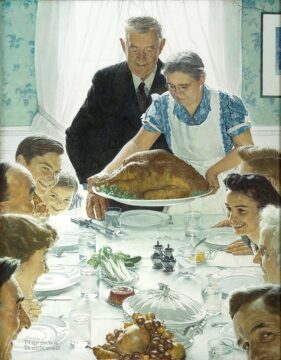
Nobody ever told me that half-way through Jonathan Franzen’s door-stopper modern classic The Corrections that a sentient, talking, foul-mouthed turd appears. I’d have entered into rectifying this cultural lacuna of a quarter-of-a-century in a slightly different frame of mind had I expected Franzen’s sprawling family epic with its ironic Midwestern detachment as effectively featuring the equivalent of South Park’s Mr. Hanky the Christmas Poo who appears to dementia-and-Parkinson-addled Alfred Lambert aboard a Maritime Canadian cruise ship, spreading its brown effluence and general bad vibes all across his white sheets of the cabin and then the white tiles of the lavatory. The turd is a hallucination (and he appears again), but it underscores just how much odder The Corrections is than the general literary conservatism projected onto (and sometimes declared) by Franzen would indicate. The author – frequently as castigated as any contemporary writer who hasn’t earned cancellation can be – seemingly desires the comparison to a Dickens or even a Zola, but The Corrections reads more like a less-experimental version of the writing of his friend and competitor David Foster Wallace, from the (annoying) blanked out proper names of corporations and organizations to the detailed explications of high finance or psychotropic pharmaceuticals. “Life…. had a kind of velvet luster,” writes Franzen. “You looked at yourself from one perspective and all you saw was weirdness. Move your head a little bit, though, and everything looked reasonably normal;” an apt summation of reading The Corrections itself.
Even twenty-five years after its publication, it’s hard to separate The Corrections from the circumstances of its creation. You might be familiar with the Oprah kerfuffle as regards his most well-regarded book, while the publication date of September 1st, 2001 was arguably the most fortuitous bit of luck for a cultural release since the Strokes’ dropping of Is This It? five days earlier. Like many wunderkinds of his generation, there was and is a kind of schadenfreude in trying to bring the (obviously talented) Franzen down a bit, where one blogger’s appraisal of his being the “worst great writer” working today is somehow even meaner than Dale Peck’s hatchet-job appraisal of Rick Moody. The Corrections was hailed in some corners as the first great American novel of the 21st century, if not The Great American Novel itself, the complex narrative around poor suffering Enid Lambert’s attempts to gather her three children for one last Christmas in St. Jude (a stand-in for Franzen’s native St. Louis) a means for interrogating everything from U.S. economic policy in post-Cold War eastern Europe to the vagaries of critical theory, high cuisine and gentrification to the cynicism of the pharmaceutical wellness industry. Hard not to imagine the superlatives heaped upon The Corrections not resulting in disappointment and hangover, of Franzen’s novel being unfairly dismissed as Gen-X ephemera, some vaguely embarrassing turn-of-the-century work to be ignored, American Beauty for those with New Yorker subscriptions. Yet all of that would be a grave disservice to a work that if not the Great American Novel (for what is?) is still a very good novel, a book that more than two decades later does seem to have an uncanny prescience for how life would unfold over the next American century. Ultimately, however, The Corrections remains what Franzen claimed it was – a story about family; how individual members hurt each other and the fictions which they craft to keep themselves whole.
Family was also the major theme of one of Franzen’s contemporaries, with Zadie Smith’s On Beauty fundamentally about the same topics that animate The Corrections. Marketed and remembered as an allegory about the culture wars (which twenty years ago were far saner than they are today), On Beauty basically covers similar ground to those past British novelists that Smith adores, of not just Dickens and George Elliot, but of E.M. Forster who is the direct inspiration for this 2005 novel. The Belsley family, including the white British academic and Rembrandt-expert Howard, his Black wife Kiki and their multiracial children Jerome, Zora, and Levi, live a relatively idyllic existence in suburban Boston, even while the paterfamilias snarls and fumes over his intellectual competition with the conservative British academic Monty Kipps, himself a member of the Caribbean Windrush generation. Predictably, Monty (whose daughter Jerome is in love with) arrives at a visiting lectureship at the fictitious Wellington College. Smith, who is a prose-master, so-called “hysterical realism” aside, is too adept to let Howard and Monty turn into mere-ciphers for “The Long 90s” carping about the canon or Dead White Men, for the real concern of On Beauty are the negotiations and elusions, the infidelities and fictions that define her characters. “You don’t have favorites among your children but you do have allies,” Smith writes, and with a lesser author that would perhaps be interpreted as cynicism, but she cares too much for her characters to ever dismiss them as anything less than fully and gloriously human.
Culture wars are very much at the center of Jess Walter’s new novel So Far Gone, released in June of this year. Similarly sympathetic to his characters as Smith is, even the real shitty ones, Walter has written a work that is somehow comedy, mystery, and travelogue about our current disunited states of America at this exact point in time, a kind of adept and humane treatment of the age of Twitter posts and QAnon, Pizzagate and climate catastrophe. Walter’s protagonist is Rhys Kinnick, a former environmental beat reporter in Spokane who after he punches his mouth-breathing, Trump-voting son-in-law at a 2016 Thanksgiving decides to pull a Thoreau and live in rural Washington where he is compiling a never-finished magnum opus about philosophy and the state of ecology today. When his precocious grand-children are deposited by a concerned neighbor on his cabin doorstep because their mother and their step-father have disappeared, the later seemingly connected with a Christian Nationalist militia, Rhys is forced to become both caring grandfather and hardboiled detective. In the journey to track down his daughter (and also eventually those same grandchildren) Rhys is assisted by an ex-girlfriend, her ex-cop ex-boyfriend, and an ex-friend-turned-friend-again. So Far Gone, the title both a description of Rhy’s existence and our current moment, provides an empathetic analysis of this cankered era that somehow doesn’t devolve into mealy-mouthed bothsideism, a strangely hopeful work despite Rhys’ feeling that “it didn’t feel like I was dropping out… It felt more like I was… stepping aside. I felt like the world was drifting in one direction and I was going the other way.”
The novel which most reminded me of Michelle Huneven’s Bug Hollow, also released in June, is Jennifer Egan’s classic chimerical novel-through-short-stories A Visit from the Goon Squad. Both use the medium of the episodic story to tell an overall narrative in glimpses, to flit in and out of past, present, and future, allowing minor characters to return in importance and other figures to fade away, all as a manner of giving expression to the kaleidoscopic nature of individual biography assembled over time. At the center of Bug Hollow is the southern Californian Samuelson family, already broken and conflicted, but even more so after the tragic drowning of the college-age son Ellis in the 1970s. Each character is shaped by this trauma, from father Phil (an aspiring architect reduced to being an engineer on projects not of his own design) to his wife Sibyl who descends deeper into an alcoholism that her husband and children scarcely acknowledge, while their daughters Katie and Sally must contend with the memories of their beloved, dead brother. The central death in Bug Hollow happens early (it’s not the only one), but the novel is narrated from the perspective of life, after Ellis’ summer girlfriend, free-spirited artist Julia, arrives pregnant at the Samuelson’s door. The novel itself doesn’t actually perseverate in Ellis’ death, though like any grief it flits about at the margins of everything that happens to Julia and the Samuelson family. There are infidelities and addictions, illnesses and bereavements, but Huneven allows her characters their own simple graces, a work that understands the complexities of any single person and the way that perspective – and even truth – can depend so much on who is doing the telling, or even when they’re telling it. “For as long as I could remember – from my very first remembered though – I’d had a sense of coming from somewhere else, a place of kindness and good humor and justice, where people weren’t so grouchy and annoyed,” reflects Sally, but the tragedy is that she isn’t from someplace else. That’s also her fortune.
The variability of not just memory, but indeed the epistemological ambiguities of what we can even know about somebody else – especially those whom we’re most intimate with – is also at the core of Ian McEwan’s upcoming book What We Can Know, to be released on September 16th. Continuing with an ongoing interest in speculative fiction, McEwan’s latest is narrated by a humanities professor named Thomas Metcalfe in 2119 (we still exist!) investigating the circumstances around a quasi-mythic poem entitled “A Corona for Vivienne” recited at the birthday of its subject, the wife of the poet Harold Blundy, in 2014. The second half of What We Can Know lets Vivien speak herself, with the novel dramatizing the ways in which an individual life (or poem) accrues so much in the ways of experience and interpretation that the title of the novel itself can be read elegiacally. The metafictional narrative structure of What We Can Know, divided by two time periods, will be familiar to readers of McEwan’s 2001 Booker Prize winning Atonement – while also being reminiscent of David Mitchell’s Cloud Atlas, though less narratively Matryoshka-like – even while his recent turn to speculative fiction seems ever to depart from the historical realism of that earlier, laureled work. Other critics have been disparaging of McEwan as a science fiction stylist, but I found that What We Can Know offered one of the most arresting pictures of the near future that I’ve read in a recent novel. Metcalfe’s sunken and temperate world isn’t like ours but further along in the calendar; as a work of world-building, What We Can Know functions exceedingly well, with the portrait of the archipelago that used to be southern England simultaneously despairing and strangely beautiful. Setting shouldn’t be confused for meaning, however, for despite the evocative future envisioned by McEwan, at its core What We Can Know takes its title very seriously, asking what we can know of history, of literature, of each other.
***
Ed Simon is the editor of Belt Magazine, an emeritus staff-writer for The Millions, a columnist at 3 Quarks Daily, and Public Humanities Special Faculty in the English Department of Carnegie Mellon University. The author of over a dozen books, his upcoming title Relic will be released by Bloomsbury Academic in January as part of their Object Lessons series, while Devil’s Contract: The History of the Faustian Bargain will be released by Melville House in July of 2024.
Enjoying the content on 3QD? Help keep us going by donating now.