
by Ken MacVey
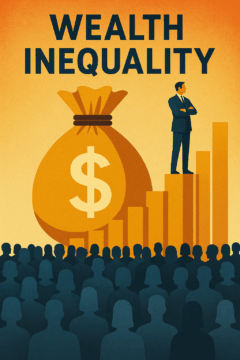 By many measures wealth inequality in the US and globally has increased significantly over the last several decades. The number of billionaires has increased at a staggering rate. Since 1987, Forbes has systematically verified and counted the global number of billionaires. In 1987, Forbes counted 140. Two decades later Forbes tallied a little over 1000. It counted 2000 billionaires in 2017. In 2024 it counted 2,781, and in March this year it counted 3,028 billionaires (a 50% increase in the number of billionaires since 2017 and almost a 9% increase since 2024).
Wealth concentration has increased in the US in the last few decades as well according to the Federal Reserve. It reported that the wealthiest .1 percent (the top fraction of one percent) has increased its share of national wealth from 8.67 % in 1989 to 14% in 2024. The top one percent’s share has increased altogether, now accounting for 31% of US wealth. At the same time, the bottom 50% accounted for only 3.5% of US wealth in 1989,and in 2024 that percent is down to 2.5%.
Thinktank Oxfam estimated in 2024 that the wealthiest one percent of the globe has as much wealth as 95 percent of humanity. It also predicts that in the next decade there will be five trillionaires.
To put this in personal context, if you had a million dollars and spent one thousand dollars a day (and assuming no interest or other return on your million), you would use up the million in a little more than two and a half years. If you had a billion, at a thousand a day, you would use that up in about 2,700 years. If you had a trillion, you would use it up in about 2,700,000 years. This is the result of the simple fact that a billion is a thousand times greater than one million, and a trillion is one thousand times greater than a billion.
Undoubtedly, many would argue that these statistics and numbers are wrong or at best misleading. It could be argued, for example, that there are more billionaires because there is more wealth, which is a good thing. Or that there are more billionaires because of inflation, which isn’t a good thing. But it could also be argued that statistics understate the true degree of inequality. It is true after accounting for inflation a billion in 2025 is not the same as a billion in earlier years, such as 2000. But in some ways a billion in 2025 has more buying power than a billion dollars would have in 2000, not less, as most of us would expect. Before the Supreme Court’s Citizens United decision in 2010 there were caps on what an individual could contribute to a political campaign. Citizens United paved the way for SuperPACs, which now grease the way for massive political contributions by wealthy individuals. According to Americans for Tax Fairness, billionaires accounted for .3% of total federal election contributions in 2008. In 2020 they accounted for 9.3% and in 2024 about one sixth. Americans for Tax Fairness claims that the amount of billionaire federal election contributions has increased since 2010 by almost 160-fold. Today’s billionaires are simply going to get the ears of politicians in a way nobody could have prior to 2010, including pre-2010 billionaires.
Many antitrust economists have also concluded that market concentration with accompanying market power and price mark ups has significantly increased in the United State in the last three decades in several significant markets. Federal Reserve data shows that the wealthiest one percent own 50 percent of all equity funds. Putting these two together, this may mean that greater wealth concentration can work in tandem with markets now dominated by a handful of corporations.
So increased wealth concentration may not just be about a wealthier and proportionately smaller elite. It might mean it’s about a smaller and more powerful elite with a greater say on how the rest of us live. Wealth equals a lot of power, not just a lot of money.
The issue of wealth concentration is not going away. With the passage of the “One Big Beautiful Bill” and its promotion of tax cuts for the wealthy and reduction in the safety net for less fortunate members of society, the issue of economic inequality could easily rise to the political forefront.
How The Yard Sale Model May Explain Wealth Inequality
What is the possible cause of these trends toward increasing wealth concentration? Thomas Pikety, a French economist, has studied economic inequality and written bestselling books on the subject. He asserts that wealth inequality results when over the long term the rate of return on capital exceeds the rate of economic growth and thereby the owners of capital gather more wealth. He has raised alarms about recent increases in economic inequality due to the differences in the two rates. Some economists have developed computer models based on simplistic assumptions in which economic inequality naturally emerges.
Interestingly, physicists and mathematicians have also taken on the subject of wealth inequality. They have developed mathematical models of wealth distribution now known as the “yard sale model.” Proponents of this model claim that under very simple assumptions “wealth condensation” (transition from more even wealth distribution to wealth concentration in the hands of a few) is inevitable unless remedial action is taken. They claim that this model remarkably matches the actual state of wealth inequality in the world. What is intriguing is that under the model, by an unbiased random process, a small group or even a single individual will randomly end up holding all the wealth. It’s not a matter of the survival of the fittest or the best getting more than the rest—it’s a matter of the luckiest. Who is lucky is random. The fact that there will be a winner taking it all is not random, it’s almost inevitable.
Physicist Anirban Chakraborti first developed a mathematical version of the model borrowing from statistical mechanics. Formally, versions of this model are considered to be agent based random exchange asset models. There can be different variations of such models. One version of the mathematical model assumes a group of agents each have the same amount of wealth. Each is randomly paired with another agent to make a trade. This is similar to a yard sale, which is how the “yard sale model” label came about. Physicist/mathematician Bruce M. Boghosian has developed and elaborated on the yard sale model in published scientific articles. In his fascinating article in the Scientific American “Is Inequality Inevitable?” (which I have used in a university public policy class I taught and which is currently available on-line without a paywall) he explains the model while leaving out most of the calculus. He gives the example of an agent being randomly paired with another agent out of 1000 to make a bet based on the random toss of a fair coin. Then another pair of agents is randomly selected from the 1000. But it is also assumed that the poorer person in the bet won’t want to blow all their wealth on a single bet and will bet only a fraction of their wealth. This random selection of bettors and coin tosses in a computer simulation can be run thousands or even millions of times. Even though initially each agent has an equal amount of wealth, ultimately only a handful or even a single agent will end up holding all the wealth. It seems that losing bettors keep getting deeper in the hole and would need a very lucky streak of wins to get out of it. There will also be an accompanying increasingly narrow group of winners.
Boghosian’s model is not about generating wealth so the total amount of wealth for the group stays the same. Unlike in the real world, initially it is not assumed the wealthier have better opportunities because of their wealth (for example, rich people can get favorable financing terms no one else can get). No one under the model is smarter or more knowledgeable than anyone else. Everyone is in the same boat and starts with the same amount of wealth. Yet, except for the winner-take- all, everyone loses.
These results seem counterintuitive. On the internet there are a number of websites with computer simulations of the yard sale model you can play to see the wealth condensation process unfold before your eyes.
Boghosian went a step further in his model and made additional adjustments to make it more aligned with the real world. He accounted mathematically for wealth begats more wealth factors (e.g, the fact the rich get the best financing terms) and for the reality that there may be wealth transfers from the better off to the less off through taxation and government subsidies. He claims in his Scientific American article that with these adjustments the model results are within two percent of certain statistically reported wealth distributions. He also concludes it is because of government taxation and subsidies that there is not a complete winner-take-all scenario. At the same time, this taxation and subsidization are still insufficient to prevent significant wealth inequality.
I have not found any academic research that contradicts Boghosian’s claims or the yard sale model in general. There are several studies that refine or claim to provide alternative proofs of the validity of the model. The articles are extremely technical and require mathematical expertise (which I have none) to assess. (Several of these articles can be found by searching “yard sale model” at arixiv.org.)
If the yard sale model does in whole or in part apply to the real world, the implications are stunning. It means that a large portion of wealth will tend to end up in the hands of the few, not because of merit but just by random process. It also means that government action may be essential in constraining wealth condensation.
Nozick’s Anarchy, State and Utopia, or Maybe Dystopia
The yard sale model may also present a provocative challenge to some versions of libertarianism.
Philosopher Robert Nozick in 1974 published his book Anarchy, State, and Utopia, which even those who fervently reject its radical conclusions consider to be a political philosophy masterpiece. Nozick offers an intricate philosophical justification for what is often called “the nightwatchman state.” This is a libertarian state where the state is limited to protecting individual rights, most particularly property rights. The foundation of his argument rests on individual natural rights—specifically property rights which are derivative of each individual’s self-ownership that exists as a natural fact of being a person. Under this framework someone’s property cannot be taken legitimately without the owner’s consent. This includes taxation, such as taxation to give subsidies to the poor. Taxation, according to Nozick, is equivalent to the state coercively taking partial ownership of a person in violation of that person’s self-ownership.
Property that is legitimately acquired (i.e., within natural rights) and legitimately transferred (i.e., without coercion or fraud) is none of the state’s or anyone else’s business. People get to hold on to property, not because they deserve it, or because property ownership promotes the general good, but simply because it was legitimately acquired within the scope of natural rights. Nozick rejects utilitarianism and social justice theories, such as promoted by Peter Singer or John Rawls. He rejects results justified government policy. He focuses on the pattern of legitimate acquisition and exchange, not where it ends up and leads to. If the pattern reflects a legitimate (i.e., non-coercive or fraudulent) history of exchange, that is what counts and nothing more.
Nozick’s book title focuses on “anarchy” because under his view of individual rights it is legitimate to ask , why not anarchy? The title then focuses on “state” by explaining hypothetically how a nightwatchman state could emerge without violating any rights. Nozick does so by a hypothetical story of individuals voluntarily joining mutual defense associations that ultimately coalesce into the nightwatchman state. Nozick then focuses on “utopia.” Toward the end of his book, Nozick waxes on how this version of the state leads to a “utopia” where people can freely band together in collectives of their own choosing, allowing them to live meaningful lives determined by their own values and choices.
The yard sale model is entirely consistent with Nozick’s vision of individual rights. Under the model, there is no issue of the legitimacy of the wealth acquired and the wealth exchanged. Yet it leads to almost everyone losing. It depicts a society of losers. Everyone gets to exercise their property rights but where almost everyone inexorably loses all their property. Under Nozick’s criteria, the pattern is legitimate, so the outcome is beside the point. But the question remains, is this utopia or is it dystopia? Would you want to live in such a world? Would you want the ones you care about to live in it either?
Even if the yard sale model turns out to be only correct as an abstract mathematical model, it provides a provocative thought experiment against Nozick’s thought experiment. After all, Nozick’s narrative about how a legitimate state could come about consists of a convoluted “just-so” story of competing protective associations morphing into a government that he finds acceptable.
I once got to present a similar thought experiment to a prominent libertarian philosopher. Many years ago when I was in college, my philosophy college professor invited philosopher John Hospers to present his case for libertarianism. Hospers was the author of several excellent philosophy textbooks (I still have two of them). He was once friends with Ayn Rand and became a libertarian. He also was to become the Libertarian Party’s first presidential candidate. After Hospers finished his presentation, he asked the attending small group of students if there were any comments or questions. I raised my hand and posed a hypothetical. Suppose there is a society totally governed by libertarian principles but it is clear that as a result everyone is miserable. Suppose there is another society whose people are of similar make-up but the society instead is governed by a state committed to promoting the general good and equity through such things as taxation, public investment in infrastructure, and government assistance. As a result, everyone is happy. I asked Hospers based on his libertarian position which rejected utilitarianism wouldn’t he have to say the first society is better than the second? Or if he didn’t, wouldn’t he have to abandon or modify his libertarianism? Hospers brushed me off with a non-response and then quickly called on someone else. After the program was over and people were leaving, I wanted to follow up on my hypothetical. I went up to Hospers who was talking with my college professor. I stood patiently as they chatted. After several minutes with no acknowledgment of my presence, I left. A couple of days later when I bumped into my philosophy professor in the campus quad, he told me that I had “impressed” Hospers. Then he corrected himself. No, I had “depressed” him, because Hospers had admitted to him he didn’t know how to respond to my hypothetical.