
by David Beer
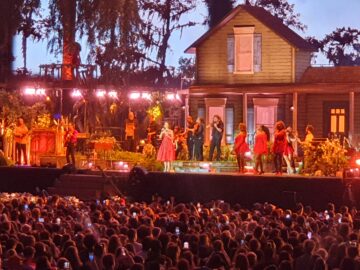 Lana Del Rey exists in a meticulously crafted world of her own. It’s a world apart. I purchased an invite to drop-by this summer, so that I might glimpse its finer details. Along with the crowd at the Anfield stadium in Liverpool, I was standing at its perimeter, gazing inwards, wondering. The atmosphere seemed rarified, there were even lily pads on the custom-built pond.
Afterwards, standing in the well organised queue for the shuttle bus, it occurred to me that Lana Del Rey is an artist suited to these baffling times. That’s not to say the music is escapism, it’s much more artful than that. It may be a bubble, but it has far greater intricacy than we expect of pop, and a depth of ambiguity too. Spinning at about 80 beats per minute, it’s an alternative planet. The music comes packaged with a possibility of being somewhere else, of joining an inner sanctum. This other time and space brings a promise of leaving things behind.
The show was quite a spectacle. The stage was deeply dressed with trees, plants, a pergola, candelabra, that pond, and a full-scale wooden house. There are details everywhere, fleshing-out the little ecology of the stage.
The house itself, I assumed, was supposed to be idyllic or perhaps even quaint, yet squint and it might be the type of place Norman Bates’ mother is silhouetted at the window. When preparing the stage prior to the event, one of the road staff carefully cleaned those windows. Or perhaps the structure had been rescued from the studio lot of one of the Scream franchise films. There is a slight undercurrent to it. Though it does provide a space of sanctuary, a closed-off part of the stage that the crowd cannot see into.
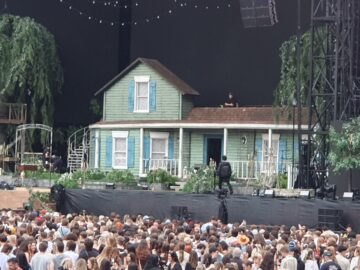 Lana, if i may, since I’m a house guest, appeared from the door midway through the gentle opening track Stars Fell on Alabama. She later stepped back inside for a performance, with a portion of the front wall folding open to reveal the living room, before closing at the song’s conclusion. Before that Lana appeared at the upstairs window, in hologram form, to perform two shortened tracks. The crowd stayed politely outside, at the threshold.
Lana is a compelling artist with an astounding back catalogue. Tonight the curated selection of songs washed-by with subtle brush-works of melody. There’s a seamlessness and a stylishness to it. You can get carried away with a line or phrase, which are often repeated to the point where the casual listener is able to sing along. The songs draw you in, especially when reinvented for live performance. Despite the sheer volume of sound, in this arena those tracks seemed somehow more fragile and delicate. If I was a proper culture reviewer I might call them elegiac.
The music has a timeless feel. It doesn’t seem to belong to any particular moment or era. There are some loose, very loose, references to the 1960s (or is it the 70s?). There are haunting versions of those sounds, whilst nothing is obvious or direct. Instead it’s both now and then, existing in its own timeframe as well as its own space.
The soundtrack from Hitchcock’s 1958 film Vertigo featured during tonight’s interlude. The little sonic references are also dizzying. They may be flavours of Petula Clarke or Cilla Black or Sandie Shaw or Dusty Springfeild or Carole King or many others. It’s a taster menu of things that seem familiar and yet uncertain.
Perhaps there is a non-representational quality to Lana’s world. Refracted through its ozone, it’s hard to gauge what matters and what is going on. That seems to be the appeal. Its exclusivity combined with its possibilities for reinterpretation. With no narratives, just sound, movement and image, this world can be retold. The enigmatic gaps left behind can be filled however we wish to fill them.
Around the midpoint of the evening a group of dancers wheeled out a small dollhouse replica of the stage set. This was when Lana took a seat in the sitting room of the full size house, blanket on legs, to sing Quiet in the South. We could see her singing in a chair. Whilst, at the same time, dancers moved a miniature doll around the equivalent dollhouse room. It was visible to us what was happening in the open-fronted toy abode, and so it appeared to be the only moment of the show when the audience seemingly knew more of what was happening than Lana herself (as in Vertigo when the viewer thinks they know more than Scottie). The song ended with the dollhouse being set on fire and the full-size house, through the medium of a light show and smoke, seeming to burn with the actual Lana in it. The representation of the representation took over, as is the case with public personas.
And what is fame in Lana’s terms. It seems uncomfortable whilst also coming naturally. There is a hesitation to it, a look of vulnerability toward the crowd, before they wave-back from beyond the fence, and Lana smiles back. In the brand new track entitled simply 57.5, performed toward the end of the show, the chorus tells us that the metric is a reference to the number of millions of listeners Lana has on Spotify. Seemingly picking-up on the same theme as the burning dollhouse, it seems a melodic whilst barbed retort to those who measure success in such terms.
At the close, having met some fans at the foot of the stage during a long outro to Take Me Home Country Roads, performed by the slick backing band, Lana waved outwards to the crowd for a final time and then exited through the house door from which she had first emerged. She closed it gently behind her. The crowd, already gradually dispersing, collectively turned to leave in the other direction. As the stadium floodlights brightly illuminated the stairwells, it was an uncomfortably stark message that the visit was over.
***
Enjoying the content on 3QD? Help keep us going by donating now.